My good friend Ginnie, over at the goodreads site, has put together a list of links of tributes to David Foster Wallace. In her words:
McSweeney's has a terrific page of memories and tributes from fellow writers and former students of Wallace's from Pomona College
McSweeneys
Here is Time magazine.
Time
Here is the Guardian UK.
guardian
Here is DFW's delightful 2006 New York Times piece on Roger Federer,
federer
and also "Host," his fantastic 2005 piece about right-wing hate radio, from the Atlantic.
host
Here is Wallace interviewed on Charlie Rose from about ten years ago.
rose interview
And here is a huge obit roundup on the DFW fan site, Howling Fantods.
obits
DFW's 2005 commencement address at Ohio's Kenyon College is being re-posted everywhere, and is just terrifically worthy of your time, if you're so inclined.
commencement address
Finally, Harper's magazine has graciously posted every DFW piece they ever ran, in PDF, including the famed "Shipping Out."
Harper's
Reading it again now, the reality seems even truer, even more heartbreaking, than ever. The world of words just won't be the same without him.
Saturday, September 20, 2008


Animals of the Christian Theme Park
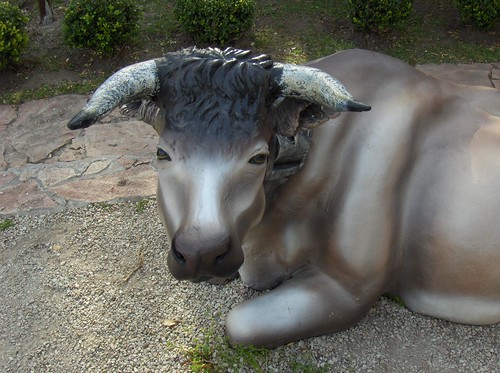
For some unfathomable reason, the charming photo set, Animals of the Christian Theme Park , has received only a single viewing thus far. These poor, neglected, hideously ugly, papier-mâché critters need attention.
Won't you please pay them a visit?
Friday, September 19, 2008
Palabras nuevas
conejillo de Indias : a guinea pig (literally, "little rabbit of the Indies"; compare with the German "Meerschweinchen", or "little pig of the sea"). All of these terms seem inaccurate to some degree, for an animal that is neither pig nor rabbit, nor particularly pelagic, Indian nor from Guinea.
choripan : a hot dog in a bun (derived from chorizo and pan)
pancho : a hot dog in a bun (also derived from pan and chorizo)
gauchesco : the language of the gauchos (see later entry on Martín Fierro).
cafisho : Lunfardo for "pimp"
lobisón : a werewolf, or the Argentine version thereof (metamorphoses into a cross between a pig and a wild dog, as there are no wolves in Argentina); the transformation occurs every Friday at midnight, independently of the phase of the moon. Favorite diet is "excrementos" of every type, spiced up occasionally with the flesh of an unbaptized infant. As noted previously, being a lobisón is the fate of any seventh consecutive male child*. Physically, the untransformed lobisón is thin, subject to digestive ailments, with a propensity for staying in bed on Saturdays. Not terribly surprising, given his nocturnal activities on Fridays.
*For extra credit: Juan and Begoña are a Patagonian couple with five strapping sons (and no daughters). Given that they are devout practising Catholics and have two further children, what is the probability that their seventh child is a lobisón?
choripan : a hot dog in a bun (derived from chorizo and pan)
pancho : a hot dog in a bun (also derived from pan and chorizo)
gauchesco : the language of the gauchos (see later entry on Martín Fierro).
cafisho : Lunfardo for "pimp"
lobisón : a werewolf, or the Argentine version thereof (metamorphoses into a cross between a pig and a wild dog, as there are no wolves in Argentina); the transformation occurs every Friday at midnight, independently of the phase of the moon. Favorite diet is "excrementos" of every type, spiced up occasionally with the flesh of an unbaptized infant. As noted previously, being a lobisón is the fate of any seventh consecutive male child*. Physically, the untransformed lobisón is thin, subject to digestive ailments, with a propensity for staying in bed on Saturdays. Not terribly surprising, given his nocturnal activities on Fridays.
*For extra credit: Juan and Begoña are a Patagonian couple with five strapping sons (and no daughters). Given that they are devout practising Catholics and have two further children, what is the probability that their seventh child is a lobisón?
Thursday, September 18, 2008
Erratum
Due to some faulty translation work, yesterday's post conveyed the erroneous impression that the Argentine owl, Buo Magellanicus, was capable of magnetizing cats and other domestic animals. More careful research suggests that the Thpanish word "magnetizar" actually means "to hypnotize". Thus the phenomenon in question should more correctly be classified as a form of avian hypnotism. While it could be argued that a type of animal magnetism is involved, it is not the case that affected cats can be used as refrigerator magnets, or as a good luck measure in card games, as yesterday's post implied, also erroneously.
We apologize for any inconvenience caused by this regrettable error. Please rest assured that the faulty translator will be severely castigated.
The management.
The Plain People of Ireland: Sinéad! Put down that cat! Turns out yer man has it wrong again.
(fade to the sound of background feline shrieking...)
The Management: sigh...
We apologize for any inconvenience caused by this regrettable error. Please rest assured that the faulty translator will be severely castigated.
The management.
The Plain People of Ireland: Sinéad! Put down that cat! Turns out yer man has it wrong again.
(fade to the sound of background feline shrieking...)
The Management: sigh...
Oenological Report
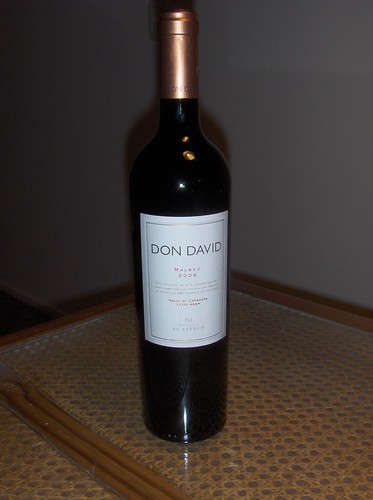
When I saw this in the supermarket, I had to buy it. Not just your average supermarket plonk either - it set me back a full 32 pesos.
A full report will follow in due course.
Don David.
Wednesday, September 17, 2008
Today's Haul
At lunchtime today, I went all out and splurged at the bookstore, spending a full 100 pesos, or 33 US dollars. As you can imagine, this netted me a pretty good haul, pictured below: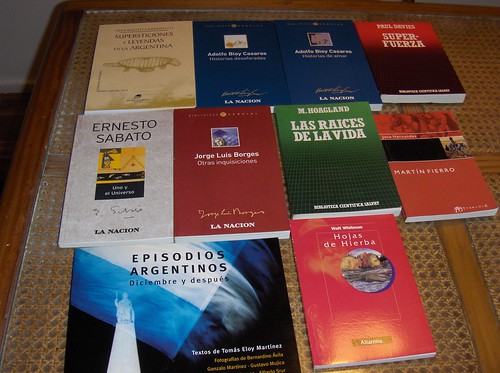
The jewel in the crown of this collection was undoubtedly the delightful "Supersticiones y Leyendas en la Argentina", about which I will have much more to say in a future post.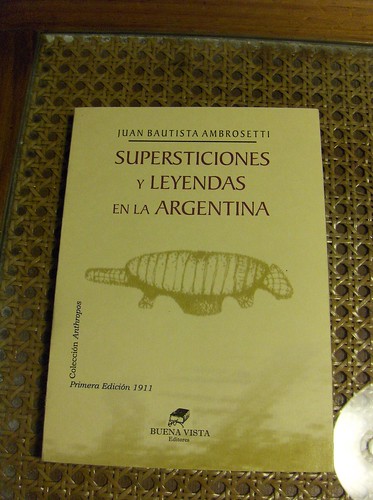
For now, let me just finish with a couple of questions.
Did you know
- that the owl Buo magellanicus has the ability to magnetize cats and other domestic animals?
- that the black crow is an augur of rain and should never be shot, because the rifle will stay damp for ever after?
- that rubbing your thumbs with a magnet brings good luck at cards? (presumably if you don't have a magnet to hand you might try rubbing your thumbs with a cat or other domestic animal that has been magnetized by an owl)
- that the seventh of seven consecutive sons is doomed to be a lobisón, or werewolf? On the distaff side, the seventh consecutive daughter would, of course, be a witch.
- that if the idiot girl next to me in the internet cafe doesn't quit her vacuous high-pitched giggling, I may have to kill her?
Tuesday, September 16, 2008
A City of Readers

I've mentioned, ad nauseam, how inexpensive books are here in Buenos Aires. The picture above depicts one of the factors contributing to this phenomenon. Beginning on Saturday, readers of "La Nación", one of the two main papers here in Buenos Aires (the other is "El Clarín"), will have the option of picking up one of Isabel Allende's novels with their paper, at a special price of only 16.90 pesos, or about 5.50 US dollars. If past experience with similar promotions is any guide, by Christmas time one will be able to pick up Allende's books in any of the many bookstores on the Avenida Corrientes for only 10 pesos apiece.
It's promotions like this one that have enabled me to pick up the works of Borges for 10 pesos a book, classical CD recordings for 6 pesos apiece. This type of promotion was also very common in Madrid, though the prices were a bit higher. It generally supports the notion that the newspaper readers of Buenos Aires are a fairly cultured bunch. Certainly more so than their counterparts in San Francisco, or almost any other U.S. city one might care to mention - I could never imagine this happening in the United States. Time-Life books, and certain Reader's Digest classical music collections come to mind, but from a bygone age, and I doubt any newspaper could pull it off in their local city.
Further anecdotal evidence of a more deeply entrenched local reading habit is provided by Rafael, the waiter (mozo) at my favorite local restaurant, who gives me regular recommendations on what I should be reading. (As well as a remarkable impromptu discussion of the relative merits of Borges and Cortázar, the two giants of 20th century Argentine literature, which came completely out of the blue on Friday evening; remarkable both for the cogency of the points he made, as well as the passion with which he made them). Nestor, doorman of the building in which the school is located (i.e. just a regular midtown office building), has also come through with some excellent recommendations.
Maybe I've just been lucky. Maybe I'm unconsciously filtering my experiences to fit some preconceived notion of a highly literate local population. But I don't think so - the dozens of books stores within eight or ten blocks of my home also suggest otherwise.
A booklover's paradise. Which is to say, an enormous occasion of sin* for yours truly. One that extends for miles in every direction.
*: a technical Catholic term, meaning a source of great temptation from which a good Catholic should immediately extract himself. (Not a chance)
MEAT!!!!! (It's what's for dinner)
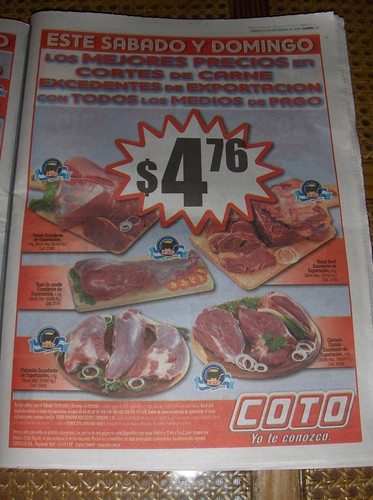
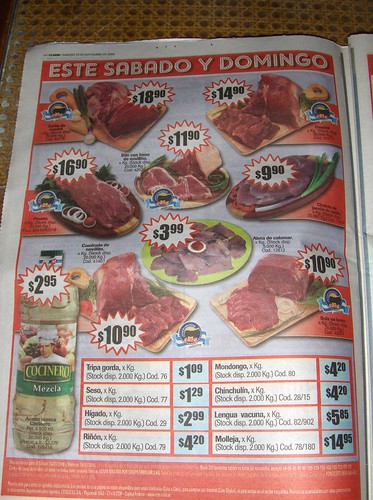
Personally, it'll be a cold day in hell before you catch me putting something called "MONDONGO" in my mouth. It sounds so ...... NASTY..... somehow. And - let's be honest here - "CHÍNCHULÍN" doesn't sound a whole lot better, does it now?
Monday, September 15, 2008
At the theme park
Things started out normally enough yesterday afternoon. As I left the apartment, my plan was straightforward - head for the Japanese garden in Palermo, in search of a little serenity. An hour later, I felt like I had stumbled into a bad Graham Greene novel. What was I doing wandering around "Tierra Santa", Buenos Aires' incredibly bizarre Christian theme park? Why were the park staff dressed like mujahadeen? What was the significance of the number 37? Why was the oddly flirtatious Armenian lady at the concession stand offering to read my fortune in the dregs of the bitter-tasting Armenian coffee I had - perhaps foolishly - just consumed? Was there a Viennese Ferris Wheel somewhere in my immediate future?
Well, no. Apparently not. The number 37 bus took me right back to Cordoba Street where I had boarded it in the first place. But if there is a moral to the story it is surely - when someone (in this case, the porter in the apartment building) suggests to you that you really have to visit this "historical theme park" that is "lo mas lindo que hay en todo Buenos Aires" (the most beautiful attraction in all of B.A.), do a little more homework before taking the bait. This might have revealed, for example, that "historical" was apparently code for "Christian", and that beauty is definitely in the eye of the beholder.
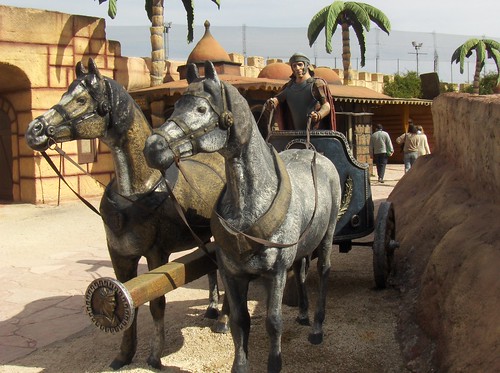
The place is enormous. Right by the airport. With that kind of bizarrely hideous ugliness that ends up having a fascinating charm of its own. The photos are on Flickr. Judge for yourself. I omitted those with the most blatantly obnoxious Catholic flavour.
It was a strange afternoon. But there was belly dancing, falafels, and remarkably good baklava. And the manger sound-and-light show was impressive enough in its own way. I skipped the Creation show. The Crucifixion too. Lines were long, even though you would think people know how it all turned out.
Well, no. Apparently not. The number 37 bus took me right back to Cordoba Street where I had boarded it in the first place. But if there is a moral to the story it is surely - when someone (in this case, the porter in the apartment building) suggests to you that you really have to visit this "historical theme park" that is "lo mas lindo que hay en todo Buenos Aires" (the most beautiful attraction in all of B.A.), do a little more homework before taking the bait. This might have revealed, for example, that "historical" was apparently code for "Christian", and that beauty is definitely in the eye of the beholder.
The place is enormous. Right by the airport. With that kind of bizarrely hideous ugliness that ends up having a fascinating charm of its own. The photos are on Flickr. Judge for yourself. I omitted those with the most blatantly obnoxious Catholic flavour.
It was a strange afternoon. But there was belly dancing, falafels, and remarkably good baklava. And the manger sound-and-light show was impressive enough in its own way. I skipped the Creation show. The Crucifixion too. Lines were long, even though you would think people know how it all turned out.
Sunday, September 14, 2008
David Foster Wallace, RIP
The American author David Foster Wallace, probably the most brilliant of his generation, hanged himself at his home in Pomona, California, on Friday evening. He was 46 years old. When I read this, I was chilled, and deeply saddened. To explain why, I include below reviews I wrote of two of his books ("A Supposedly Fun Thing I'll Never Do Again" and "Consider the Lobster").
Not all of Wallace's writing worked for me - I definitely preferred his collections of shorter pieces. "Oblivion" and "Girl with the Curious Hair" are also well worth reading; I found the bleakness of "Brief Interviews with Hideous Men" too much to bear, and would be afraid to read it again, given the author's suicide. But even when he failed, he did so magnificently, in my opinion. There was an exuberant, over-the-top quality to his writing that was never less than exciting.
Consider The Lobster
Full disclosure: I have a major intellectual crush on David Foster Wallace. Yes, yes, I know all about his weaknesses - the digressions, the rampant footnote abuse, the flaunting of his amazing erudition, the mess that is 'Infinite Jest'. I know all this, and I don't care. Because when he is in top form, there's nobody else I would rather read. The man is hilarious; I think he's a mensch, and I don't believe he parades his erudition just to prove how smart he is. I think he can't help himself - it's a consequence of his wide-ranging curiosity. At heart he's a geek, but a charming, hyper-articulate geek. Who is almost frighteningly smart.
The pieces in “Consider the Lobster” have appeared previously in Rolling Stone, The Atlantic Monthly, the New York Observer, the Philadelphia Enquirer, Harper’s, Gourmet, and Premiere magazines. Among them are short meditations on Updike’s ‘Toward the end of Time’, on Dostoyevsky, on Kafka’s humor, and on the ‘breathtakingly insipid autobiography’ of tennis player Tracy Austin. An intermediate length piece describes Foster Wallace’s (eminently sane) reaction to the attacks of September 11th. Each of these shorter essays is interesting, but the meat and potatoes of the book is in the remaining five, considerably longer, pieces. They are:
Big Red Son: a report on the 1998 Adult Video News awards (the Oscars of porn) in Las Vegas.
Consider the Lobster: a report on a visit to the annual Maine Lobster Festival (for Gourmet magazine).
Host: a report on conservative talk radio, based on extensive interviews conducted with John Ziegler, host of “Live and Local” on Southern California’s KFI.
Up Simba: an account of seven days on the campaign trail with John McCain in his 2000 presidential bid (for Rolling Stone).
Authority and American Usage: a review of Bryan Garner’s “A Dictionary of Modern American Usage” , which serves as a springboard for a terrific exegesis of usage questions and controversies.
Here’s what I like about David Foster Wallace’s writing: I know of nobody else who writes as thoughtfully and intelligently. That he manages to write so informatively, with humor and genuine wit, on almost any subject under the sun is mind-blowing – it’s also why I am willing to forgive his occasional stylistic excesses. (Can you spell ‘footnote’?) You may not have a strong interest in lobsters or pornography, but the essays in question are terrific. The reporting on Ziegler and McCain is amazingly good, heartbreakingly so, because it makes the relative shallowness of most other political reporting painfully evident. Finally, the article on usage is a tour de force – when it first appeared in Harper’s, upon finishing it, I was immediately moved to go online and order a copy of Garner’s book (which is just as good as DFW promised).
How can you not enjoy an essay that begins as follows?
"Did you know that probing the seamy underbelly of US lexicography reveals ideological strife and controversy and intrigue and nastiness and fervor on a near Lewinskian scale?
....... (several other rhetorical questions) ......
Did you know that US lexicography even had a seamy underbelly? "
And which later contains sentences such as:
"Teachers who do this are dumb.
This argument is not quite the barrel of drugged trout that Methodological Descriptivism was, but it’s still vulnerable to objections."
and – my personal favorite –
"This is so stupid it practically drools. "
A Supposedly Fun Thing I'll Never Do Again
David Foster Wallace is one awesomely smart guy. This is both his greatest strength and his potential Achilles heel as a writer. Personally, I will read anything this man writes, because I think he is a true genius with a rare sense of compassion, and a hilarious sense of humor. Even when his writing falls victim to its own cleverness, I still find it worthwhile - perhaps because one senses that the writer is a true mensch (not something I feel when being dazzled by the cleverness of a Dave Eggers, for instance).
Oh hell, I want to be seated next to DFW on a long transpacific flight subject to major delays, OK? I have an enormous intellectual crush on this man. And when I cavil, it is done out of love, pure and simple. But when discussing this book of his, caviling would simply be out of place. It contains two of the funniest essays I have ever read in my life (the descriptions of his experiences on a cruise liner and at the state fair, respectively). I think you should buy your own copy, because I certainly am not going to loan you mine.
May he, and his family and friends, find peace. The world is poorer for his death.
Not all of Wallace's writing worked for me - I definitely preferred his collections of shorter pieces. "Oblivion" and "Girl with the Curious Hair" are also well worth reading; I found the bleakness of "Brief Interviews with Hideous Men" too much to bear, and would be afraid to read it again, given the author's suicide. But even when he failed, he did so magnificently, in my opinion. There was an exuberant, over-the-top quality to his writing that was never less than exciting.
Consider The Lobster
Full disclosure: I have a major intellectual crush on David Foster Wallace. Yes, yes, I know all about his weaknesses - the digressions, the rampant footnote abuse, the flaunting of his amazing erudition, the mess that is 'Infinite Jest'. I know all this, and I don't care. Because when he is in top form, there's nobody else I would rather read. The man is hilarious; I think he's a mensch, and I don't believe he parades his erudition just to prove how smart he is. I think he can't help himself - it's a consequence of his wide-ranging curiosity. At heart he's a geek, but a charming, hyper-articulate geek. Who is almost frighteningly smart.
The pieces in “Consider the Lobster” have appeared previously in Rolling Stone, The Atlantic Monthly, the New York Observer, the Philadelphia Enquirer, Harper’s, Gourmet, and Premiere magazines. Among them are short meditations on Updike’s ‘Toward the end of Time’, on Dostoyevsky, on Kafka’s humor, and on the ‘breathtakingly insipid autobiography’ of tennis player Tracy Austin. An intermediate length piece describes Foster Wallace’s (eminently sane) reaction to the attacks of September 11th. Each of these shorter essays is interesting, but the meat and potatoes of the book is in the remaining five, considerably longer, pieces. They are:
Big Red Son: a report on the 1998 Adult Video News awards (the Oscars of porn) in Las Vegas.
Consider the Lobster: a report on a visit to the annual Maine Lobster Festival (for Gourmet magazine).
Host: a report on conservative talk radio, based on extensive interviews conducted with John Ziegler, host of “Live and Local” on Southern California’s KFI.
Up Simba: an account of seven days on the campaign trail with John McCain in his 2000 presidential bid (for Rolling Stone).
Authority and American Usage: a review of Bryan Garner’s “A Dictionary of Modern American Usage” , which serves as a springboard for a terrific exegesis of usage questions and controversies.
Here’s what I like about David Foster Wallace’s writing: I know of nobody else who writes as thoughtfully and intelligently. That he manages to write so informatively, with humor and genuine wit, on almost any subject under the sun is mind-blowing – it’s also why I am willing to forgive his occasional stylistic excesses. (Can you spell ‘footnote’?) You may not have a strong interest in lobsters or pornography, but the essays in question are terrific. The reporting on Ziegler and McCain is amazingly good, heartbreakingly so, because it makes the relative shallowness of most other political reporting painfully evident. Finally, the article on usage is a tour de force – when it first appeared in Harper’s, upon finishing it, I was immediately moved to go online and order a copy of Garner’s book (which is just as good as DFW promised).
How can you not enjoy an essay that begins as follows?
"Did you know that probing the seamy underbelly of US lexicography reveals ideological strife and controversy and intrigue and nastiness and fervor on a near Lewinskian scale?
....... (several other rhetorical questions) ......
Did you know that US lexicography even had a seamy underbelly? "
And which later contains sentences such as:
"Teachers who do this are dumb.
This argument is not quite the barrel of drugged trout that Methodological Descriptivism was, but it’s still vulnerable to objections."
and – my personal favorite –
"This is so stupid it practically drools. "
A Supposedly Fun Thing I'll Never Do Again
David Foster Wallace is one awesomely smart guy. This is both his greatest strength and his potential Achilles heel as a writer. Personally, I will read anything this man writes, because I think he is a true genius with a rare sense of compassion, and a hilarious sense of humor. Even when his writing falls victim to its own cleverness, I still find it worthwhile - perhaps because one senses that the writer is a true mensch (not something I feel when being dazzled by the cleverness of a Dave Eggers, for instance).
Oh hell, I want to be seated next to DFW on a long transpacific flight subject to major delays, OK? I have an enormous intellectual crush on this man. And when I cavil, it is done out of love, pure and simple. But when discussing this book of his, caviling would simply be out of place. It contains two of the funniest essays I have ever read in my life (the descriptions of his experiences on a cruise liner and at the state fair, respectively). I think you should buy your own copy, because I certainly am not going to loan you mine.
May he, and his family and friends, find peace. The world is poorer for his death.
Saturday, September 13, 2008
Hemorrhoid Cream Puffs and Tanning Bed Wetters
Sometimes, in my private moments, I play little word games in my head to keep myself amused*. Here are the results of one of them. The rules should become obvious after you read a few of the entries on the list. Please feel free to add your own:
Finally, here are a few where we stretch the rules a little bit:
- humble pie chart
- agent orange juice
- oedipus complex numbers
- three-legged stool pigeon
- fertile crescent wrench
- molotov cocktail waitress
- holland tunnel vision
- friendly fire hydrant
- strip club sandwich
- healing miracle whip
- henry james bond
- banana split decision
- french window dressing
- unmitigated gallstones
- potemkin village idiot
- genghis khan do
- cold cereal killer
- mickey finn McCool
- polka dot matrix
- equatorial guinea pig
- venetian blind ambition
- midnight's children of the corn
- dead weight watchers
- donner party favors
- cauliflower earwig
- pork belly laugh
- suckling pig latin
- grizzly bear necessities
- funeral home economics
- sacher torte law
- irish jig-saw puzzle
- poison ivy league
- cricket bat guano
- ceiling fan mail
- st elmo's fire and brimstone
- lazy susan sarandon
- merry andrew jackson
- palme d'or knob
- tasmanian devil-may-care
- disgruntled employee benefits
- swiss navy bean
- static cling peach
- mars bar graph
- bowel motion detector
- hammurabi code talkers
- honey mustard gas
- lunch counter terrorism
- single-malt scotch terrier
- southsea bubble wrap
- celestial body search
- episcopal see saw
- eggs benedict arnold
- trojan horse sense
- combination lockjaw
- styrofoam peanut gallery
- emotional baggage carousel
- sonnets from the portuguese man o'war
- unrequited love handles
- grand theft auto-da-fé
- square root vegetable
- eigenvalue added tax
- periodic table manners
- twisted sister chromatid
- möbius strip tease
- brownian motion sickness
- planck's constant complaining
- schrödinger's cat's pajamas
- newton's apple pie
Finally, here are a few where we stretch the rules a little bit:
- caterpillar of salt
- panama canal leakage
- rum raisin d'être
* It's not playing the little games in my head that's the problem so much as not being able to stop.
A Clerihew
Jorge Luis Borges
wasn't invited to many orgies.
A pity really, because his books might be a trifle less boring,
if, as a youngster, Jorge had done a little less reading and a lot more whoring.
What's that? You'd like it in Thpanish? Well, let's give it a whirl.
But respecting the clerihew style is a little too much to ask.
Borges, aunque sea genial,
me parece, a veces, demasiado cerebral.
Quizás, en lugar de leer tantos libros clásicos,
habría sido mejor si hubiera prestado más atención a sus instintos básicos.
wasn't invited to many orgies.
A pity really, because his books might be a trifle less boring,
if, as a youngster, Jorge had done a little less reading and a lot more whoring.
What's that? You'd like it in Thpanish? Well, let's give it a whirl.
But respecting the clerihew style is a little too much to ask.
Borges, aunque sea genial,
me parece, a veces, demasiado cerebral.
Quizás, en lugar de leer tantos libros clásicos,
habría sido mejor si hubiera prestado más atención a sus instintos básicos.
Thursday, September 11, 2008
Four Villon Translations
Four translations of Villon's "Ballade de bonne doctrine a ceux de mauvaise vie" (~1461)
Ballad of Good Doctrine
To Those of Evil Life (H. De Vere stacpoole, 1914)
Ye who be smugglers of papal bulls,
Or cheaters at dice, whatever be ye --
Coiners who risk life and limb like fools,
Then boil in hot oil for their felony,
Traitors disloyal -- ye know who ye be --
Stealers of jewels, of perfume and pearls:
So where goes it all, that ye get in fee?
All to the taverns and to the girls.
Rhyming and jesting, cymbals and lutes --
Don ye these emblems of minstrelsy.
Farce and imbroglio, music of flutes --
Try these in hamlets or Gay Paree.
Go mumming in masque or mystery,
Win money at cards, or at ninepin hurls.
But 'tis of no use1 It'll flow, hear ye me,
All to the taverns and to the girls.
Ye shrink before such a hard-knocks school --
Play safe, then, with honester husbandry:
Of horses be grooms, go tend to a mule,
Plow ye the fields, here and there plant a tree.
And should ye be short on Latinity,
As lowly in learning as poor pleasant churls,
Just work, lest your hard-earned pennies flee
All to the taverns and to the girls.
Envoi:
Your stockings and doublets, your fine drapery,
Every last rag that around ye furls,
Ere ye be done, will have slipped, ye shall see,
All to the taverns and to the girls.
BALLAD OF GOOD DOCTRINE TO
THOSE OF ILL LIFE. John Payne
SMUGGLE indulgences, as you may:
Cog the dice for your cheating throws.
Try if counterfeit coin will pay,
At the risk of losing your ears and nose :
Deal but in treason, lie and glose,
Rob and ravish : what profits it ?
Where do you think the money goes ?
Taverns and wenches, every whit.
Flute and juggle and cymbals play :
Follow the mountebanks and their shows :
Along with the strolling players stray,
That wander whither God onlv knows :
Act mysteries, farces, imbroglios :
Gain money by cards or a lucky hit
At the pins : however if s got, it goes :
Taverns and wenches, every whit.
Turn from your evil courses, I pray.
That smell so foul in a decent nose :
Earn your bread in some honest way.
If you have no letters, nor verse nor prose,
Plough or groom horses for food and clothes.
Enough shall you have if you stick to it:
But throw not your wage to each wind that blows :
Taverns and wenches, every whit.
ENVOI.
Doublets, pourpoints and silken hose,
Gowns and linen, woven or knit,
Ere your wede's worn, away it goes :
Taverns and wenches, every whit.
A BUG IN THE EAR TO ALL CHILDREN OF DARKNESS Peter Dale
Whether you counterfeit your brass
and end so oiled you boil and bake;
traitors whose credit wouldn't pass;
or peddle pardons; learn to shake
the loaded dice; or maybe take
to filching in and out of doors -
where does it go, the money you make?
All to the taverns and the whores.
Rhyme or rail or clash your brass,
like shameless fools that always fake;
mime, mum, or try some magic pass;
or if in towns and cities, make
miracles, mysteries, jigs; or take
a trick or two or skittle scores -
soon gained, soon gone! (You still awake?)
All to the taverns and the whores.
If depths like these are not your class,
then plough up fields or drive a rake;
or turn to doctoring horse and ass.
But only if you cannot take
to book and pen. A crust you'll make.
Yet if you've slaved at prison chores
you haven't lifted loot to take
all to the taverns and the whores.
Envoi
Before you do much worse then, take
trousers and shoes and all that's yours,
gowns and the silks for your own sake
all to the taverns and the whores.
and - my absolute favorite -
V's Straight Tip to all Cross Coves (W.E. Henley, late 19th century)
Suppose you screeve? or go cheap-jack?
Or fake the broads? Or fig a nag?
Or thimble-rig? Or knap a yack?
Or pitch a snide? or smash a rag?
Suppose you duff? or nose and lag?
Or get the straight, and land your pot?
How do you melt the multy swag?
Booze and the blowens cop the lot.
Fiddle, or fence, or mace, or mack;
Or moskeneer, or flash the drag;
Dead-lurk a crib, or do a crack;
Pad with a slang, or chuck a fag;
Bonnet, or tout, or mump and gag;
Rattle the tats, or mark the spot;
You cannot bank a single stag;
Booze and the blowens cop the lot.
Suppose you try a different tack,
And on the square you flash your flag?
At penny-a-lining make your whack,
Or with the mummers mug and gag?
For nix, for nix the dibbs you bag!
At any graft, no matter what,
Your merry goblins soon stravag:
Booze and the blowens cop the lot.
The Moral:
It's up the spout and Charley Wag
with wipes and tickers and what not.
Until the squeezer nips your scrag,
Booze and the blowens cop the lot.
Explanations of the slang terms appearing in the translation above, and a brief biographical sketch of Villon, may be found at this excellent link:
cant
The challenges of translating this poem are beautifully discussed in Chapter 7 of Douglas Hofstadter's book on translation "Le Ton beau de Marot"*. All but the Payne translation are taken from that book.
One of my Favorite. Books. Ever.
And yes. You've guessed right. It makes me want to learn French. Properly this time.
Which solves the 2009 problem.
Ballad of Good Doctrine
To Those of Evil Life (H. De Vere stacpoole, 1914)
Ye who be smugglers of papal bulls,
Or cheaters at dice, whatever be ye --
Coiners who risk life and limb like fools,
Then boil in hot oil for their felony,
Traitors disloyal -- ye know who ye be --
Stealers of jewels, of perfume and pearls:
So where goes it all, that ye get in fee?
All to the taverns and to the girls.
Rhyming and jesting, cymbals and lutes --
Don ye these emblems of minstrelsy.
Farce and imbroglio, music of flutes --
Try these in hamlets or Gay Paree.
Go mumming in masque or mystery,
Win money at cards, or at ninepin hurls.
But 'tis of no use1 It'll flow, hear ye me,
All to the taverns and to the girls.
Ye shrink before such a hard-knocks school --
Play safe, then, with honester husbandry:
Of horses be grooms, go tend to a mule,
Plow ye the fields, here and there plant a tree.
And should ye be short on Latinity,
As lowly in learning as poor pleasant churls,
Just work, lest your hard-earned pennies flee
All to the taverns and to the girls.
Envoi:
Your stockings and doublets, your fine drapery,
Every last rag that around ye furls,
Ere ye be done, will have slipped, ye shall see,
All to the taverns and to the girls.
BALLAD OF GOOD DOCTRINE TO
THOSE OF ILL LIFE. John Payne
SMUGGLE indulgences, as you may:
Cog the dice for your cheating throws.
Try if counterfeit coin will pay,
At the risk of losing your ears and nose :
Deal but in treason, lie and glose,
Rob and ravish : what profits it ?
Where do you think the money goes ?
Taverns and wenches, every whit.
Flute and juggle and cymbals play :
Follow the mountebanks and their shows :
Along with the strolling players stray,
That wander whither God onlv knows :
Act mysteries, farces, imbroglios :
Gain money by cards or a lucky hit
At the pins : however if s got, it goes :
Taverns and wenches, every whit.
Turn from your evil courses, I pray.
That smell so foul in a decent nose :
Earn your bread in some honest way.
If you have no letters, nor verse nor prose,
Plough or groom horses for food and clothes.
Enough shall you have if you stick to it:
But throw not your wage to each wind that blows :
Taverns and wenches, every whit.
ENVOI.
Doublets, pourpoints and silken hose,
Gowns and linen, woven or knit,
Ere your wede's worn, away it goes :
Taverns and wenches, every whit.
A BUG IN THE EAR TO ALL CHILDREN OF DARKNESS Peter Dale
Whether you counterfeit your brass
and end so oiled you boil and bake;
traitors whose credit wouldn't pass;
or peddle pardons; learn to shake
the loaded dice; or maybe take
to filching in and out of doors -
where does it go, the money you make?
All to the taverns and the whores.
Rhyme or rail or clash your brass,
like shameless fools that always fake;
mime, mum, or try some magic pass;
or if in towns and cities, make
miracles, mysteries, jigs; or take
a trick or two or skittle scores -
soon gained, soon gone! (You still awake?)
All to the taverns and the whores.
If depths like these are not your class,
then plough up fields or drive a rake;
or turn to doctoring horse and ass.
But only if you cannot take
to book and pen. A crust you'll make.
Yet if you've slaved at prison chores
you haven't lifted loot to take
all to the taverns and the whores.
Envoi
Before you do much worse then, take
trousers and shoes and all that's yours,
gowns and the silks for your own sake
all to the taverns and the whores.
and - my absolute favorite -
V's Straight Tip to all Cross Coves (W.E. Henley, late 19th century)
Suppose you screeve? or go cheap-jack?
Or fake the broads? Or fig a nag?
Or thimble-rig? Or knap a yack?
Or pitch a snide? or smash a rag?
Suppose you duff? or nose and lag?
Or get the straight, and land your pot?
How do you melt the multy swag?
Booze and the blowens cop the lot.
Fiddle, or fence, or mace, or mack;
Or moskeneer, or flash the drag;
Dead-lurk a crib, or do a crack;
Pad with a slang, or chuck a fag;
Bonnet, or tout, or mump and gag;
Rattle the tats, or mark the spot;
You cannot bank a single stag;
Booze and the blowens cop the lot.
Suppose you try a different tack,
And on the square you flash your flag?
At penny-a-lining make your whack,
Or with the mummers mug and gag?
For nix, for nix the dibbs you bag!
At any graft, no matter what,
Your merry goblins soon stravag:
Booze and the blowens cop the lot.
The Moral:
It's up the spout and Charley Wag
with wipes and tickers and what not.
Until the squeezer nips your scrag,
Booze and the blowens cop the lot.
Explanations of the slang terms appearing in the translation above, and a brief biographical sketch of Villon, may be found at this excellent link:
cant
The challenges of translating this poem are beautifully discussed in Chapter 7 of Douglas Hofstadter's book on translation "Le Ton beau de Marot"*. All but the Payne translation are taken from that book.
One of my Favorite. Books. Ever.
And yes. You've guessed right. It makes me want to learn French. Properly this time.
Which solves the 2009 problem.
Mission Accomplished?
I caught a cold earlier in the week so this afternoon, between the congestion, coughing, and slight homesickness after Brad's departure last night, I was feeling a little sorry for myself. But during my private class with Cecilia (morning classes this week are with Ciro, so I have a new teacher for my one-on-one sessions), I got just the pick-me-up I needed. At some point she made mention of the "fact" that I had already attained "legendary status" within the school, in particular in the teachers' lounge. When I pressed her for details (who wouldn't?), it appears that the reasons are twofold -- (i) they get just as much a kick out of my blowing the assembled 19-year olds out of the water as I do, and (ii) although nobody ever quite knows what I am likely to say next, they can be sure it will be entertaining, fluent, and grammatically correct.
I can't tell you how happy that last part made me feel. I mean, that has been the whole point of this exercise, hasn't it? I'd been feeling pretty good about my progress, but it felt really wonderful to receive that kind of validation.
(I'll spare you my little swelled head fantasies about hiring myself out for parties with the slogan "equally charming in three languages"*)
Although I still plan on going to Madrid for November, I am seriously questioning the value of taking the advanced DELE exam. It seems to me that maybe I have reached the point I wanted to get to. Do I really need a piece of paper, that I will never use, to prove it?
*: note that, despite my having been the only non-native speaker on the All-Ireland champion Irish debating team in high school, I cannot in all conscience include Irish on the list. Not that would really affect one's marketability, I suspect. Time to revive Flann O' Brien's infamous escort service, perhaps.
I can't tell you how happy that last part made me feel. I mean, that has been the whole point of this exercise, hasn't it? I'd been feeling pretty good about my progress, but it felt really wonderful to receive that kind of validation.
(I'll spare you my little swelled head fantasies about hiring myself out for parties with the slogan "equally charming in three languages"*)
Although I still plan on going to Madrid for November, I am seriously questioning the value of taking the advanced DELE exam. It seems to me that maybe I have reached the point I wanted to get to. Do I really need a piece of paper, that I will never use, to prove it?
*: note that, despite my having been the only non-native speaker on the All-Ireland champion Irish debating team in high school, I cannot in all conscience include Irish on the list. Not that would really affect one's marketability, I suspect. Time to revive Flann O' Brien's infamous escort service, perhaps.
The case of the missing coins (continued)
I've been re-reading some of the Father Brown mysteries (in Thpanish, of course), which has prompted me to do a little detective work of my own. Specifically concerning the puzzling shortage of coins here in Buenos Aires. I am beginning to form a little theory of my own.
My initial reasoning was as follows. Any shortage must have a beginning (and - one hopes - an end). So I began to examine the dates on all coins that did come into my hands. The results so far can be summarized in the following two-by-two table:
************* Before 2000 ********** After 2000
Small coins .....................0.................................14
Large coins ....................12.................................0
Here, "small" refers to both the size and denomination (5- and 10-centavo pieces), as does "large" (25- and 50-centavo and 1-peso coins). Numbers in the table represent frequencies (the asterisks and dots mean nothing, they are just to trick Blogger into making a halfway readable format).
Me parece interesante. Voy a continuar mis investigaciones.
I know y'all are on edge to get to the bottom of this. You can rely on me. I'm all over it.
The plain people of Ireland: Could you describe your sampling procedures in a little more detail, to allow the reader to get a sense of the generalisability of your results?
The management: I could, but I don't feel like it. Please go back to your caves.
My initial reasoning was as follows. Any shortage must have a beginning (and - one hopes - an end). So I began to examine the dates on all coins that did come into my hands. The results so far can be summarized in the following two-by-two table:
************* Before 2000 ********** After 2000
Small coins .....................0.................................14
Large coins ....................12.................................0
Here, "small" refers to both the size and denomination (5- and 10-centavo pieces), as does "large" (25- and 50-centavo and 1-peso coins). Numbers in the table represent frequencies (the asterisks and dots mean nothing, they are just to trick Blogger into making a halfway readable format).
Me parece interesante. Voy a continuar mis investigaciones.
I know y'all are on edge to get to the bottom of this. You can rely on me. I'm all over it.
The plain people of Ireland: Could you describe your sampling procedures in a little more detail, to allow the reader to get a sense of the generalisability of your results?
The management: I could, but I don't feel like it. Please go back to your caves.
Wednesday, September 10, 2008
Occupational hazards
From a study reported on the Frontline website at pbs.org
Roughly 120 million people worked in the U.S. in 1992. Every job carries some risks. Many workers are exposed to job-related safety risks of traffic accidents, falls, murder, electrocution, fire, being struck by objects, explosion, heat, cold, animal attacks, and airplane crashes, as well as health risks from radiation, asbestos, silica, benzene, coal dust, tuberculosis, secondhand smoke, carbon monoxide, pesticides, benzidine, arsenic, lead, chromium, and stress.
Also the abbreviation for the Norfolk, VA airport.
Popcorn Worker's Lung: Occupational airway diseases such as occupational asthma, bronchitis, reactive airways dysfunction syndrome and byssinosis are common workplace diseases. The involvement of the small airways, such as the bronchioles are infrequently reported in occupational airway disease, but these may lead to serious chronic lung injury.
One such disease of the bronchioles is bronchiolitis obliterans. This disease is initiated by damage to the epithelium of the small conducting airways and progresses to inflammation of the airways, frequently to the adjacent alveolar tissue as well. The clinical consequence of this injury and inflammation is irreversible airway obstruction.
Exposure to an agent during diacetyl production appears to be responsible for causing bronchiolitis obliterans syndrome in chemical process operators, consistent with the suspected role of diacetyl in downstream food production.
This first came to public attention when eight former employees of the Gilster-Mary Lee popcorn plant in Jasper, Missouri, developed bronchiolitis obliterans. In 2000, the Missouri Department of Health called in NIOSH to make a determination of the cause, and to recommend safety measures. After surveying the plant and each patient's medical history, NIOSH recommended respiratory protection for all workers in microwave popcorn production. Due to this event, bronchiolitis obliterans began to be referred to in the popular media as "Popcorn Lung" or "Popcorn Workers Lung".
Coal Worker's Pneumoconiosis: Coal worker's pneumoconiosis is a lung disease caused by breathing in dust from coal, graphite, or man-made carbon for a long time. Although some miners never develop the disease, others may develop the early signs after less than 10 years of mining experience.
Coal worker's pneumoconiosis (CWP) can be defined as the accumulation of coal dust in the lungs and the tissue's reaction to its presence. The disease is divided into 2 categories: simple CWP (SCWP) and complicated CWP (CCWP), or pulmonary massive fibrosis (PMF), depending on the extent of the disease.
Prognosis is poor once the patient has been determined to have PMF. Treatment is palliative.
Simple CWP specimen
Progressive massive fibrosis specimen (caution - high nausea potential)
All in all, it makes one think that perhaps the work of OSHA is underappreciated.
Roughly 120 million people worked in the U.S. in 1992. Every job carries some risks. Many workers are exposed to job-related safety risks of traffic accidents, falls, murder, electrocution, fire, being struck by objects, explosion, heat, cold, animal attacks, and airplane crashes, as well as health risks from radiation, asbestos, silica, benzene, coal dust, tuberculosis, secondhand smoke, carbon monoxide, pesticides, benzidine, arsenic, lead, chromium, and stress.
- Roughly 6,371 job-related injury deaths, 13.3 million nonfatal injuries, 60,300 disease deaths, and 1,184,000 illnesses occurred in the U.S. workplace in 1992.
- The total direct and indirect costs associated with these injuries and illnesses were estimated to be $155.5 billion, or nearly 3 percent of gross domestic product (GDP). Injuries generated roughly 85 percent whereas diseases generated 15 percent of all costs.
- Small firms have exceptionally high injury rates.
- Occupations contributing the most to costs included truck drivers, laborers, janitors, nursing orderlies, assemblers, and carpenters. On a per capita basis, lumberjacks, laborers, millwrights, prison guards, and meatcutters contributed the most to costs.
- Occupations at highest risk for carpal tunnel syndrome include dental hygienists, meatcutters, sewing machine operators, and assemblers. Among well-paid professions, dentists face the highest risks.
- Disabling injuries are strongly correlated with job experience. New employees, regardless of age, experience a high and disproportionate number of injuries.
- Men are more likely than women to sustain a work injury. This is especially true for an injury resulting in death The nonfatal injury ratio for men to women is nearly 2:1, whereas the fatal injury ratio is about 11:1.
- Blacks and Hispanics experience greater injury rates than non-Hispanic whites.
- In 1992, the CFOI and the NHIS underestimate injuries experienced by blacks.* The self-employed, persons employed in small firms, and persons over age 65 are at high risk for sustaining an injury death.
- Laborers, truck drivers, and taxi drivers generate among the highest death rates of all occupations.
- Mining, farming, and construction are the industries with the highest rates of fatal and nonfatal injuries.
- Murder is the most likely cause of death for business executives and sales workers.
- Operators and laborers generate the greatest numbers of deaths and nonfatal injuries among all broad occupation groups.
- Laborers, truck drivers, nursing aides, janitors, assemblers, stock handlers, and cashiers generate the most disabling injuries among detailed occupations.
- Being at work is not safer than being at home. People who work are more likely to be injured at work than at home. This is especially true for men. Moreover, work-related injuries are more likely to result in hospitalizations than injuries originating outside of work.
With that as background, let's take a walk down memory lane, to examine some of the risks associated with professions that are now defunct:
Hatter's shakes: Related, of course, to the phrase 'mad as a hatter'. What was the root cause of your ailments, if you were a hatter? Mercury, even more toxic than lead.
From Michael Quinion's World Wide Words site:.... the term derives from an early industrial occupational disease. Felt hats were once very popular in North America and Europe; an example is the top hat. The best sorts were made from beaver fur, but cheaper ones used furs such as rabbit instead.A complicated set of processes was needed to turn the fur into a finished hat. With the cheaper sorts of fur, an early step was to brush a solution of a mercury compound — usually mercurous nitrate — on to the fur to roughen the fibres and make them mat more easily, a process called carroting because it made the fur turn orange. Beaver fur had natural serrated edges that made this unnecessary, one reason why it was preferred, but the cost and scarcity of beaver meant that other furs had to be used.Whatever the source of the fur, the fibres were then shaved off the skin and turned into felt; this was later immersed in a boiling acid solution to thicken and harden it. Finishing processes included steaming the hat to shape and ironing it. In all these steps, hatters working in poorly ventilated workshops would breathe in the mercury compounds and accumulate the metal in their bodies.We now know that mercury is a cumulative poison that causes kidney and brain damage. Physical symptoms include trembling (known at the time as hatter’s shakes), loosening of teeth, loss of co-ordination, and slurred speech; mental ones include irritability, loss of memory, depression, anxiety, and other personality changes. This was called mad hatter syndrome.
Woolsorter's disease: Anthrax, from handling the fleeces.
Goldsmelter's cataract: Goldsmiths and other metal workers were at greater risk of developing cataracts because they used to stare at the bright molten metal. A tangential note: St Clare (of Assisi) is the patron saint of needle-workers, embroiderers, eyes and eye diseases, goldsmiths, gilders, laundry workers, telegraph, telephone, television writers and good weather. Toward the end of her life, when she was too ill to attend Mass, an image of the service would be displayed on the wall of her cell; because of this, she became the patron saint of television
Painter's colic: Lead poisoning caused by inhaling fumes from lead-based paints.
Phossy-jaw: Phossy jaw, formally phosphorus necrosis of the jaw is a deadly occupational hazard for those who work with white phosphorus without proper safeguards. It was most commonly seen in workers in the match industry in the 19th and early 20th century. Modern occupational hygiene practices have eliminated the conditions which lead to this affliction.
Chronic exposure to the vapour of white phosphorus, the active ingredient of most matches from the 1840s to the 1910s, caused a deposition of phosphorus in the jaw bones. It also caused serious brain damage. Workers afflicted would begin suffering painful toothaches and swelling of the gums. Over time, the jaw bone would begin to abscess, a process which was both extremely painful and disfiguring to the patient, and repellent to others, since drainage from the dying bone tissue was exceedingly foul-smelling. The jawbones would gradually rot away and would actually glow a greenish-white color in the dark. Surgical removal of the afflicted jaw bones might save the sufferers' life at this point—otherwise, death from organ failure would invariably follow.
Public revulsion eventually caused changes in match manufacturing which eliminated the disease. In some nations, legislative action was required to force these changes on a reluctant industry.
Dialpainter's disease: "The doctors tell me I will die, but I mustn't. I have too much to live for-- a husband who loves me and two children I adore. They say nothing can save me, nothing but a miracle." Ottawa native Catherine Donohue wrote those words and more from her bed to the Our Lady of Sorrows Roman Catholic Church in Chicago in the mid-1930s. She asked for a novena to bring her a miracle. She had to write the words for she could not speak them. Her teeth and a large portion of her jawbone were gone. Cancer was eating away at her bone marrow. The doomed young mother weighed only 65 pounds. Catherine Donohue was a charter member of the nonexistent organization, "The Society of the Living Dead," so called because members had two things in common: all worked at the Radium Dial Company in Ottawa, Illinois and all eventually suffered an agonizing death from radium radiation poison. More than 30 of these area co-workers (among others in dialpainting plants across the country), each of whom painted a radium-laced solution onto clock faces, watch dials and military equipment so they would glow in the dark, found that the simple habit of licking their brushes into a fine point eventually gave them terminal head and bone cancer.
Assured that the radium-laced compound was completely safe, even digestible, the young women painted their dress buttons, fingernails, eyelids and even their teeth for fun. When they went home from work, they thrilled their families and friends with glowing clothes, fingers and hair. Dialpainters were instructed in the technique of lippointing to perform their finely detailed work. Mixing the dry, luminous paint powder with paste and thinner, the workers drew their small brush to a point with their lips before dipping it in the paint, and then meticulously filled in the numbers or other marks on clockfaces or other equipment before repeating the process. The whole sorry story is documented in two different books, "Deadly Glow" and "Radium Girls".
Caisson disease: Dr. Andrew Smith first utilized the term "caisson disease" describing 110 cases of decompression sickness as the physician in charge during construction of the Brooklyn Bridge. The project employed 600 compressed air workers. Recompression treatment was not used. The project chief engineer Washington Roebling suffered from caisson disease. (He took charge after his father John Augustus Roebling died of tetanus.) Washington's wife, Emily, helped manage the construction of the bridge after his sickness confined him to his home in Brooklyn. He battled the after-effects of the disease for the rest of his life. During this project, decompression sickness became known as "The Grecian Bends" because afflicted individuals characteristically arched their backs: this is possibly reminiscent of a then fashionable women's dance maneuver known as the Grecian Bend.
X-ray dermatitis: Yes, indeedy, maybe those shoe-fitting fluoroscopes weren't such a boffo idea after all.
pdf file
Fiddler's neck: occupational hazards for musicians
Bagpiper's fungus: See previous entry
Beat knee: Beat knee, beat hand, and beat elbow are acute inflammation of the tissues under the skin of the part affected. Beat knee results from constant kneeling in thin seams, beat hand results from using rough-handled tools, beat elbow results from pressure on the joint caused by crawling in very thin seams or from holing. The symptoms are pain, swelling, stiffness of the parts affected, probably followed by suppuration. Preventive measures include the use of pads for the knees and elbows, and the application of iodine to cuts and abrasions.
Ankylostomiasis: ANKYLOSTOMIASIS, or Anchylostomiasis (also called helminthiasis, "miners' anaemia," and in Germany Wurmkrankheit), a disease to which in recent years* much attention has been paid, from its prevalence in the mining industry in England, France, Germany, Belgium, North Queensland and elsewhere.
This disease is due to the presence in the intestine of nematoid worms (Ankylostoma duodenalis) from one-third to half an inch long. The symptoms include pain in the stomach, capricious appetite, pica (or dirt-eating), obstinate constipation followed by diarrhoea, palpitations, small and unsteady pulse, coldness of the skin, pallor of the skin and mucous membranes, diminution of the secretions, loss of strength and, in cases running a fatal course, dysentery, haemorrhages and dropsies. The parasites, which cling to the intestinal mucous membrane, draw their nourishment from the blood-vessels of their host, and as they are found in hundreds in the body after death, the disorders of digestion, the increasing anaemia and the consequent dropsies and other cachectic symptoms are easily explained.
The disease was first known in Europe among the Italian workmen employed on the St Gotthard tunnel. In 1896, though previously unreported in Germany, 107 cases were registered there, and the number rose to 295 in 1900, and 1030 in 1901. In England an outbreak at the Dolcoath mine, Cornwall, in 1902, led to an investigation for the home office by Dr Haldane F.R.S. (see especially the Parliamentary Paper, numbered Cd. 1843), and since then discussions and inquiries have been frequent.
The parasites thrive in an environment of dirt, and the main lines of precaution are those dictated by sanitary science. Malefern, santonine, thymol and other anthelmintic remedies are prescribed.
*: this account is taken from a 1911 encyclopedia.
Orf: contagious pustular dermatosis - caused by a pox virus, this is a zoonosis caught from sheep - an occupational hazard for farmers and veterinarians. It is self-limiting but unpleasant and painful.
Also the abbreviation for the Norfolk, VA airport.
Popcorn Worker's Lung: Occupational airway diseases such as occupational asthma, bronchitis, reactive airways dysfunction syndrome and byssinosis are common workplace diseases. The involvement of the small airways, such as the bronchioles are infrequently reported in occupational airway disease, but these may lead to serious chronic lung injury.
One such disease of the bronchioles is bronchiolitis obliterans. This disease is initiated by damage to the epithelium of the small conducting airways and progresses to inflammation of the airways, frequently to the adjacent alveolar tissue as well. The clinical consequence of this injury and inflammation is irreversible airway obstruction.
Exposure to an agent during diacetyl production appears to be responsible for causing bronchiolitis obliterans syndrome in chemical process operators, consistent with the suspected role of diacetyl in downstream food production.
This first came to public attention when eight former employees of the Gilster-Mary Lee popcorn plant in Jasper, Missouri, developed bronchiolitis obliterans. In 2000, the Missouri Department of Health called in NIOSH to make a determination of the cause, and to recommend safety measures. After surveying the plant and each patient's medical history, NIOSH recommended respiratory protection for all workers in microwave popcorn production. Due to this event, bronchiolitis obliterans began to be referred to in the popular media as "Popcorn Lung" or "Popcorn Workers Lung".
Coal Worker's Pneumoconiosis: Coal worker's pneumoconiosis is a lung disease caused by breathing in dust from coal, graphite, or man-made carbon for a long time. Although some miners never develop the disease, others may develop the early signs after less than 10 years of mining experience.
Coal worker's pneumoconiosis (CWP) can be defined as the accumulation of coal dust in the lungs and the tissue's reaction to its presence. The disease is divided into 2 categories: simple CWP (SCWP) and complicated CWP (CCWP), or pulmonary massive fibrosis (PMF), depending on the extent of the disease.
Prognosis is poor once the patient has been determined to have PMF. Treatment is palliative.
Simple CWP specimen
Progressive massive fibrosis specimen (caution - high nausea potential)
All in all, it makes one think that perhaps the work of OSHA is underappreciated.
What you can buy for 10 dollars
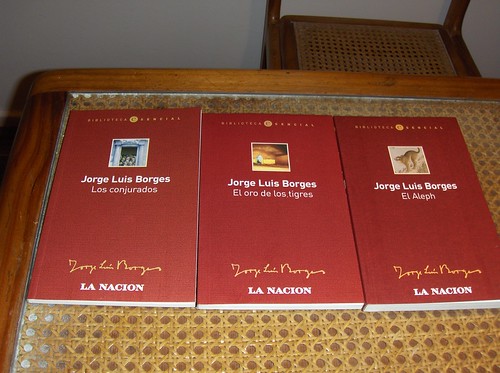
Three books by Borges, including some pretty amazing poetry.
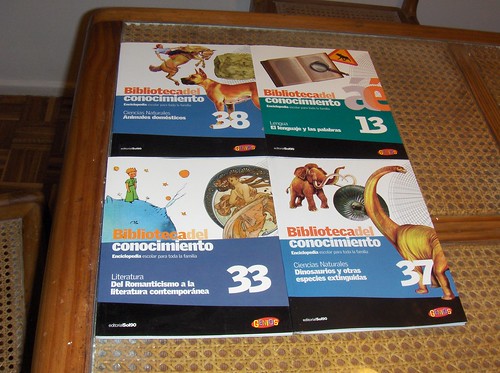
15 books in the exciting Biblioteca del Conocimiento series (just like the four in the picture), covering topics from dinosaurs to algebra and world literature.
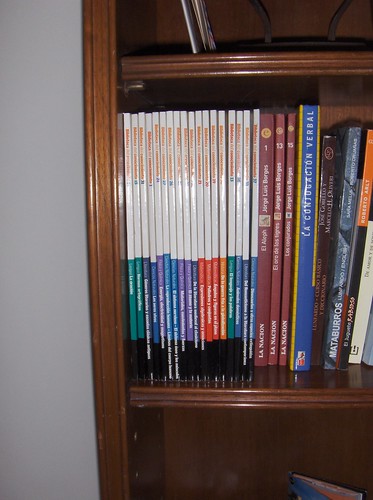
OK: I might have bought more than 15. So sue me. They are 2 pesos apiece, for crying out loud!

Or five classical music CD's.
Or three tickets to see "Mamma Mia!".
Tuesday, September 9, 2008
Subscribe to:
Posts (Atom)


