Friday, April 17, 2009

Drogging While Blunk

Well, gentle readers, we knew it would come to this. But I feel that I can retain a certain amount of dignity by pointing to the fact that there have been 507 posts, written while I was completely sober, before this one. Where I am definitely - hic! - not.

There are two clearly identifiable factors which have led to this situation. In no particular order, they are:

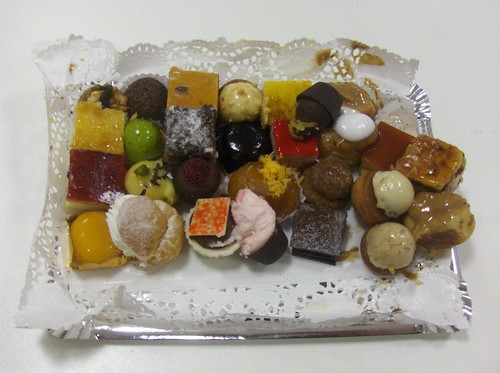
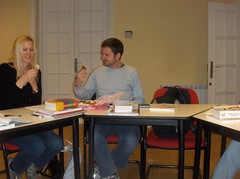
april_17 001

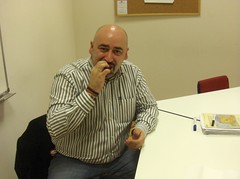
Alex, my absolutely charming Parisian classmate with the unpronounceable Basque surname,

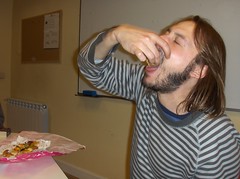
delirium tremens 002

Any beer which features dancing pink elephants on the bottle is not to be taken lightly.

Anyhow, it seemed like the most natural thing in the world to join Alex for a farewell beer or three after class. After three inferior Spanish beers, it seemed even more sensible to continue our drinking session in the apartment with some infinitely superior Belgian beer, before meeting up with some of the other students at eight o' clock to continue drinking.

In retrospect, it might have been a good idea to build in more food opportunities into our plan.

But not to worry, eight hours later, I am home safe and sound. (Alex and the others were last seen in some delightful, nameless, smoky bar in the Lavapiés district).

Why blog in an obviously intoxicated state? Well, because, for one reason or another, I can't remember when I've had as much fun as I've had this week. With today being a particular highlight. I am happy to be heading home, because two months away is a long time. But it seems important to record for posterity, just how much of a blast I've had here in Madrid. It's been a gift, the entire time.

And if I can't take the time out to acknowledge that on this blog, then I shouldn't be blogging in the first place.

Another happy note is that when Alex saw Elsie,

Elsie looking ... well... bovine

it was love at first sight. So that I can now leave Madrid, knowing that Elsie will be left in a loving home.

I am *so* happy right now. (And not nearly as drunk as I pretend to be. But definitely tipsy).

My flight leaves Madrid tomorrow at around 4:30 pm. God willing, I should arrive back in San Francisco on Sunday evening, after breaking my journey by staying overnight chez Paddy in Alexandria.

Signing out for this particular blogstage.

Abrazos.

Wednesday, April 15, 2009

Kermit and Pooh go for a Ride

april_15 001

Tales of the Pampas (Search Engine Poetry)

Poetry constructed using only search engine terms by which people arrived at this blog. The only modification I have made is to change the punctuation in a few places.

1. Speak to me Jimmy !!!

Tony's fat.
Tubermensch.
Pig of the sea.
"What would I look like 4 stone lighter?"
The unfeasibly tall Greek billionaire.
Sinuous trophy wife.

2. On the Pampas Vocabulary Activities

Reina Sofia metrosexual,
Jet lagged hamster,
Static strips for motion sickness,
Raves on the pampas.
Sweaty men.
Beef extract.
Pampas meat.

Pampas meat?
Guinea pigs, baby!!!

3. The Case of the Marmalade Cat

Los Gatos deaths.
Desiccation syndrome.
Bagpiper's lung fungus.
Fat coma.
Caisson disease constipation.
Camilla Windsor accident.
Marmalade cat.
Cat of doom.

4. Does Travel Broaden the Mind or is it just a Waste of Time and Money?

Four reasons why travelling broaden the mind.
Raccoons in space.
Guanajuato strip clubs.
Hello Kitty, Chapel Hill.
Segovia aquaducks.


5. Mainly on the Plain

Pandas in action.
Squid and frog.
Two-headed bunny.
Doctor Ruth.
Traceable jackalope.
Puddy tats.
Laundercats.
Javelina siege.
Itzcuintli dog with me.

Hideous, ugly, animals.
Keep track of your flock.

Ethel the aardvark goes quantity surveying.
Don Quixote goes to the movies.

The rain in Spain falls mainly on the plain
And there is love,
But also pain.
And the rain.

Tuesday, April 14, 2009

Susan Boyle

Someone over on the Salon TableTalk board alerted me to this link:

http://www.youtube.com/watch?v=9lp0IWv8QZY

Two years ago, I blogged about Paul Potts, who went on to win that year's "Britain´s Got Talent" contest. The video in the link has that same heartwarming quality - you may tear up a bit watching it. The best part is watching the judges' reactions.

Thanks to Inara for pointing me to the link in question.

Streets of Malasaña

I have created a new Flickr photoset here . Almost all of the photos were taken on my way to and from school.


april14 041

Enjoy!

Monday, April 13, 2009

The cost of living

Yesterday, I wrote a post about the economic crisis ("la crisis") affecting Spain, and suggested that its effects were not all that obvious here in Madrid. On a related note, I thought it might be interesting to provide some anecdotal data about the cost of living here, from a personal point of view.

The first thing to note is that the exchange rate is a little more favorable now than it was two years ago. Given that prices of many items appear not to have changed perceptibly (perhaps a 5% increase in things like the price of a newspaper, cup of coffee, or a beer, which is offset by the improvement in the exchange rate), I have no sense that things have gotten more expensive. In fact, since I had paid for my three main expenses - travel to and from Spain, seven weeks of classes, and two months rental of the apartment - upfront, the amount that I spend weekly is relatively low. Definitely lower than my day-to-day expenses in San Francisco (though obviously certain monthly expenses in SF - mortgage, utilities, phone and DSL service, health insurance and the like - continue in my absence).

But daily expenditures here don't amount to all that much. I generally have breakfast in the break between my first two classes - 2€ for coffee and a pastry. Then, at 3pm, after my conversation class is finished, it's time for lunch (my favorite couple of hours in the day). A couple of days a week I will generally eat lunch with some of the other students, or some of the teachers in the school; three days a week I eat lunch on my own, with time to read the newspaper at leisure and mark my vocabulary words. Lunch in Madrid is definitely the best value going. Almost every restaurant or bar offers a fixed price, three-course meal, beverage included, for somewhere between 9 and 12€ (1 euro = roughly $1.30). Often, I will finish at around 4:45 or so, which leaves a couple of hours until my 7pm culture class. Having eaten a full lunch during the day, going out to dinner seems pointless, so I generally pick up the makings of a light meal to prepare at home (maybe another 5€). Which ends up at around $25 a day for food. Going to the movies is also fairly cheap (5 to 7€, depending on the time of day). The newspaper is 1.10€ during the week, double that on Sunday. The metro, and city buses, are a steal - you can get a 10-trip ticket for less than 7€. So that I seem to end up using the cash machine far less often here than at home.

Hotels are also pretty reasonable. Obviously, it's possible to spend a lot of money, if you choose a particularly fancy hotel. But, to give a reference point, the Ateneo, the three-star hotel where Paddy stayed during both visits here, which is right near the city center (but very quiet), offers a double room, single occupancy, for just 75 to 80€ a night (the desk guy was so smitten with Paddy that he comped her several free breakfasts at the buffet, though it technically wasn't included in her room rate).

So, if you haven't yet made travel plans this year, maybe you should consider España.

Sunday, April 12, 2009

Ruthless Rhymes for Easter

Little Willie

Little Willie, feeling mean
Pushed his sister through a screen
Mother stopped his innovations
Said it made for strained relations.

Willie and three other brats
Ate up all the Rough-On-Rats;
Papa said, when Mama cried,
"Don't worry, dear, they'll die outside."

Necessity

Late last night I slew my wife,
Stretched her on the parquet flooring;

I was loath to take her life,

But I had to stop her snoring.


Calculating Clara


O'er the rugged mountain's brow

Clara threw the twins she nursed,

And remarked, "I wonder now

Which will reach the bottom first?"


"Ruthless Rhymes for Heartless Homes"
"Col. D. Streamer" (pseudonym of Harry Graham)


La Crisis

So, although Thursday and Friday were official holidays (and Madrid was deserted, making me doubly glad that I didn't push myself to go to Bilbao), Spain did get a new government this week. On Tuesday, accompanied by the usual fanfare and gobbledygook, Prime Minister Zapatero announced a major reshuffle of his cabinet. The main change appears to be that the new cabinet is composed of more hardline socialists, and that - for the first time in the country's history - a woman will head up the Ministry of Economics. Specifically, this woman, Elena Salgado:


(picture found here )

As an article in today's "El País" points out, she will have her work cut out for her. Unemployment here in Spain is creeping up inexorably towards the 4 million mark, assorted banks have failed and had to be bailed out within the past six months -- it's the same, sad, familiar story as everywhere else.

When we were in Andalucia last week, the signs of "la crisis" were obvious. Other than one other couple, we appeared to be the only guests in the hotel. Cafés and bars were relatively deserted. It was a marked contrast to two years ago, when I was in Seville at pretty much the same time of the year and the place was bustling with tourists. Here in Madrid, signs of the crisis are not as immediately evident, but are fairly obvious once you keep your eyes peeled. One example that comes to mind is that both churches that I pass on the way to my 7pm class have long lines of folks waiting for the soup kitchens to open at 7 o'clock. Something that, if it was happening two years ago, I have no recollection of seeing.

Nonetheless, there are still crowds of shoppers at El Corte Inglés, and pretty much everyone managed to get out of town this weekend, so whatever the true dimensions of "la crisis", it doesn't yet appear to have hit the madrileño middle classes very hard.

Future Plans (and Champagne)

It occurs to me that I have blogged very little about my day-to-day life here in Madrid during this trip, so I thought I'd try to remedy that as I head into my final week. I think part of the reason is because I've been so happy here - somehow calamity and adversity seem to make for better blogfodder than day-to-day contentedness. It has been a wonderful trip, providing further confirmation for the observation that it does me a power of good to get up off my rear end and get out of San Francisco. Those winter reading marathons are enjoyable in their own way, and raise my profile over on the goodreads site, but nothing beats actually getting out of the apartment and out of the city. As always, even the mundane stuff is more fun when you do it in a foreign city and in a foreign language.

The only problem is that I'm not sure how long I can continue to use learning Spanish as a pretext for my travels. Although classes at Don Quijote have been enjoyable, and my Spanish has continued to improve, the inescapable truth is that the gains at this point are somewhat marginal, at best. This time around I placed directly into the highest level, where I had the distinct feeling most of the time of being well ahead of my classmates, at least as far as speaking ability is concerned. I slacked off a bit on the grammar this time, largely out of boredom, but also due to a certain degree of laziness. As always, the teachers at dQ have been wonderful; I wouldn't say the same for my classmates, a few of whom I actively dislike. Though it's tempting to elaborate, I will leave it at that, because I don't want to offend anyone unnecessarily who might end up reading this blog. I'm just glad that I didn't sign up to stay through the advanced DELE exam in mid-May, because faced with the option of preparing for it with the particular group assembled in Madrid, I would have had to flee to Salamanca.

Anyway, I think I can justify one more trip to Latin America (with maybe a side trip of a week or two to Costa Rica), probably in the July-September time frame. I very much want to go back to Buenos Aires, as well as seeing more of Argentina, and would like to spend some time in Chile as well. The Don Quijote school in Cuzco, in contrast, at an elevation of 11,000 feet, holds no particular attraction. After that, I will be faced with a major decision - either try to put my knowledge of Spanish to practical use by, e.g. seeking a visiting academic position in a Spanish-speaking location (something I intend to look into seriously as soon as I get back to SF), or start afresh with a new language, most probably French. Interestingly, one thing that doesn't tempt me in the slightest is going back to practice statistics within the biopharmaceutical sector - I spent a very enjoyable 25 years doing that, but have no particular desire to do it again. And, though it's taken me two years to reach this point, I also no longer feel guilty about not wanting to go back. But I do need something to get me out of San Francisco, even if it's for only half the year, as I have a definite tendency to fall into a rut if I stay there too long.

Anyway, the plan for the immediate future* is to go back and take care of my taxes, go down to visit my friends Peggy and Andy in Southern California round the beginning of May. Then fly to Scotland and Ireland to visit friends and relatives there, and to meet up with my sister Emer and her husband Dale, later on in May. In June I hope to spend some time on the east coast (DC, Baltimore, New York, Chapel Hill) to catch up with friends there, before taking a longer trip to Latin America, starting in July. The big question is what happens after that, but right now I'm happy enough to map things out six months at a time.

I know, I know. Everybody should have such problems. Trust me, I count my blessings every day.

*: Major props are due to Paddy, Katie, and Adam for helping me shape this plan, and for making it clear in no uncertain terms that if I showed further signs of falling into a vegetative rut in San Francisco that they would personally mount an intervention to save me from myself. I love them all dearly, more than they can possibly know.

The plain people of Ireland: Yes, yes. That's all very interesting, but aren't you forgetting something? Isn't there some occasion you want to mark?
MOTP: ?! Oh, yes. Sure. Happy Easter to all my readers.
The plain people of Ireland: Not that. Something else, maybe?
MOTP: Ah, yes. Of course. It's champagne ye're after isn't it? Well, have a pew and join me in a glass to celebrate this, the quinquecentennial post on this blog.
The plain people of Ireland: Yerra, we thought you'd never ask. Still, five-hundred, that's not too shabby at all.
Fade to the sound of ribald celebration.

Saturday, April 11, 2009

Fake Words (Corporate Edition)

  • Exxonerate: to display excessive leniency towards companies charged with environmental pollution.
  • Michelinzer Torte: a fruit tart with a strange, rubbery consistency.
  • Aviscerate: to total one's rental car; alternatively, to steal the engine out of a parked rental car.
  • Benettoner: multi-hued all-purpose toner for color copiers.
  • Go for a Halliburton: to absquatulate, to pull a disappearing act after embezzling huge sums of money.
  • Firestonewalling: to block an opponent's passage by erecting a barrier of old tires; the burning of tires as a form of civil disobedience during a gay rights demonstration.
  • Cingularity: a communications black hole.
  • Chrysleriana: Schumann's recently discovered "Detroit suite" for piano.
  • Heinekenning: a characteristic feature of 19th century German romantic poetry. Example: Hopfenblut, or "hop's blood", meaning "beer".
  • Dijon Vu: the feeling you've tasted this mustard before. (I cannot take credit for this, alas)

and a few other, non-corporate, terms -

  • Feefifobia: fear of giants.
  • Fobia: fear of misspeled words.
  • Bentholaryngomania: an obsession with the movie "Deep Throat".
  • Ichthyodigitalophagist: an eater of fish fingers.
http://news.bbc.co.uk/1/hi/uk/4282290.stm
  • Sherpes: a viral infection endemic to the Himalayas.
  • Blandau: An undistinguished four-wheeled carriage; the antithesis of the hansom cab. Not quite as passive-aggressive as the sulky.
  • Warmageddon: the likely result of uncontrolled climate change.

Mountweazels

Ever heard of Lillian Virginia Mountweazel, the famous photographer who perished prematurely in a terrible accident while on assignment for "Combustibles" magazine?

Or did she? In fact, mountweazel was an infamous "fake" entry in an edition of the New Columbia Encyclopedia, inserted as a deliberate trap to catch potential lexicological plagiarists. The name has since become synonymous with any similar trap, generally a fake word or name devised by reference-book editors to trap plagiarists. In the world of cartography, it is not uncommon to invent non-existent streets, or to place non-existent curves in existing streets, with the same purpose in mind.

Another recent example in the world of dictionaries is the "word" esquivalience. From Wikipedia:

Esquivalience, according to the August 29, 2005 New Yorker article "Ink: Not a Word" by Henry Alford, is a fictitious entry in the New Oxford American Dictionary (NOAD), which was designed and included to protect copyright of the publication. The word was invented by Christine Lindberg, one of the editors of the NOAD. It was leaked that the dictionary had put in a fake word in the letter "e" and Alford set out to find the word. It was discovered after review of a short list by several experts. When the editor, Erin McKean, was contacted she admitted that it was indeed a fake word and had been in since the first edition, in order to protect the copyright of the CD-ROM edition.

The word is defined as "the wilful avoidance of one's official responsibilities."

Other examples, in similar vein, include the delightful (but completely imaginary) food items: funistrada, buttered ermal, and braised trake.

Funistrada is an imaginary food name invented by the U.S. armed forces to see if participants of written food surveys were paying attention or just answering randomly. In a 1974 survey respondents ranked funistrada higher than eggplant, instant coffee, apricot pie, harvard beets, canned lima beans, grilled bologna, and cranberry juice. Two other imaginary foods fared less well - buttered ermal and braised trake.

A more dangerous food item is the infamous Swedish lemon angel, whose recipe calls for combining lemon juice and baking soda; if attempted, the result is the same as making a vinegar-and-baking-soda volcano.

Maybe it would be best just to stick to lamb for Easter lunch.

More about this subject can be found under the Wikipedia article on fictitious entries: http://en.wikipedia.org/wiki/Fictitious_entry

The Hazards of Reading Hamlet

From "The New York Times", December 27th, 1907:

POURED LEAD INTO HIS EAR.; Belief Is That Conkling Had Been Reading "Hamlet."
Special to The New York Times.

MIDDLETOWN, N.Y., Dec. 26. -- James H. Conkling, a prominent business man of this city, is in a critical condition in Thrall Hospital, suffering from the effects of molten lead, which, it is believed, he himself poured into his right ear with suicidal intent.

Full story here, in pdf format

Book Review : How to Live (Henry Alford)

Third in a series of three reviews of books which address some of the issues associated with aging.

How to Live: A Search for Wisdom from Old People (While They Are Still on This Earth)

A more accurate title for this book would be "Growing Old Gracefully", as it's obvious that the question Alford is really interested in is "How should we come to terms with our own mortality?" He decides the best way to find out is to ask a bunch of elderly people, then try to distil key life lessons from the resulting conversations. Framing this process as a “search for wisdom” doesn't help particularly, and occasionally causes him to get sidetracked into some fairly unproductive academic discussions. It’s not surprising that encouraging people to talk about their own lives works far better than asking them about “wisdom” in the abstract, an approach which, predictably, yields mostly just bland generalities.

As a general rule, his success is inversely proportional to the fame of the interviewee. Conversations with Harold Bloom* and Edward Albee lead to unhelpful pseudo-profundities like “wisdom is a perfection that can either absorb or destroy us”, and pointless exchanges about the dictionary definition of “wisdom”. A series of meetings with actress Sylvia Miles reveal little more than her apparently bottomless self-infatuation. The most interesting thing that is gleaned from self-styled guru Ram Dass’s pontification on “wisdom” and “spirituality” is his admission that he doesn’t plan to attend his own brother’s funeral. This, quite rightly, bothers Alford, though he later suggests that Dass is redeemed by the calm acceptance he displays in the aftermath of a disabling stroke. It’s unclear whether this reflects Alford’s innate generosity of spirit, or an unwillingness to admit to himself how worthless his pilgrimage to meet with Dass has been. Sandra Tsing Loh has already written more about her eccentric father than anyone might possibly want to know, so Alford’s decision to include further anecdotes about Mr Loh’s dumpster-diving and public urination is baffling.

* I should add that the most memorable response Alford elicits, in an otherwise fairly ho-hum interview with Bloom, is in answer to the simple question “What have you gained with age?” Bloom: “A healthier respect and affection for my wife than I used to have...” (smiles) “Next May will be our fiftieth anniversary”. Somehow that moment of sweetness makes one forgive Professor Bloom many of his more pompous utterances over the years.

Fortunately for Alford, and for the reader, his conversations with less well-known senior citizens are more rewarding. The best chapters of this book are those in which Alford describes meetings with ‘ordinary’ senior citizens: Charlotte Prozan, a San Francisco psychotherapist he met on a cruise organized by The Nation; Althea Washington, a 75-year old retired schoolteacher who lost her husband and her house in Hurricane Katrina; Setsuko Nishi, 86-year old professor emerita of sociology at Brooklyn College and CUNY; Doris Haddock (aka Granny D), who staged a 3000-mile walk across America in support of campaign finance reform back in 1999, when she was still a spry octogenarian.

Most affecting of all are the author’s conversations with his own mother and stepfather. In what comes as an obvious shock, shortly after he interviews each of them, his mother (aged 79 at the time) asks for a divorce. Alford’s account of the events that follow, and the reverberations throughout the family, is remarkable for his ability to navigate obviously treacherous emotional territory without ever becoming exploitative or judgemental. In all of his writing, one senses that Alford is fundamentally a true mensch, a really decent guy. It’s part of what makes his work so enjoyable, and it really serves him well here. His writing about his family is funny and moving (never exploitative: David Sedaris, please take note), and is one of the best parts of this book.

Interspersed among the conversations are the results of Alford’s auxiliary research – what various philosophers have to say about wisdom, what other cultures have to offer on the subject. There is also a (desultory) consideration of deathbed confessions and famous last words as possible sources of insight. These are, at best, intermittently amusing.

This book is a departure from Alford’s previous work, the two collections “Big Kiss” and “Municipal Bondage”, humorous essays reminiscent of, and often much funnier than, the work of David Rakoff and David Sedaris. Though his choice of subject here doesn’t afford him the chance to be as hilariously funny as he was in the earlier books, he is witty and engaging throughout. The interviews with Bloom, Dass, and Albee would have benefited from a little less deference: one gets the sense that Alford was holding his natural snark in check. “How to Live” doesn’t quite have the mischievous exuberance that made “Municipal Bondage” such a joy to read, but it does have compensating virtues of it own, particularly the interviews with ‘ordinary seniors’ and Alford’s extremely moving writing about his own family.

I had expected Henry Alford to be charming. Who knew he could be wise as well?

****: Four stars out of a possible five.

Book Review : Deaf Sentence (David Lodge)

David Lodge is not a flashy writer, but he is an extremely good one. Superficially, his predilection for working the same, relatively narrow, ground (he is a master of the academic novel) might seem constricting. But each of his novels delivers fresh insights, with his signature blend of intelligence, wit, and genuine affection for his characters.

"Deaf Sentence" is no exception. Although it's not as hilariously funny as some of his earlier books, it is - like all of his work - compulsively readable, and ultimately very moving, in an understated kind of way. Lodge's description of the various indignities that deafness brings is hilariously funny and so utterly convincing that you know it has to be based on first-hand experience. There is far more wisdom about aging in this unassuming story by Lodge than, for example, in Julian Barnes's recent, migraine-inducing, bloviation about his own mortality.

When I think of the trio of Julian Barnes, Martin Amis, and David Lodge (I try to think of Christoper Hitchens as little as possible), restaurant analogies come to mind. Amis is the risk-taking molecular gastronomist, brashly confident of his own genius, and hey - if the diners don't always appreciate the flashiness, that’s not his problem. To his credit, when he’s on target, he can be sublime. But the brilliance is hit-or-miss. Barnes is closer to Amis than he might care to admit, thought perhaps not writ quite so large. In general, the quality of his work doesn’t fluctuate quite as much, but he is still capable of succumbing to navel-gazing, and cleverness (or perhaps his consciousness of his own cleverness) is definitely his Achilles heel. You’ll be served some extraordinary meals chez Barnes, but there will be an occasional inedible mess. At the risk of beating this analogy to death, David Lodge, perhaps at the cost of never reaching the Olympian heights attained sporadically by the others, never disappoints, reliably serving hearty nourishing comfort food that leaves the reader satisfied and looking forward to the next visit.

That might sound like damning with faint praise, but is actually meant as the highest compliment. I can think of very few novelists working today who are consistently such a delight to read. He joins a very short list of authors (Margaret Drabble in early and mid-career, Anne Tyler) whose work is reliably intelligent, thought-provoking and interesting without being flashy. Such craftsmanship is rare and not something one should take for granted. I look forward to each new novel by Lodge, and thus far have never been disappointed.

****: Four stars out of a possible five.

Book Review : Nothing to be Afraid Of (Julian Barnes)

MASSIVE FURBALL ALERT!!!!

In this massive eructation of self-indulgent, rambling, repetitive prose, Julian Barnes contemplates his mortality. At considerable, punishing, length. Where does it get him? To paraphrase another writer: And the end of all his exploring is to arrive where he began. Despite the purgatorial length of this hideous hairball of a book, he never really arrives at any conclusion. The reader isn't even offered the courtesy of a chapter break. The book just meanders on with no evident direction until (mercifully) it finally just peters out.

"But surely", I hear you ask, "this is Julian Barnes, a man of such wit and erudition, he cannot fail to be delightful company along the way".

That’s what I thought, gentle reader, but I was mistaken. I believe the relevant phrase is epic fail. The biographical stuff is faintly interesting at best, and Barnes – obviously a very private man – is careful to avoid anything genuinely revealing about his personal life. Anecdotes about various friends and acquaintances, and their thoughts about death, are tediously pointless. They are rendered all the more irritating by Barnes’s referring to the people involved as ‘P’, ‘S’, ‘A’ etc., a device that should have been outlawed after the death of Kafka, and that lends the text all the crackling excitement of a proof from Euclid. Barnes's rehashing of what other writers have written about death is equally soporific.

This is a baffling and irritating book. There is no apparent reason for it to exist at all - if Mr Barnes has nothing to say to us, why not leave us in peace? Whatever made him feel impelled to torment us with these vacuous scribblings? Reading this book feels exactly like watching your favorite cat cough up a particularly dense, matted hairball. It takes forever, and you feel vicariously exhausted when it’s all over. I know that, in mediaeval times, magical healing properties were attributed to such animal hairballs, or bezoars. But the best that can be said for this one is that you won’t have to clean up the carpet afterwards.

Try Henry Alford’s infinitely more engaging “How to Live” instead.

*: One out of five possible stars.

So relieved this is over

No, not my stay in Madrid, which has fortunately got one more week to go.
This:

easter menagerie 019

http://www.flickr.com/photos/gaelstat/sets/72157616629394578/

Yes, I know. What seemed like fun at the outset just ended up being kind of creepy. We live and learn.

Friday, April 10, 2009

OPERATION BAKED GOODS - EASTER UPDATE

april10 018

It was a cold, rainy Friday here in Madrid. The city is deserted. So what better occasion to stage another exciting test-off in the ongoing saga of "OPERATION BAKED GOODS"?

Three entrants were included in this experimental session, each purchased at the basement supermarket in El Corte Inglés, each in the 1.00€ to 1.40€ price bracket. Our three contestants are shown below:

april10 012

Larger, individual, photos may be found here , and as neighboring photos in the Flickr stream.

As always, strict safety measures were implemented during the testing session, with adequate fluid supplies at the ready to deal with any rapid-onset desiccation incidents:

april10 022

This foresight proved to be well-grounded during the testing of the magdalena valenciana, seen below

april10 020

Although the semi-enrobement in chocolate prevented the Romo "melindras choco" from reaching quite the same silica-gel desiccation levels as the vile magdalena valenciana, truth be told, they fared only marginally better. You wouldn't feed them to your mother-in-law.

april10 021

Remarkably, there was a clear winner:

april10 019

Yes, folks. Although the pastry chefs of Vienna, indeed of all of Northern Europe, still need not quake in their boots, the fact of the matter is that the "brazo trufa", or chocolate-truffle flavored Swiss roll, from the pasteleria of Angel Garro, was surprisingly tasty and - I never thought I would type these words in an edition of OBG - deliciously MOIST.

So it emerges as the clear winner.