I don't delude myself that anyone is paying really close attention, but anyone who might be tracking such matters will recognize that tomorrow ends my planned 12 weeks of classes here in Madrid. Given that my beginning level in Granada was B1 (beginning intermediate) and that I have been in level C2 (the highest level) for several weeks now, feeling less and less like an impostor, I think it is safe to say that I've learned quite a bit during my time in Madrid.
Not to mention that I've had a blast doing so, while managing to see a fair bit of the city as well. There are, of course, things I didn't manage to do (that trip to Toledo, for instance, or going to the opera, or visiting the Palacio Real), but this is all to the good as it surely means I will come back again. It's a terrific city, with a distinctly different atmosphere than that in Andalucía or Barcelona, and I think spending the best part of 3 months here was an excellent idea. It's nice to be around long enough to have one's regular breakfast spot (Faborit, on the Calle Alcala), a few lunch places where they get to know you as a regular (a shout out to the folks at "Root" on the Calle Virgen de los Peligros, who were always nothing less than amable and would help me with vocabulary questions whenever they had a spare minute).
What next? Well, it turns out that when I made my original plans, I wasn't paying close enough attention to the fact that 3 months equals 13 weeks, not 12. So my time in Salamanca is not slated to start until a week from Monday, leaving me next week free of classes. So I decided earlier in the month, with the very gracious cooperation of my housesitters in San Francisco, to use the week to fly back to San Francisco and catch up on things there for a bit. Accordingly, I fly out tomorrow (Madrid - Filadelfia - San Francisco), arriving Friday evening local time, and will fly back to Madrid, leaving Sunday July 29th, arriving back in Madrid on the morning of Monday July 30th. From where I will take a bus to Salamanca later that day.
There, because I am nothing if not goal-oriented, I will spend 4 weeks taking the preparatory class for an exam called the DELE (Diploma de Español como Lengua Extranjera), and take the exam itself on August 24th. After which there is no further plan, except that if I don't get to Ireland some time reasonably soon, a whole bunch of folks there are going to be justifiably annoyed, so I imagine that is where I will end up in late August and early September.
And now, you will have to excuse me. I need to start packing. The brand-new maleta, purchased just this afternoon at El Corte Inglés, should come in very useful.
Anyone in the Bay Area reading this is heartily invited to give me a ring (my number is in the San Francisco directory) to catch up, either in phone or in person, next week. Or send me an e-mail. After four months away, I'm dying to catch up with everyone. Assuming people can tear themselves away from the final Harry Potter tome.
So I won't be blogging a whole lot next week. Because I hope to be seeing many of you in person.
David
Thursday, July 19, 2007


Wednesday, July 18, 2007
Meadowlands

This afternoon I went to the Prado. Where there is, frankly, an overwhelming amount of art. But I did manage to claw my way through the crowds to see "Las Meninas" (above). Which was larger than I had expected. Silent contemplation was not an option, however.
Overall, I have to say that I prefer Goya to Velazquez. Though that picture of Saturn devouring his son is unabashedly creepy. Not included here, to avoid giving my readers nightmares, though I encourage you to search for it on the web, as it is a very powerful image.
Previous entries have established beyond doubt that I am a lousy writer about art. So I will close this entry here.
The Prado: it's the Louvre of Madrid. Well worth a bisit.
Tuesday, July 17, 2007
The suite life
Regular readers of this blog will recall a certain amount of gloating a couple of weeks ago, occasioned by my having moved into the fancy suite here at Calle Valverde 32 (4º, izq). Gloating is, of course, always unattractive. More to the point, it is also highly unwise. I realize that now. Because, while the Greek gods may have fallen out of fashion, they are hardly out of work. Eternally s(c)ouring the globe (I personally imagine Hermes as a UPS man) for evidence of hubris, a gloating human somewhere, needing to be taken down a peg or two.
Ot to make my point using a different cliché, be careful what you wish for. Recall, that when I was waxing rhapsodic about the virtues of the suite, one photograph adduced as supporting evidence was the following:
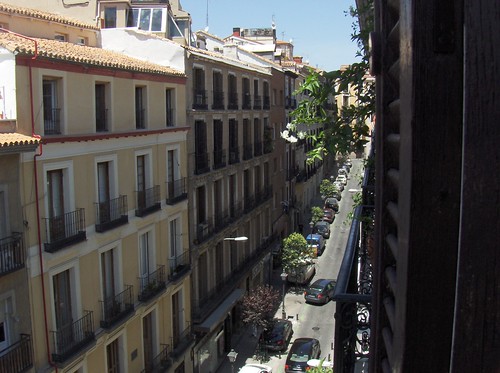
Yes, the delightful "view from the suite, onto the street below". Aye, gentle readers, there's the rub. Let's try adding a few appropriate adjectival phrases to that previous sentence.
"onto the incredibly noisy street, populated by loud, drunken pedestrians and garbage trucks that would raise the dead that pass by at all hours of the morning".
So there's that. A little bit of a noise problem. Which can be addressed, at least in part, by shutting the windows ( a reasonably tight seal) and the heavy wooden shutters. Except that this strategy leads to a little bit of a heat problem at night. Causing the kind of sweaty tossing and turning that is wholly unconducive to getting a good night's sleep.
God, I barely remember what a good night's sleep feels like.
But tonight I have a plan. I have my specially purchased earplugs from the Farmácia, and intend to use them. So that instead of tossing and turning, worrying about balancing the heat and the noise, I can instead toss and turn, obsessing about being unable to get the earplugs out of my ears ever again. Because you know I will. Obsess, that is.
I wonder if Spanish sign language is very different from American sign language?
Good night, gentle readers. Sleep tight.
Ot to make my point using a different cliché, be careful what you wish for. Recall, that when I was waxing rhapsodic about the virtues of the suite, one photograph adduced as supporting evidence was the following:
Yes, the delightful "view from the suite, onto the street below". Aye, gentle readers, there's the rub. Let's try adding a few appropriate adjectival phrases to that previous sentence.
"onto the incredibly noisy street, populated by loud, drunken pedestrians and garbage trucks that would raise the dead that pass by at all hours of the morning".
So there's that. A little bit of a noise problem. Which can be addressed, at least in part, by shutting the windows ( a reasonably tight seal) and the heavy wooden shutters. Except that this strategy leads to a little bit of a heat problem at night. Causing the kind of sweaty tossing and turning that is wholly unconducive to getting a good night's sleep.
God, I barely remember what a good night's sleep feels like.
But tonight I have a plan. I have my specially purchased earplugs from the Farmácia, and intend to use them. So that instead of tossing and turning, worrying about balancing the heat and the noise, I can instead toss and turn, obsessing about being unable to get the earplugs out of my ears ever again. Because you know I will. Obsess, that is.
I wonder if Spanish sign language is very different from American sign language?
Good night, gentle readers. Sleep tight.
Seated in the Courtyard in the Alhambra
From A FAR ROCKAWAY OF THE HEART
#76 Seated in the Courtyard in the Alhambra
by Lawrence Ferlinghetti
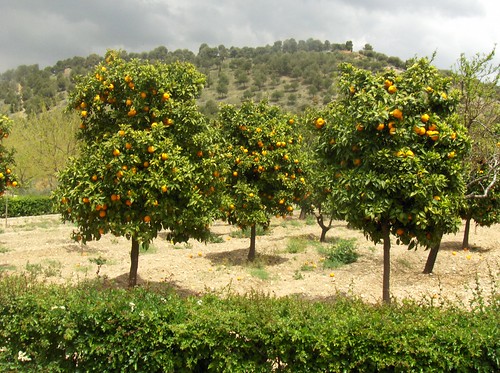
In the gardens of the Alhambra
I stole a small orange and ate it
The pulp dry and bitter
and the juice
(acrid as an arab driven from his land)
made a desert of my mouth
and shriveled up my tongue
in the Sultan's last revenge
And I fell upon the ground
in a deep swoon
Deep as the duende
in a gypsy's keening
#76 Seated in the Courtyard in the Alhambra
by Lawrence Ferlinghetti
In the gardens of the Alhambra
I stole a small orange and ate it
The pulp dry and bitter
and the juice
(acrid as an arab driven from his land)
made a desert of my mouth
and shriveled up my tongue
in the Sultan's last revenge
And I fell upon the ground
in a deep swoon
Deep as the duende
in a gypsy's keening
Candle Hat


Candle Hat
by Billy Collins
In most self-portraits it is the face that dominates:
Cezanne is a pair of eyes swimming in brushstrokes,
Van Gogh stares out of a halo of swirling darkness,
Rembrant looks relieved as if he were taking a breather
from painting The Blinding of Sampson.
But in this one Goya stands well back from the mirror
and is seen posed in the clutter of his studio
addressing a canvas tilted back on a tall easel.
He appears to be smiling out at us as if he knew
we would be amused by the extraordinary hat on his head
which is fitted around the brim with candle holders,
a device that allowed him to work into the night.
You can only wonder what it would be like
to be wearing such a chandelier on your head
as if you were a walking dining room or concert hall.
But once you see this hat there is no need to read
any biography of Goya or to memorize his dates.
To understand Goya you only have to imagine him
lighting the candles one by one, then placing
the hat on his head, ready for a night of work.
Imagine him surprising his wife with his new invention,
the laughing like a birthday cake when she saw the glow.
Imagine him flickering through the rooms of his house
with all the shadows flying across the walls.
Imagine a lost traveler knocking on his door
one dark night in the hill country of Spain.
"Come in, " he would say, "I was just painting myself,"
as he stood in the doorway holding up the wand of a brush,
illuminated in the blaze of his famous candle hat.
Monday, July 16, 2007
Bourbon and water

Little baby Sofía was baptised yesterday. That's her, wearing the same christening outfit her sister and her daddy wore in their day. The baptismal font is also some kind of ancient relic, as is the arzebispo cardinal of Madrid. According to my reliable sources, the water in the baptismal font came straight from the river Jordan (insert lame joke about being flown in by Jordan-Air here ad lib).

Here is the Infanta, along with her older sister Leonor (ahead of her in the succession line), her parents and her grandparents. The lady in the pantsuit, holding Leonor, is the queen. Far left and far right are Doña Letizia's parents. Presumably glad that their daughter is adding a bit of variety to the Bourbon gene pool. Interestingly, Letizia's mother and father are now divorced, and her dad has found himself a new trophy wife. For purposes of official photographs, however, aforementioned new trophy wife simply does not exist.

Who have we here? You don't really want all the details, do you? Oh, very well. Back row - assorted duques of hazzard (i.e. the Príncipe's two older sisters and their aristocratty husbands); brunette in the back row is Letizia's sister. Joining the parents and grandparents in the front row are the surviving great-grandparents, all on Letizia's side. Letizia's maternal grandmother seems to have color-coordinated her outfit with the queen. Front row, assorted royal brats (I mean cousins, of course), future Eurotrash. The kid on the right is called Froílan, or something equally improbable.

And with this charming picture of Leonor and the new Christian, we will have to leave things for today. Even my saturation point has been reached. A little Bourbon goes a long way, especially when diluted with water.
Sunday, July 15, 2007
Saturday, July 14, 2007
Of pride and the fall
So this evening, for dinner, I went back to the ribs place. I had bought my copy of El País, and alternated during dinner between reading what the Spaniards think of David Foster Wallace's latest offering "Hablamos de Langostas" (Consider the Lobster) and watching the E-Spanish bersion of that ever-popular American TV staple - the woman who is so fat that she is unable to get out of bed. Parenthetical note - by American standards, the E-spanish señora was a mere piker, weighing in at a puny 210 kg, not even coming close to the 500-pound mark; they don't even pay attention on the Maury Povitch show unless someone is at least 900 lb and needs assistance breaking down the wall of the trailer in order to get out of bed.
Anyway, the ribs were juicy, the waiter was friendly, helping me with vocabulary words, and I was feeling pretty good about my life in general, and my Spanish knowledge in particular. Can you spell P - R - I - D - E ?
The waiter returns with the dessert menu. Nothing piques my appetite, so I decide instead to have a liqueur. With unwarranted self-satisfaction, I order a Drambuie with "un poquito de helado". The waiter seems surprised? Am I sure? Mutual confusion for a half a minute or so, until the penny finally drops. The word for "ice" is not "helado", dammit, it's "hielo".
Though, come to think of it, Drambuie and ice-cream sounds like a pretty decent combination too.
At least the waiter was kind enough not to offer to bring me the English version of the menu.
Anyway, the ribs were juicy, the waiter was friendly, helping me with vocabulary words, and I was feeling pretty good about my life in general, and my Spanish knowledge in particular. Can you spell P - R - I - D - E ?
The waiter returns with the dessert menu. Nothing piques my appetite, so I decide instead to have a liqueur. With unwarranted self-satisfaction, I order a Drambuie with "un poquito de helado". The waiter seems surprised? Am I sure? Mutual confusion for a half a minute or so, until the penny finally drops. The word for "ice" is not "helado", dammit, it's "hielo".
Though, come to think of it, Drambuie and ice-cream sounds like a pretty decent combination too.
At least the waiter was kind enough not to offer to bring me the English version of the menu.
Friday, July 13, 2007
Torn
I knew nothing about Natalie Imbruglia before seeing these videos:
http://www.youtube.com/watch?v=mgT-rZAVdTM
http://www.youtube.com/watch?v=osnUB9bUm-E
Got to give her major points for good humor and charm.
http://www.youtube.com/watch?v=mgT-rZAVdTM
http://www.youtube.com/watch?v=osnUB9bUm-E
Got to give her major points for good humor and charm.
Bun-o-vision
As part of our commitment to scouring the internet for the good stuff so that you can spend your time at work shopping on E-Bay, here is a link to the exciting and entertaining Bun-o-Vision site.
http://www.angryalien.com/
Rabbits re-enacting major Hollywood movies in 30 second summaries - what's not to love?
http://www.angryalien.com/
Rabbits re-enacting major Hollywood movies in 30 second summaries - what's not to love?
1000 demons
As I close in on my final week here in Madrid, I begin, very cautiously, to breathe a slow sigh of relief. One of the worries about scheduling a three-month stay, to span the months of May, June, and July was - well - July in Madrid. Whenever I would mention to a Spaniard that I was planning to be in Madrid during July, there would be an inevitable furrowing of the brow, followed by deployment of the phrase "un calor de mil demonios" (the heat of a thousand demons).
But, I am relieved to report, so far things have been entirely soportable. While daytime temperatures have occasionally climbed to the mid-90's, there is a general cooling off at night, and the humidity has been reasonable.
I have my own theory as to why this has been the case. It is my belief that many of the hard-working heat demons have been seconded by Pope Rat-zinger to the newly reopened infierno, to deploy their little toasting forks in poking at Jerry Falwell and his ilk. This leaves central Spain suffering a seasonal shortage of demons, accounting for the relatively tolerable summer temperatures. Exact figures are hard to come by, but if one thinks that each circle of hell would need 100 demons as a skeleton crew, this leaves a maximum of 100 for Madrid.
I am working on an exact equation to convert the number of demons to degrees Fahrenheit, but my formula is not quite ready for prime time. Here, however, is how to convert temperatures from Fahrenheit to Celsius, and vice versa:
But, I am relieved to report, so far things have been entirely soportable. While daytime temperatures have occasionally climbed to the mid-90's, there is a general cooling off at night, and the humidity has been reasonable.
I have my own theory as to why this has been the case. It is my belief that many of the hard-working heat demons have been seconded by Pope Rat-zinger to the newly reopened infierno, to deploy their little toasting forks in poking at Jerry Falwell and his ilk. This leaves central Spain suffering a seasonal shortage of demons, accounting for the relatively tolerable summer temperatures. Exact figures are hard to come by, but if one thinks that each circle of hell would need 100 demons as a skeleton crew, this leaves a maximum of 100 for Madrid.
I am working on an exact equation to convert the number of demons to degrees Fahrenheit, but my formula is not quite ready for prime time. Here, however, is how to convert temperatures from Fahrenheit to Celsius, and vice versa:
F = 32 + (9/5) x C
C = (5/9) x (F - 32)
Thursday, July 5, 2007
On hiatus
To those of you panting for torrid accounts of my torrid adventures in torrid Madrid, I must apologize for the gap between transmissions. Regular blogging will resume next week.
Sunday, July 1, 2007
Three odd words
Here are examples of some Spanish words I find odd or noteworthy:
- liderazgo : leadership (with the kind of etymology that presumably gives members of the RAE, the Real Academia Española, the fantods, deriving as it does from the Spanglish "líder").
- esdrújulo/a : bearing the stress on the antepenultimate syllable (example - "esdrújula"); what surprises me about this word is its very existence.
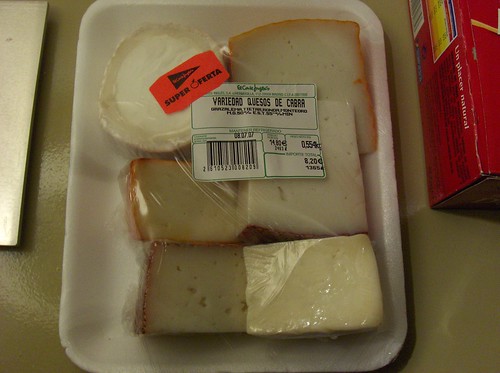
- celestina : a procuress, or madam. Such a mellifluous word deserves a less shabby meaning.
Famous depictions of la celestina in art include those by Picasso and Sorolla (see Friday's post):


Saturday, June 30, 2007
In the suite
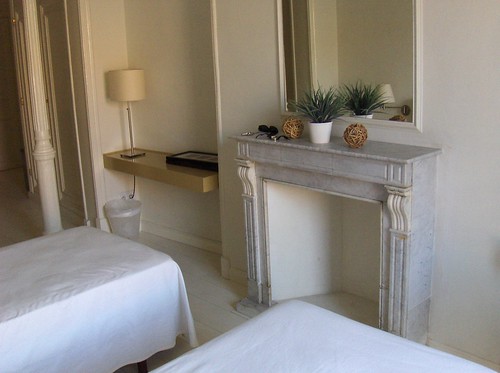
Whee! Today is my first exciting day in the suite where I will be staying for the rest of my time here in Madrid.
Here is a picture:
To take the virtual tour (picture of my private bathroom not included), visit this link
http://www.flickr.com/photos/gaelstat/sets/72157600570599303/
And try not to be too jealous, OK?
Here is a picture:
To take the virtual tour (picture of my private bathroom not included), visit this link
http://www.flickr.com/photos/gaelstat/sets/72157600570599303/
And try not to be too jealous, OK?
Friday, June 29, 2007
El segúrometro
WARNING: oddly idiosyncratic rant ahead.
I assume that one purpose of a blog is to function as a useful channel for venting. So that's what this post is about. Something I need to get off my chest. Something unashamedly geekish, I might add. So don't say you weren't warned.
Here's the thing. Every language has its peculiarities, and Spanish is no exception. For anyone trying to learn Spanish, one striking and frustrating feature of the language is its apparent obsession with the speaker's degree of certainty. Of course, it is possible in Spanish to utter a simple declarative statement: "Begoña wore a blue dress", for instance. As a general rule, such simple declarations of fact pose no particular problem.
Should you, however, depart from the realm of objectively ascertainable facts, then - to put it mildly - all hell breaks loose. For now you have entered into the shadowy world of opinion, conjecture, and supposition, a morass from which you cannot hope to emerge unscathed. For some odd reason, should you depart, even in the slightest degree, from a state of absolute certainty, a huge spectrum of expressions and idioms opens up before you, ranging from the mildest conjecture ("Maybe Begoña was wearing a dress. It could have been blue. I really couldn't say for sure") to a high degree of confidence ("I'm pretty sure Begoña was wearing that blue dress she wore at her sister's wedding") to near-certainty. Or anything along the continuum of probability from complete ignorance to absolute certainty. Here is a small sampling:
and whatever you're having yourself.
What's the problem? Well, for one thing, some of these expressions are followed by the indicative, some by the subjunctive, some by either indicative or subjunctive (depending on, you've guessed it, the teachers' favorite copout, "the context"). And you'd better get it right, because if you don't you will immediately mark yourself as an ignorant foreigner, whose command of the language is surpassed by any Spanish ten-year old. Furthermore - and this is the kernel of my rant - apparently, each of the expressions above represents an exquisitely calibrated tick-mark along the spectrum of certainty. Even worse, there is complete unanimity among all teachers of Spanish that it is the responsibility of every educated person to be able to associate each expression with its corresponding degree of certainty, whether one is using such an expression oneself, or trying to understand what someone else is saying.
Diagrammatically:

If you've read this far, thank you for your indulgence. I feel much better now that I've gotten that off my chest. Next post will be back to our regularly scheduled blogging, with some useful information about the wines of Spain.
I assume that one purpose of a blog is to function as a useful channel for venting. So that's what this post is about. Something I need to get off my chest. Something unashamedly geekish, I might add. So don't say you weren't warned.
Here's the thing. Every language has its peculiarities, and Spanish is no exception. For anyone trying to learn Spanish, one striking and frustrating feature of the language is its apparent obsession with the speaker's degree of certainty. Of course, it is possible in Spanish to utter a simple declarative statement: "Begoña wore a blue dress", for instance. As a general rule, such simple declarations of fact pose no particular problem.
Should you, however, depart from the realm of objectively ascertainable facts, then - to put it mildly - all hell breaks loose. For now you have entered into the shadowy world of opinion, conjecture, and supposition, a morass from which you cannot hope to emerge unscathed. For some odd reason, should you depart, even in the slightest degree, from a state of absolute certainty, a huge spectrum of expressions and idioms opens up before you, ranging from the mildest conjecture ("Maybe Begoña was wearing a dress. It could have been blue. I really couldn't say for sure") to a high degree of confidence ("I'm pretty sure Begoña was wearing that blue dress she wore at her sister's wedding") to near-certainty. Or anything along the continuum of probability from complete ignorance to absolute certainty. Here is a small sampling:
- Creo que
- Me parece que
- Supongo que
- Se supone que
- Me imagino
- Seguro que
- Estoy seguro de que
- Es seguro
- Para mí
- Yo diría
- Eso es
- Es probable que
- Es posible que
- Puede ser
- Puede
- Quizás
- Tal vez
- Probablamente
- Posiblemente
- A lo mejor
- Igual
- Lo mismo
and whatever you're having yourself.
What's the problem? Well, for one thing, some of these expressions are followed by the indicative, some by the subjunctive, some by either indicative or subjunctive (depending on, you've guessed it, the teachers' favorite copout, "the context"). And you'd better get it right, because if you don't you will immediately mark yourself as an ignorant foreigner, whose command of the language is surpassed by any Spanish ten-year old. Furthermore - and this is the kernel of my rant - apparently, each of the expressions above represents an exquisitely calibrated tick-mark along the spectrum of certainty. Even worse, there is complete unanimity among all teachers of Spanish that it is the responsibility of every educated person to be able to associate each expression with its corresponding degree of certainty, whether one is using such an expression oneself, or trying to understand what someone else is saying.
Diagrammatically:

if we think of "F" a representing a state of complete certainty, and "E" that of total ignorance, or sheer conjecture, then apparently, it matters - a lot - to your average Spanish speaker, just where one's opinion lies along the spectrum in between. Hence the bewildering plethora of expressions, not to mention the hideous indicative-subjunctive wrinkle.
Gentle readers, I don't wish to brag. But I do have a Ph.D. in statistics, so it's fair to say that I know a thing or two about probability. When this odd Spanish fascination with specifying the exact nuances of a speaker's degree of certainty was explained to me, my immediate thought (after "you've got to be kidding me!") was how inefficient the whole system was. All those phrases, and still no guarantee that each speaker is measuring by the same yardstick: Jose's "me parece que" may or not correspond to the same degree of belief as Maria's, leading to confusion all around. So my INTJ brain immediately came up with a brilliant alternative - namely that everyone could carry a little calibrated semicircular disc, with a movable arrow, along the lines of the fuel gauge pictured above, simply move the arrow along the continuum until the desired certainty point is reached, and Bob's your uncle. Thus, if I am 71% sure that Begoña was wearing that damned blue dress, I can indicate as much with a simple flick of the wrist. No fuss, no muss, no confusion.
Yes, yes - of course I understand the potential pitfalls. Before long the cool kids will be less than satisfied with the cumbersome, manually operated analog display. Inevitably, the gizmo will undergo the same kinds of developments as the wristwatch - digital displays, accessorization in different colors, use as a status symbol. Divers will want their instruments depth-proofed. But we know that these technological challenges can be met. And if the society cares so deeply about communicating the exactly nuanced shade of belief, then this solution seems like a bold, crisp, new alternative to the ambiguous thicket of phrases, moods, and tenses that currently ensnares the learner. ¡Hola, Juan! estoy 83.456% seguro de que Begoña ..... Of course, you'd still have the indicative/subjunctive choice to make. But a simple default rule (e.g. less than 50% - subjunctive, otherwise indicative) would work well.
Sadly, I regret to say that, when I have presented my proposal in class, it has been met with eye-rolling disapproval and dismissive contempt by sundry teachers. I can only conclude that the sheer genius-like simplicity of the proposal makes them nervous by threatening their job security.
Until this week, that is. We were (yet again!) reviewing the hideous list of phrases above and (yet again!) trying to figure out which took the indicative form of the verb, which the subjunctive. When suddenly, in the margin of the text, I noticed what - at first glance - appeared to be a thermometer:
Oddly enough, a thermometer that appeared to be graded from 0 to 100%. Then I read the word next to it. Sure enough, gentle readers, it said "segúrometro", and was being used to locate each of the phrases above along a spectrum of probability from 0 to 100%.
So here is the essence of my rant. For proposing a device already used in their own pedagogical materials I was subjected to mockery and abuse by my teachers. When (after all, I am an INTJ) I pointed out the injustice of this (in a good-natured way) - stares of bovine incomprehension. The complete isomorphism between the fuel gauge display and the thermometer display was apparently too much to grasp.If you've read this far, thank you for your indulgence. I feel much better now that I've gotten that off my chest. Next post will be back to our regularly scheduled blogging, with some useful information about the wines of Spain.
El pintor de la luz

"El pintor de la luz". Horrifyingly, in English this phrase has been appropriated by one Thomas Kinkade (The Painter of Light TM), to the extent that Media Arts Group, the company that peddles his work to the public at large, has somehow managed to trademark the phrase. "How can such things be?" you ask. I have no idea. As this is a family blog, and I have no desire to be accused of contributing to the corruption of the artistic taste of any children who might be exposed to its contents, I will spare you any visual depictions of what Laura Miller, book critic for Salon.com, describes memorably as:
Kinkade's weirdly compelling images of snug stone cottages whose unimaginably cozy interiors send an amber glow cascading out over their radioactively colorful gardens in the violet light of dusk.
For her entertaining review of Kinkade's literary efforts, follow this link:
The Writer of Dreck TM
Fortunately, where art is concerned, the Spanish are a little more selective. El pintor de la luz (not trademarked) refers not to el maestro de kitsch TM , but to the painter Joaquin Sorolla y Bastida, born in Valencia in 1863.
artrenewal.org link for sorolla (83 paintings)
Kinkade's weirdly compelling images of snug stone cottages whose unimaginably cozy interiors send an amber glow cascading out over their radioactively colorful gardens in the violet light of dusk.
For her entertaining review of Kinkade's literary efforts, follow this link:
The Writer of Dreck TM
Fortunately, where art is concerned, the Spanish are a little more selective. El pintor de la luz (not trademarked) refers not to el maestro de kitsch TM , but to the painter Joaquin Sorolla y Bastida, born in Valencia in 1863.
artrenewal.org link for sorolla (83 paintings)


Why am I telling you about Sorolla this evening? Because he was the subject of this evening's culture class. Which reminded me that our trip to the Museo Sorolla was one of the high points of Paddy's visit a few weeks ago. The museum is located in the artist's former home, and is an oasis of serenity on one of Madrid's busier traffic arteries. In addition to being filled with Sorolla's work, and some wonderful period furniture, the house is suffused with a kind of joy - it is obvious that the family who lived there was a happy and loving one. Here is a link to the museum's website:
Joaquin Sorolla y Bastida : el verdadero pintor de la luz.
Super laz-i-blog mode
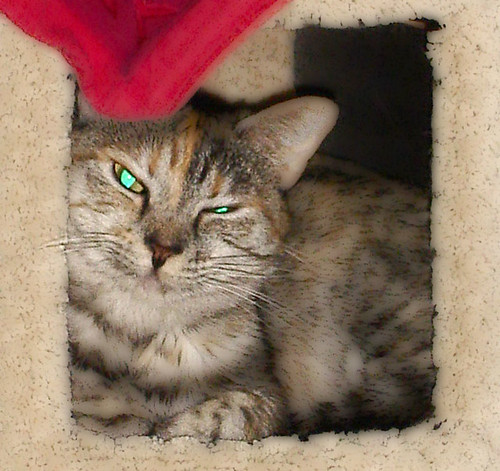
Laz-i-blog mode is when I am too lazy to check the factual accuracy of whatever I write. Super laz-i-blog mode is when I am too lazy to bother to write anything of substance. Relying instead on cute pictures of my pets to carry the day.
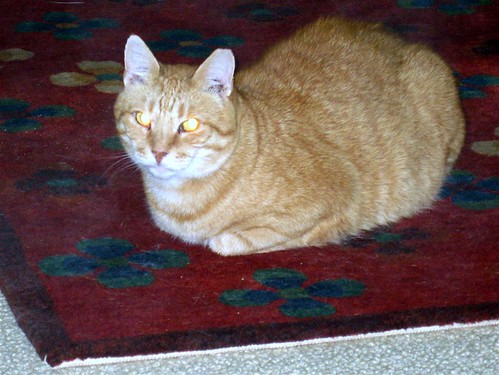
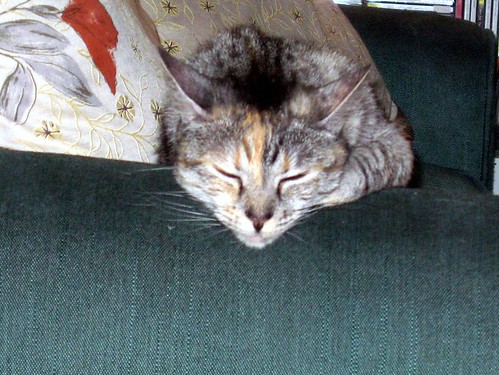
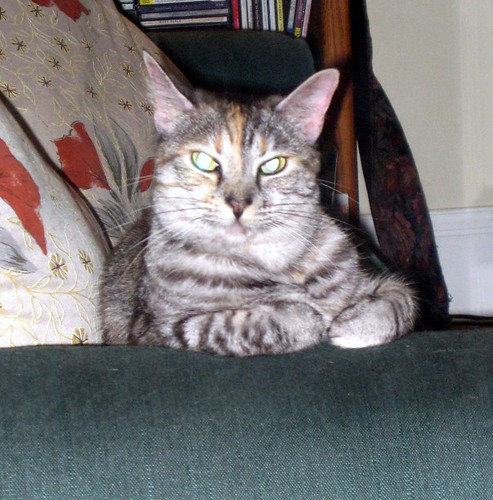
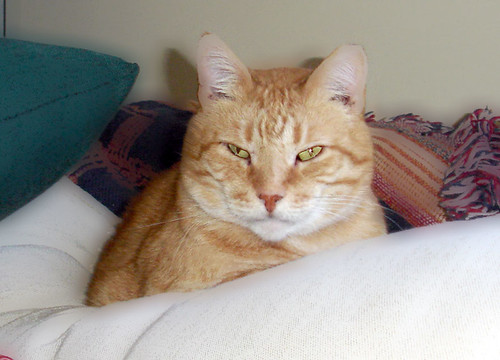
The plain people of Ireland: Begob, but it looks like that marmalade cat is finally getting his weight under control.
The management: Silence, wretches! As I've told you before, Boris is not fat, he is merely big-boned. But now that you mention it, he does look a little slimmer - and more handsome than ever - in the picture above.
The plain people of Ireland: Begob, but it looks like that marmalade cat is finally getting his weight under control.
The management: Silence, wretches! As I've told you before, Boris is not fat, he is merely big-boned. But now that you mention it, he does look a little slimmer - and more handsome than ever - in the picture above.
Subscribe to:
Posts (Atom)


