Tuesday, September 16, 2008

A City of Readers

a culture of reading

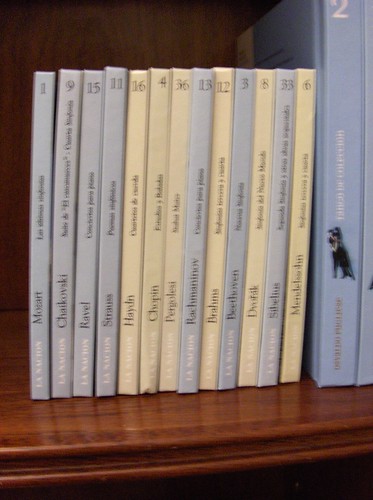
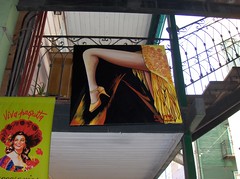
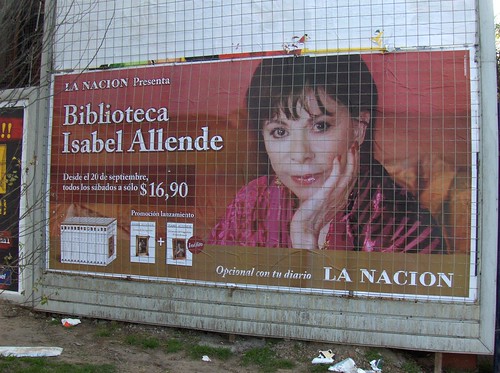
I've mentioned, ad nauseam, how inexpensive books are here in Buenos Aires. The picture above depicts one of the factors contributing to this phenomenon. Beginning on Saturday, readers of "La Nación", one of the two main papers here in Buenos Aires (the other is "El Clarín"), will have the option of picking up one of Isabel Allende's novels with their paper, at a special price of only 16.90 pesos, or about 5.50 US dollars. If past experience with similar promotions is any guide, by Christmas time one will be able to pick up Allende's books in any of the many bookstores on the Avenida Corrientes for only 10 pesos apiece.

It's promotions like this one that have enabled me to pick up the works of Borges for 10 pesos a book, classical CD recordings for 6 pesos apiece. This type of promotion was also very common in Madrid, though the prices were a bit higher. It generally supports the notion that the newspaper readers of Buenos Aires are a fairly cultured bunch. Certainly more so than their counterparts in San Francisco, or almost any other U.S. city one might care to mention - I could never imagine this happening in the United States. Time-Life books, and certain Reader's Digest classical music collections come to mind, but from a bygone age, and I doubt any newspaper could pull it off in their local city.

Further anecdotal evidence of a more deeply entrenched local reading habit is provided by Rafael, the waiter (mozo) at my favorite local restaurant, who gives me regular recommendations on what I should be reading. (As well as a remarkable impromptu discussion of the relative merits of Borges and Cortázar, the two giants of 20th century Argentine literature, which came completely out of the blue on Friday evening; remarkable both for the cogency of the points he made, as well as the passion with which he made them). Nestor, doorman of the building in which the school is located (i.e. just a regular midtown office building), has also come through with some excellent recommendations.

Maybe I've just been lucky. Maybe I'm unconsciously filtering my experiences to fit some preconceived notion of a highly literate local population. But I don't think so - the dozens of books stores within eight or ten blocks of my home also suggest otherwise.

A booklover's paradise. Which is to say, an enormous occasion of sin* for yours truly. One that extends for miles in every direction.

*: a technical Catholic term, meaning a source of great temptation from which a good Catholic should immediately extract himself. (Not a chance)

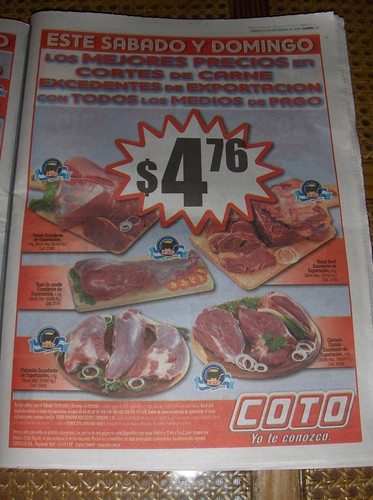
MEAT!!!!! (It's what's for dinner)

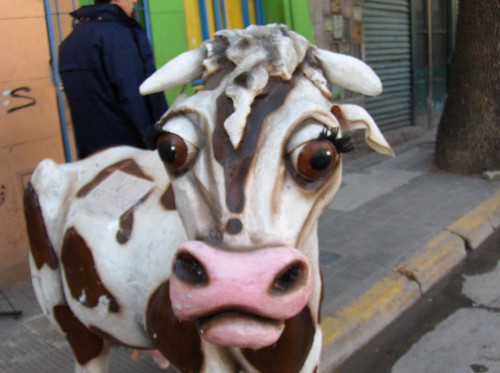
meat!!

lots of meat!!

Personally, it'll be a cold day in hell before you catch me putting something called "MONDONGO" in my mouth. It sounds so ...... NASTY..... somehow. And - let's be honest here - "CHÍNCHULÍN" doesn't sound a whole lot better, does it now?

Monday, September 15, 2008

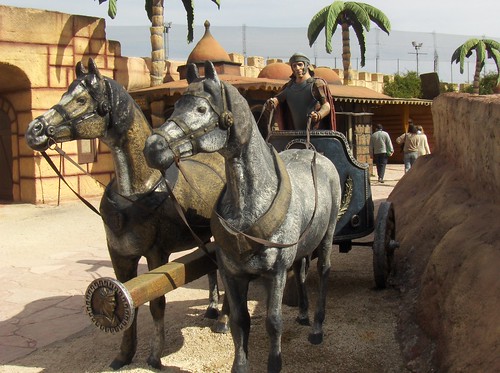
At the theme park

Things started out normally enough yesterday afternoon. As I left the apartment, my plan was straightforward - head for the Japanese garden in Palermo, in search of a little serenity. An hour later, I felt like I had stumbled into a bad Graham Greene novel. What was I doing wandering around "Tierra Santa", Buenos Aires' incredibly bizarre Christian theme park? Why were the park staff dressed like mujahadeen? What was the significance of the number 37? Why was the oddly flirtatious Armenian lady at the concession stand offering to read my fortune in the dregs of the bitter-tasting Armenian coffee I had - perhaps foolishly - just consumed? Was there a Viennese Ferris Wheel somewhere in my immediate future?

Well, no. Apparently not. The number 37 bus took me right back to Cordoba Street where I had boarded it in the first place. But if there is a moral to the story it is surely - when someone (in this case, the porter in the apartment building) suggests to you that you really have to visit this "historical theme park" that is "lo mas lindo que hay en todo Buenos Aires" (the most beautiful attraction in all of B.A.), do a little more homework before taking the bait. This might have revealed, for example, that "historical" was apparently code for "Christian", and that beauty is definitely in the eye of the beholder.


The place is enormous. Right by the airport. With that kind of bizarrely hideous ugliness that ends up having a fascinating charm of its own. The photos are on Flickr. Judge for yourself. I omitted those with the most blatantly obnoxious Catholic flavour.

It was a strange afternoon. But there was belly dancing, falafels, and remarkably good baklava. And the manger sound-and-light show was impressive enough in its own way. I skipped the Creation show. The Crucifixion too. Lines were long, even though you would think people know how it all turned out.


christian_theme_park 012

Sunday, September 14, 2008

David Foster Wallace, RIP

The American author David Foster Wallace, probably the most brilliant of his generation, hanged himself at his home in Pomona, California, on Friday evening. He was 46 years old. When I read this, I was chilled, and deeply saddened. To explain why, I include below reviews I wrote of two of his books ("A Supposedly Fun Thing I'll Never Do Again" and "Consider the Lobster").

Not all of Wallace's writing worked for me - I definitely preferred his collections of shorter pieces. "Oblivion" and "Girl with the Curious Hair" are also well worth reading; I found the bleakness of "Brief Interviews with Hideous Men" too much to bear, and would be afraid to read it again, given the author's suicide. But even when he failed, he did so magnificently, in my opinion. There was an exuberant, over-the-top quality to his writing that was never less than exciting.


Consider The Lobster

Full disclosure: I have a major intellectual crush on David Foster Wallace. Yes, yes, I know all about his weaknesses - the digressions, the rampant footnote abuse, the flaunting of his amazing erudition, the mess that is 'Infinite Jest'. I know all this, and I don't care. Because when he is in top form, there's nobody else I would rather read. The man is hilarious; I think he's a mensch, and I don't believe he parades his erudition just to prove how smart he is. I think he can't help himself - it's a consequence of his wide-ranging curiosity. At heart he's a geek, but a charming, hyper-articulate geek. Who is almost frighteningly smart.

The pieces in “Consider the Lobster” have appeared previously in Rolling Stone, The Atlantic Monthly, the New York Observer, the Philadelphia Enquirer, Harper’s, Gourmet, and Premiere magazines. Among them are short meditations on Updike’s ‘Toward the end of Time’, on Dostoyevsky, on Kafka’s humor, and on the ‘breathtakingly insipid autobiography’ of tennis player Tracy Austin. An intermediate length piece describes Foster Wallace’s (eminently sane) reaction to the attacks of September 11th. Each of these shorter essays is interesting, but the meat and potatoes of the book is in the remaining five, considerably longer, pieces. They are:

Big Red Son: a report on the 1998 Adult Video News awards (the Oscars of porn) in Las Vegas.
Consider the Lobster: a report on a visit to the annual Maine Lobster Festival (for Gourmet magazine).
Host: a report on conservative talk radio, based on extensive interviews conducted with John Ziegler, host of “Live and Local” on Southern California’s KFI.
Up Simba: an account of seven days on the campaign trail with John McCain in his 2000 presidential bid (for Rolling Stone).
Authority and American Usage: a review of Bryan Garner’s “A Dictionary of Modern American Usage” , which serves as a springboard for a terrific exegesis of usage questions and controversies.

Here’s what I like about David Foster Wallace’s writing: I know of nobody else who writes as thoughtfully and intelligently. That he manages to write so informatively, with humor and genuine wit, on almost any subject under the sun is mind-blowing – it’s also why I am willing to forgive his occasional stylistic excesses. (Can you spell ‘footnote’?) You may not have a strong interest in lobsters or pornography, but the essays in question are terrific. The reporting on Ziegler and McCain is amazingly good, heartbreakingly so, because it makes the relative shallowness of most other political reporting painfully evident. Finally, the article on usage is a tour de force – when it first appeared in Harper’s, upon finishing it, I was immediately moved to go online and order a copy of Garner’s book (which is just as good as DFW promised).

How can you not enjoy an essay that begins as follows?

"Did you know that probing the seamy underbelly of US lexicography reveals ideological strife and controversy and intrigue and nastiness and fervor on a near Lewinskian scale?

....... (several other rhetorical questions) ......

Did you know that US lexicography even had a seamy underbelly? "

And which later contains sentences such as:
"Teachers who do this are dumb.
This argument is not quite the barrel of drugged trout that Methodological Descriptivism was, but it’s still vulnerable to objections."
and – my personal favorite –
"This is so stupid it practically drools. "


A Supposedly Fun Thing I'll Never Do Again

David Foster Wallace is one awesomely smart guy. This is both his greatest strength and his potential Achilles heel as a writer. Personally, I will read anything this man writes, because I think he is a true genius with a rare sense of compassion, and a hilarious sense of humor. Even when his writing falls victim to its own cleverness, I still find it worthwhile - perhaps because one senses that the writer is a true mensch (not something I feel when being dazzled by the cleverness of a Dave Eggers, for instance).

Oh hell, I want to be seated next to DFW on a long transpacific flight subject to major delays, OK? I have an enormous intellectual crush on this man. And when I cavil, it is done out of love, pure and simple. But when discussing this book of his, caviling would simply be out of place. It contains two of the funniest essays I have ever read in my life (the descriptions of his experiences on a cruise liner and at the state fair, respectively). I think you should buy your own copy, because I certainly am not going to loan you mine.


May he, and his family and friends, find peace. The world is poorer for his death.

Saturday, September 13, 2008

Hemorrhoid Cream Puffs and Tanning Bed Wetters

Sometimes, in my private moments, I play little word games in my head to keep myself amused*. Here are the results of one of them. The rules should become obvious after you read a few of the entries on the list. Please feel free to add your own:
  • humble pie chart
  • agent orange juice
  • oedipus complex numbers
  • three-legged stool pigeon
  • fertile crescent wrench
  • molotov cocktail waitress
  • holland tunnel vision
  • friendly fire hydrant
  • strip club sandwich
  • healing miracle whip
  • henry james bond
  • banana split decision
  • french window dressing
  • unmitigated gallstones
  • potemkin village idiot
  • genghis khan do
  • cold cereal killer
  • mickey finn McCool
  • polka dot matrix
  • equatorial guinea pig
  • venetian blind ambition
  • midnight's children of the corn
  • dead weight watchers
  • donner party favors
  • cauliflower earwig
  • pork belly laugh
  • suckling pig latin
  • grizzly bear necessities
  • funeral home economics
  • sacher torte law
  • irish jig-saw puzzle
  • poison ivy league
  • cricket bat guano
  • ceiling fan mail
  • st elmo's fire and brimstone
  • lazy susan sarandon
  • merry andrew jackson
  • palme d'or knob
  • tasmanian devil-may-care
  • disgruntled employee benefits
  • swiss navy bean
  • static cling peach
  • mars bar graph
  • bowel motion detector
  • hammurabi code talkers
  • honey mustard gas
  • lunch counter terrorism
  • single-malt scotch terrier
  • southsea bubble wrap
  • celestial body search
  • episcopal see saw
  • eggs benedict arnold
  • trojan horse sense
  • combination lockjaw
  • styrofoam peanut gallery
  • emotional baggage carousel
  • sonnets from the portuguese man o'war
  • unrequited love handles
  • grand theft auto-da-fé
Here are some with a pseudo-scientific flavor:
  • square root vegetable
  • eigenvalue added tax
  • periodic table manners
  • twisted sister chromatid
  • möbius strip tease
  • brownian motion sickness
  • planck's constant complaining
  • schrödinger's cat's pajamas
  • newton's apple pie

Finally, here are a few where we stretch the rules a little bit:
  • caterpillar of salt
  • panama canal leakage
  • rum raisin d'être

* It's not playing the little games in my head that's the problem so much as not being able to stop.

A Clerihew

Jorge Luis Borges
wasn't invited to many orgies.
A pity really, because his books might be a trifle less boring,
if, as a youngster, Jorge had done a little less reading and a lot more whoring.

What's that? You'd like it in Thpanish? Well, let's give it a whirl.
But respecting the clerihew style is a little too much to ask.

Borges, aunque sea genial,
me parece, a veces, demasiado cerebral.
Quizás, en lugar de leer tantos libros clásicos,
habría sido mejor si hubiera prestado más atención a sus instintos básicos.

Thursday, September 11, 2008

Four Villon Translations

Four translations of Villon's "Ballade de bonne doctrine a ceux de mauvaise vie" (~1461)


Ballad of Good Doctrine
To Those of Evil Life (H. De Vere stacpoole, 1914)

Ye who be smugglers of papal bulls,
Or cheaters at dice, whatever be ye --
Coiners who risk life and limb like fools,
Then boil in hot oil for their felony,
Traitors disloyal -- ye know who ye be --
Stealers of jewels, of perfume and pearls:
So where goes it all, that ye get in fee?
All to the taverns and to the girls.

Rhyming and jesting, cymbals and lutes --
Don ye these emblems of minstrelsy.
Farce and imbroglio, music of flutes --
Try these in hamlets or Gay Paree.
Go mumming in masque or mystery,
Win money at cards, or at ninepin hurls.
But 'tis of no use1 It'll flow, hear ye me,
All to the taverns and to the girls.

Ye shrink before such a hard-knocks school --
Play safe, then, with honester husbandry:
Of horses be grooms, go tend to a mule,
Plow ye the fields, here and there plant a tree.
And should ye be short on Latinity,
As lowly in learning as poor pleasant churls,
Just work, lest your hard-earned pennies flee
All to the taverns and to the girls.

Envoi:

Your stockings and doublets, your fine drapery,
Every last rag that around ye furls,
Ere ye be done, will have slipped, ye shall see,
All to the taverns and to the girls.


BALLAD OF GOOD DOCTRINE TO
THOSE OF ILL LIFE. John Payne

SMUGGLE indulgences, as you may:
Cog the dice for your cheating throws.
Try if counterfeit coin will pay,
At the risk of losing your ears and nose :
Deal but in treason, lie and glose,
Rob and ravish : what profits it ?
Where do you think the money goes ?
Taverns and wenches, every whit.

Flute and juggle and cymbals play :
Follow the mountebanks and their shows :
Along with the strolling players stray,
That wander whither God onlv knows :
Act mysteries, farces, imbroglios :
Gain money by cards or a lucky hit
At the pins : however if s got, it goes :
Taverns and wenches, every whit.

Turn from your evil courses, I pray.
That smell so foul in a decent nose :
Earn your bread in some honest way.
If you have no letters, nor verse nor prose,
Plough or groom horses for food and clothes.
Enough shall you have if you stick to it:
But throw not your wage to each wind that blows :
Taverns and wenches, every whit.

ENVOI.
Doublets, pourpoints and silken hose,
Gowns and linen, woven or knit,
Ere your wede's worn, away it goes :
Taverns and wenches, every whit.

A BUG IN THE EAR TO ALL CHILDREN OF DARKNESS Peter Dale

Whether you counterfeit your brass
and end so oiled you boil and bake;
traitors whose credit wouldn't pass;
or peddle pardons; learn to shake
the loaded dice; or maybe take
to filching in and out of doors -
where does it go, the money you make?
All to the taverns and the whores.

Rhyme or rail or clash your brass,
like shameless fools that always fake;
mime, mum, or try some magic pass;
or if in towns and cities, make
miracles, mysteries, jigs; or take
a trick or two or skittle scores -
soon gained, soon gone! (You still awake?)
All to the taverns and the whores.

If depths like these are not your class,
then plough up fields or drive a rake;
or turn to doctoring horse and ass.
But only if you cannot take
to book and pen. A crust you'll make.
Yet if you've slaved at prison chores
you haven't lifted loot to take
all to the taverns and the whores.

Envoi

Before you do much worse then, take
trousers and shoes and all that's yours,
gowns and the silks for your own sake
all to the taverns and the whores.

and - my absolute favorite -

V's Straight Tip to all Cross Coves (W.E. Henley, late 19th century)

Suppose you screeve? or go cheap-jack?
Or fake the broads? Or fig a nag?
Or thimble-rig? Or knap a yack?
Or pitch a snide? or smash a rag?
Suppose you duff? or nose and lag?
Or get the straight, and land your pot?
How do you melt the multy swag?
Booze and the blowens cop the lot.

Fiddle, or fence, or mace, or mack;
Or moskeneer, or flash the drag;
Dead-lurk a crib, or do a crack;
Pad with a slang, or chuck a fag;
Bonnet, or tout, or mump and gag;
Rattle the tats, or mark the spot;
You cannot bank a single stag;
Booze and the blowens cop the lot.

Suppose you try a different tack,
And on the square you flash your flag?
At penny-a-lining make your whack,
Or with the mummers mug and gag?
For nix, for nix the dibbs you bag!
At any graft, no matter what,
Your merry goblins soon stravag:
Booze and the blowens cop the lot.

The Moral:

It's up the spout and Charley Wag
with wipes and tickers and what not.
Until the squeezer nips your scrag,
Booze and the blowens cop the lot.

Explanations of the slang terms appearing in the translation above, and a brief biographical sketch of Villon, may be found at this excellent link:

cant


The challenges of translating this poem are beautifully discussed in Chapter 7 of Douglas Hofstadter's book on translation "Le Ton beau de Marot"*. All but the Payne translation are taken from that book.

One of my Favorite. Books. Ever.

And yes. You've guessed right. It makes me want to learn French. Properly this time.
Which solves the 2009 problem.

Mission Accomplished?

I caught a cold earlier in the week so this afternoon, between the congestion, coughing, and slight homesickness after Brad's departure last night, I was feeling a little sorry for myself. But during my private class with Cecilia (morning classes this week are with Ciro, so I have a new teacher for my one-on-one sessions), I got just the pick-me-up I needed. At some point she made mention of the "fact" that I had already attained "legendary status" within the school, in particular in the teachers' lounge. When I pressed her for details (who wouldn't?), it appears that the reasons are twofold -- (i) they get just as much a kick out of my blowing the assembled 19-year olds out of the water as I do, and (ii) although nobody ever quite knows what I am likely to say next, they can be sure it will be entertaining, fluent, and grammatically correct.

I can't tell you how happy that last part made me feel. I mean, that has been the whole point of this exercise, hasn't it? I'd been feeling pretty good about my progress, but it felt really wonderful to receive that kind of validation.

(I'll spare you my little swelled head fantasies about hiring myself out for parties with the slogan "equally charming in three languages"*)

Although I still plan on going to Madrid for November, I am seriously questioning the value of taking the advanced DELE exam. It seems to me that maybe I have reached the point I wanted to get to. Do I really need a piece of paper, that I will never use, to prove it?

*: note that, despite my having been the only non-native speaker on the All-Ireland champion Irish debating team in high school, I cannot in all conscience include Irish on the list. Not that would really affect one's marketability, I suspect. Time to revive Flann O' Brien's infamous escort service, perhaps.

The case of the missing coins (continued)

I've been re-reading some of the Father Brown mysteries (in Thpanish, of course), which has prompted me to do a little detective work of my own. Specifically concerning the puzzling shortage of coins here in Buenos Aires. I am beginning to form a little theory of my own.

My initial reasoning was as follows. Any shortage must have a beginning (and - one hopes - an end). So I began to examine the dates on all coins that did come into my hands. The results so far can be summarized in the following two-by-two table:

************* Before 2000 ********** After 2000

Small coins .....................0.................................14

Large coins ....................12.................................0

Here, "small" refers to both the size and denomination (5- and 10-centavo pieces), as does "large" (25- and 50-centavo and 1-peso coins). Numbers in the table represent frequencies (the asterisks and dots mean nothing, they are just to trick Blogger into making a halfway readable format).

Me parece interesante. Voy a continuar mis investigaciones.

I know y'all are on edge to get to the bottom of this. You can rely on me. I'm all over it.

The plain people of Ireland: Could you describe your sampling procedures in a little more detail, to allow the reader to get a sense of the generalisability of your results?
The management: I could, but I don't feel like it. Please go back to your caves.

Wednesday, September 10, 2008

URUGUAY

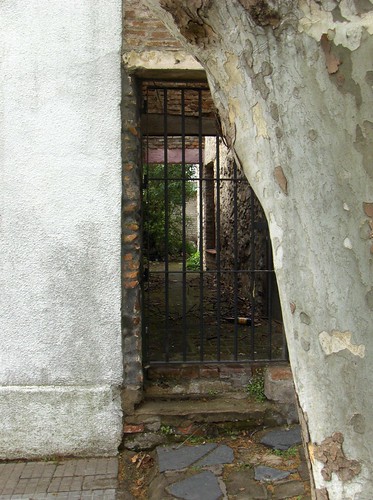
uruguay 109

uruguay 088

uruguay 079

Occupational hazards

From a study reported on the Frontline website at pbs.org

Roughly 120 million people worked in the U.S. in 1992. Every job carries some risks. Many workers are exposed to job-related safety risks of traffic accidents, falls, murder, electrocution, fire, being struck by objects, explosion, heat, cold, animal attacks, and airplane crashes, as well as health risks from radiation, asbestos, silica, benzene, coal dust, tuberculosis, secondhand smoke, carbon monoxide, pesticides, benzidine, arsenic, lead, chromium, and stress.


  • Roughly 6,371 job-related injury deaths, 13.3 million nonfatal injuries, 60,300 disease deaths, and 1,184,000 illnesses occurred in the U.S. workplace in 1992.
  • The total direct and indirect costs associated with these injuries and illnesses were estimated to be $155.5 billion, or nearly 3 percent of gross domestic product (GDP). Injuries generated roughly 85 percent whereas diseases generated 15 percent of all costs.
  • Small firms have exceptionally high injury rates.
  • Occupations contributing the most to costs included truck drivers, laborers, janitors, nursing orderlies, assemblers, and carpenters. On a per capita basis, lumberjacks, laborers, millwrights, prison guards, and meatcutters contributed the most to costs.
  • Occupations at highest risk for carpal tunnel syndrome include dental hygienists, meatcutters, sewing machine operators, and assemblers. Among well-paid professions, dentists face the highest risks.
  • Disabling injuries are strongly correlated with job experience. New employees, regardless of age, experience a high and disproportionate number of injuries.
  • Men are more likely than women to sustain a work injury. This is especially true for an injury resulting in death The nonfatal injury ratio for men to women is nearly 2:1, whereas the fatal injury ratio is about 11:1.
  • Blacks and Hispanics experience greater injury rates than non-Hispanic whites.
  • In 1992, the CFOI and the NHIS underestimate injuries experienced by blacks.* The self-employed, persons employed in small firms, and persons over age 65 are at high risk for sustaining an injury death.
  • Laborers, truck drivers, and taxi drivers generate among the highest death rates of all occupations.
  • Mining, farming, and construction are the industries with the highest rates of fatal and nonfatal injuries.
  • Murder is the most likely cause of death for business executives and sales workers.
  • Operators and laborers generate the greatest numbers of deaths and nonfatal injuries among all broad occupation groups.
  • Laborers, truck drivers, nursing aides, janitors, assemblers, stock handlers, and cashiers generate the most disabling injuries among detailed occupations.
  • Being at work is not safer than being at home. People who work are more likely to be injured at work than at home. This is especially true for men. Moreover, work-related injuries are more likely to result in hospitalizations than injuries originating outside of work.

With that as background, let's take a walk down memory lane, to examine some of the risks associated with professions that are now defunct:

Hatter's shakes: Related, of course, to the phrase 'mad as a hatter'. What was the root cause of your ailments, if you were a hatter? Mercury, even more toxic than lead.

From Michael Quinion's World Wide Words site:.... the term derives from an early industrial occupational disease. Felt hats were once very popular in North America and Europe; an example is the top hat. The best sorts were made from beaver fur, but cheaper ones used furs such as rabbit instead.A complicated set of processes was needed to turn the fur into a finished hat. With the cheaper sorts of fur, an early step was to brush a solution of a mercury compound — usually mercurous nitrate — on to the fur to roughen the fibres and make them mat more easily, a process called carroting because it made the fur turn orange. Beaver fur had natural serrated edges that made this unnecessary, one reason why it was preferred, but the cost and scarcity of beaver meant that other furs had to be used.Whatever the source of the fur, the fibres were then shaved off the skin and turned into felt; this was later immersed in a boiling acid solution to thicken and harden it. Finishing processes included steaming the hat to shape and ironing it. In all these steps, hatters working in poorly ventilated workshops would breathe in the mercury compounds and accumulate the metal in their bodies.We now know that mercury is a cumulative poison that causes kidney and brain damage. Physical symptoms include trembling (known at the time as hatter’s shakes), loosening of teeth, loss of co-ordination, and slurred speech; mental ones include irritability, loss of memory, depression, anxiety, and other personality changes. This was called mad hatter syndrome.

Woolsorter's disease: Anthrax, from handling the fleeces.

Goldsmelter's cataract: Goldsmiths and other metal workers were at greater risk of developing cataracts because they used to stare at the bright molten metal. A tangential note: St Clare (of Assisi) is the patron saint of needle-workers, embroiderers, eyes and eye diseases, goldsmiths, gilders, laundry workers, telegraph, telephone, television writers and good weather. Toward the end of her life, when she was too ill to attend Mass, an image of the service would be displayed on the wall of her cell; because of this, she became the patron saint of television

Painter's colic: Lead poisoning caused by inhaling fumes from lead-based paints.

Phossy-jaw: Phossy jaw, formally phosphorus necrosis of the jaw is a deadly occupational hazard for those who work with white phosphorus without proper safeguards. It was most commonly seen in workers in the match industry in the 19th and early 20th century. Modern occupational hygiene practices have eliminated the conditions which lead to this affliction.
Chronic exposure to the vapour of white phosphorus, the active ingredient of most matches from the 1840s to the 1910s, caused a deposition of phosphorus in the jaw bones. It also caused serious brain damage. Workers afflicted would begin suffering painful toothaches and swelling of the gums. Over time, the jaw bone would begin to abscess, a process which was both extremely painful and disfiguring to the patient, and repellent to others, since drainage from the dying bone tissue was exceedingly foul-smelling. The jawbones would gradually rot away and would actually glow a greenish-white color in the dark. Surgical removal of the afflicted jaw bones might save the sufferers' life at this point—otherwise, death from organ failure would invariably follow.
Public revulsion eventually caused changes in match manufacturing which eliminated the disease. In some nations, legislative action was required to force these changes on a reluctant industry.

Dialpainter's disease: "The doctors tell me I will die, but I mustn't. I have too much to live for-- a husband who loves me and two children I adore. They say nothing can save me, nothing but a miracle." Ottawa native Catherine Donohue wrote those words and more from her bed to the Our Lady of Sorrows Roman Catholic Church in Chicago in the mid-1930s. She asked for a novena to bring her a miracle. She had to write the words for she could not speak them. Her teeth and a large portion of her jawbone were gone. Cancer was eating away at her bone marrow. The doomed young mother weighed only 65 pounds. Catherine Donohue was a charter member of the nonexistent organization, "The Society of the Living Dead," so called because members had two things in common: all worked at the Radium Dial Company in Ottawa, Illinois and all eventually suffered an agonizing death from radium radiation poison. More than 30 of these area co-workers (among others in dialpainting plants across the country), each of whom painted a radium-laced solution onto clock faces, watch dials and military equipment so they would glow in the dark, found that the simple habit of licking their brushes into a fine point eventually gave them terminal head and bone cancer.

Assured that the radium-laced compound was completely safe, even digestible, the young women painted their dress buttons, fingernails, eyelids and even their teeth for fun. When they went home from work, they thrilled their families and friends with glowing clothes, fingers and hair. Dialpainters were instructed in the technique of lippointing to perform their finely detailed work. Mixing the dry, luminous paint powder with paste and thinner, the workers drew their small brush to a point with their lips before dipping it in the paint, and then meticulously filled in the numbers or other marks on clockfaces or other equipment before repeating the process. The whole sorry story is documented in two different books, "Deadly Glow" and "Radium Girls".

Caisson disease: Dr. Andrew Smith first utilized the term "caisson disease" describing 110 cases of decompression sickness as the physician in charge during construction of the Brooklyn Bridge. The project employed 600 compressed air workers. Recompression treatment was not used. The project chief engineer Washington Roebling suffered from caisson disease. (He took charge after his father John Augustus Roebling died of tetanus.) Washington's wife, Emily, helped manage the construction of the bridge after his sickness confined him to his home in Brooklyn. He battled the after-effects of the disease for the rest of his life. During this project, decompression sickness became known as "The Grecian Bends" because afflicted individuals characteristically arched their backs: this is possibly reminiscent of a then fashionable women's dance maneuver known as the Grecian Bend.

X-ray dermatitis: Yes, indeedy, maybe those shoe-fitting fluoroscopes weren't such a boffo idea after all.

pdf file

Fiddler's neck: occupational hazards for musicians

Bagpiper's fungus: See previous entry

Beat knee: Beat knee, beat hand, and beat elbow are acute inflammation of the tissues under the skin of the part affected. Beat knee results from constant kneeling in thin seams, beat hand results from using rough-handled tools, beat elbow results from pressure on the joint caused by crawling in very thin seams or from holing. The symptoms are pain, swelling, stiffness of the parts affected, probably followed by suppuration. Preventive measures include the use of pads for the knees and elbows, and the application of iodine to cuts and abrasions.

Ankylostomiasis: ANKYLOSTOMIASIS, or Anchylostomiasis (also called helminthiasis, "miners' anaemia," and in Germany Wurmkrankheit), a disease to which in recent years* much attention has been paid, from its prevalence in the mining industry in England, France, Germany, Belgium, North Queensland and elsewhere.

This disease is due to the presence in the intestine of nematoid worms (Ankylostoma duodenalis) from one-third to half an inch long. The symptoms include pain in the stomach, capricious appetite, pica (or dirt-eating), obstinate constipation followed by diarrhoea, palpitations, small and unsteady pulse, coldness of the skin, pallor of the skin and mucous membranes, diminution of the secretions, loss of strength and, in cases running a fatal course, dysentery, haemorrhages and dropsies. The parasites, which cling to the intestinal mucous membrane, draw their nourishment from the blood-vessels of their host, and as they are found in hundreds in the body after death, the disorders of digestion, the increasing anaemia and the consequent dropsies and other cachectic symptoms are easily explained.

The disease was first known in Europe among the Italian workmen employed on the St Gotthard tunnel. In 1896, though previously unreported in Germany, 107 cases were registered there, and the number rose to 295 in 1900, and 1030 in 1901. In England an outbreak at the Dolcoath mine, Cornwall, in 1902, led to an investigation for the home office by Dr Haldane F.R.S. (see especially the Parliamentary Paper, numbered Cd. 1843), and since then discussions and inquiries have been frequent.

The parasites thrive in an environment of dirt, and the main lines of precaution are those dictated by sanitary science. Malefern, santonine, thymol and other anthelmintic remedies are prescribed.

*: this account is taken from a 1911 encyclopedia.

Orf: contagious pustular dermatosis - caused by a pox virus, this is a zoonosis caught from sheep - an occupational hazard for farmers and veterinarians. It is self-limiting but unpleasant and painful.


Also the abbreviation for the Norfolk, VA airport.

Popcorn Worker's Lung: Occupational airway diseases such as occupational asthma, bronchitis, reactive airways dysfunction syndrome and byssinosis are common workplace diseases. The involvement of the small airways, such as the bronchioles are infrequently reported in occupational airway disease, but these may lead to serious chronic lung injury.

One such disease of the bronchioles is bronchiolitis obliterans. This disease is initiated by damage to the epithelium of the small conducting airways and progresses to inflammation of the airways, frequently to the adjacent alveolar tissue as well. The clinical consequence of this injury and inflammation is irreversible airway obstruction.

Exposure to an agent during diacetyl production appears to be responsible for causing bronchiolitis obliterans syndrome in chemical process operators, consistent with the suspected role of diacetyl in downstream food production.

This first came to public attention when eight former employees of the Gilster-Mary Lee popcorn plant in Jasper, Missouri, developed bronchiolitis obliterans. In 2000, the Missouri Department of Health called in NIOSH to make a determination of the cause, and to recommend safety measures. After surveying the plant and each patient's medical history, NIOSH recommended respiratory protection for all workers in microwave popcorn production. Due to this event, bronchiolitis obliterans began to be referred to in the popular media as "Popcorn Lung" or "Popcorn Workers Lung".

Coal Worker's Pneumoconiosis: Coal worker's pneumoconiosis is a lung disease caused by breathing in dust from coal, graphite, or man-made carbon for a long time. Although some miners never develop the disease, others may develop the early signs after less than 10 years of mining experience.

Coal worker's pneumoconiosis (CWP) can be defined as the accumulation of coal dust in the lungs and the tissue's reaction to its presence. The disease is divided into 2 categories: simple CWP (SCWP) and complicated CWP (CCWP), or pulmonary massive fibrosis (PMF), depending on the extent of the disease.

Prognosis is poor once the patient has been determined to have PMF. Treatment is palliative.

Simple CWP specimen

Progressive massive fibrosis specimen (caution - high nausea potential)


All in all, it makes one think that perhaps the work of OSHA is underappreciated.

What you can buy for 10 dollars

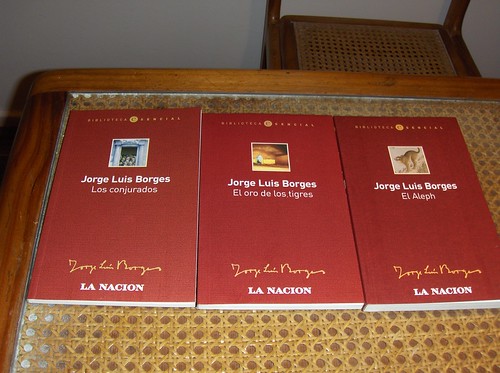
essential Borges

Three books by Borges, including some pretty amazing poetry.


doomed 001

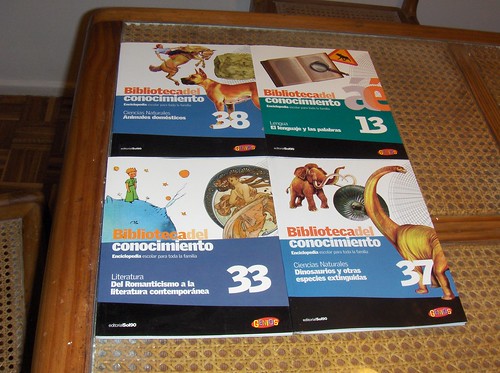
15 books in the exciting Biblioteca del Conocimiento series (just like the four in the picture), covering topics from dinosaurs to algebra and world literature.

doomed 005

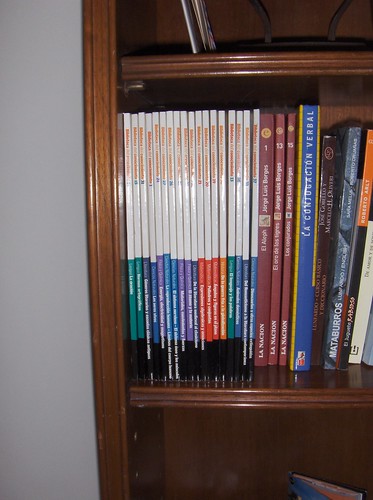
OK: I might have bought more than 15. So sue me. They are 2 pesos apiece, for crying out loud!

doomed 003

Or five classical music CD's.


Or three tickets to see "Mamma Mia!".

Tuesday, September 9, 2008

Monday, September 8, 2008

Gone to the dogs

It was a busy weekend. Since Brad is here visiting from San Francisco, I got to play tour guide. Saturday was quite rainy. We went to La Boca in the early afternoon where, despite the drizzle, we each ended up taking a boatload of pictures. Many of which turned out quite well, despite the overcast conditions. Then we hopped a cab to the Museo de Bellas Artes (a joy of living in Buenos Aires is the low cost of taxis - barely six dollars to get across town; cabs are cheap, plentiful, and tipping is not expected - you just round whatever is on the meter up to the nearest peso, because of the coin shortage, and Bob's your uncle).

The Fine Arts Museum is enormous - there are still whole wings I didn't get to explore - and full of wonderful exhibits. My favorite was on the top floor, which was given over to an exhibition of photos by Argentine photographers from the end of the 19th century. But I still need to go back.

Yesterday, we made an early start to get the ferry over to Colonia, a terrific little town more or less directly across the river/estuary from Buenos Aires. After the one-hour ferry ride, there was a one-hour guided walking tour, after which we were free to wander around on our own (with a voucher for lunch at one of the local restaurants). There are - needless to say - photos, uploading to Flickr even as I type this entry. The photos are striking for (a) the superabundance of dogs and (b) the complete lack of any feline presence at all. This is either because (i) Brad is a kind of pied piper where dogs are concerned (ii) there are no cats in Uruguay (iii) a combination of (i) and (ii) or (iv) some explanation too hideously sinister to contemplate. There was, I am glad to say, no evidence of any feline elements in the cuisine, based on our lunch choices, but then we were restricted to the limited set of choices offered to those with vouchers, so dark unsavory possibilities cannot be ruled out completely.

I am keeding, of course! It was a terrific outing, in every respect. Brad was particularly excited, because in the course of crossing and recrossing the river, he got his passport stamped six times. As did I.

Yesterday's excursion forced me to pay attention to the map, so I realized that Montevideo is not actually directly across from Buenos Aires, but quite a bit further down the coast, so that a ferry there would probably take closer to three hours each way.

Offsetting the disturbing lack of cats in Uruguay, the air was distinctly less polluted. Apparently, the pollution and smog of Buenos Aires provides them with spectacular sunsets. While the pollution in B.A. doesn't quite reach post-Krakatoa levels, at times one could be forgiven for getting that impression.

Saturday, September 6, 2008

A Learning Experience

Travel. It broadens the mind. Exposes one to new places, people, cultures, ideas. All that sort of thing. Teaches you things you might otherwise never have learned in a gazillion years. Here are a few things I have learned in the last four short weeks.


sept13_david_g 014

Sexado de loros por ADN (Parrot-sexing by DNA):

This is what the sign in the window of the local pet-store says. The first couple of times I passed by I misread it as "sexado de lobos por ADN", which - of course - made no sense at all. By the time you get close enough to a wolf to get a DNA sample, you can probably tell what sex it is - the question is, why would you want to in the first place? When I finally figured out it meant parrots, not wolves, I was relieved at first. But it still seems very odd to me. Isn't there some easier way to figure out whether your bird is a Polly or a Petey? Who knew that one would have to have recourse to DNA testing?

Though, now that I think about it, isn't chicken-sexing supposed to be one of those notoriously difficult professions, restricted to a select few talented individuals who are born with "the gift"? Suppose you are one of the rare people born with the gene for accurate chicken-sexing. How would you ever find out about your talent?


Prejudice in the House:

In contrast to the swooning Spanish fans of the sneering, misanthropic, drug-addicted, limping, implausibly brilliant, insufferably obnoxious, assmarmot diagnostician Doctor Gregory House, Argentine viewers are underwhelmed*. They have noticed a repeated, disturbing tendency for episode plots to refer to the practice of medicine throughout Latin America as if it were nothing more than a collection of primitive techniques practiced by indigenous tribes whose witch doctors never wash their hands or sterilize the instruments they use to kill the chickens used in their quaint healing rituals. Play the game yourself. Next time "House" comes on, see how far along the episode gets before "recent travel to Latin America?" comes up as a question in the differential diagnosis efforts.

Fear not. I always wear a Biohazard Level 4 protection suit (or greater), when going to the cootie-ridden internet cafe. Though it's hard to find sterilized booties in my exact size, so it's possible that the parasites are creeping in around my ankles.

*As am I. This creaking, one-note, excuse for a series passed its "sell by" date at the end of its first season, if not before. Hugh Laurie is a talented actor who needs to get out more, instead of being seduced into allowing himself be reduced to a caricature by the lure of filthy lucre.


Limbo Hands:

Then, of course, there is the vexing "manos de Perón" case. How can they still be in limbo, when the Vatican eradicated it just this past year? 'Tis a puzzlement.

Friday, September 5, 2008

Money matters

One of the odder things I noticed (or imagined) since arriving here in Buenos Aires was what appears to be a distinct shortage of coins. To the extent that cashiers will plead with you to check if you have 40 centavos, because they don't have the 60 centavos it would require to give you correct change. Or they just round the price down in your favor. In the subway, where the cost of a single trip is 90 centavos, things are so bleak that they have introduced a special card, whereby your 10 centavos change can be credited electronically. A far cry from the U.S., where every household has some kind of enormous penny jar. I asked one of the teachers yesterday, and confirmed that this is not a figment of my imagination. There is indeed a city-wide shortage of coins in Buenos Aires. Nobody can explain why. It just seems so ... odd.

Another currency-related note (vile pun intended) pertains to the 100 peso bill. Prominently featured is one of the country's former presidents, Julio Roca. Nothing particularly unusual there, one might think. Problem is, one of Roca's main contributions to the country's history was the extirpation of all of the indigenous populations (Argentina doesn't have issues with indigenous people because Roca just eliminated them all back in the 19th century). In response to criticism that portraying a mass-murderer on the country's most valuable banknote might be considered inappropriate, the government came up with the Orwellian response that the 100 peso note was the least circulated, and that Roca was thus less honored than - say - Bartolomeo Mitre (an infinitely more savory former president-scholar-writer), who appears on the lowly 2 peso note, which enjoys far greater circulation. Indeed.

Finally, I was amused to note (sorry!) on a currency exchange rate display earlier today that the pound sterling was denoted as the "libra Elizabeth".

Thursday, September 4, 2008

Descanso

My friend Brad arrived from San Francisco this morning, and will be visiting until Wednesday evening. So there might not be too much time for updating the blog over the next several days. I will do the best I can - for instance, my reading of El País has reminded me that there is much important information about European royalty that I owe my readers (marital discord - a problem which is apparently not confined to the house of Windsor - plagues some of the royal offspring; not to mention the tragic accident which has befallen the royal family of Bulgaria).

Brad has - wisely - expressed a lack of interest in the combined dinner 'n tango show recommended by the school; we may go to Uruguay on Sunday instead.

Yesterday, we went on a class outing to the Museo de Bellas Artes. Which merits a second visit (and its own blog entry, in due course).

In other news, I was very pleased with my performance on what many people consider to be the ultimate test of Spanish ability - my 40-minute conversation with the taxi-driver on the way to the airport this morning. All these classes appear to be paying off.

Sadly, there is no progress to report in the perplexing case of "las manos de Perón". Police - indeed, the country as a whole - remain baffled.

Pavement update: for the past week, city "workers" spent enormous amounts of time, and made enormous amounts of noise, repaving the sidewalk on the corner where the school is located. They finally departed yesterday. But here's the thing. Not only has the unevenness of the pavement not been ameliorated - it is noticeably worse than it was prior to the "improvements". Personally, I'm beginning to suspect some kind of hideous plot, involving the city's orthopaedic surgeons and chiropractors.

The plain people of Ireland: Here, this is very choppy today. All disjointed like.
The management: Indeed it is. Sometimes life fails to arrange itself into little neat thematic packages.
The plain people of Ireland: Is this the best you can do?
The management: The idea that I should take seriously the criticism of an entity capable of writing "phrases" such as "All disjointed like" is frankly ludicrous. Back to your caves, troglodytes!

Wednesday, September 3, 2008

La lluvia en Sevilla es una maravilla

Long-time readers of this blog will recognize the title of this post as the Thpanish version of the infamous 'enry 'iggins phrase "The rain in Spain falls mainly on the plain". As my teachers in Salamanca explained, this is considered a good test phrase, because how a Spanish speaker manages the subtle "ll" sound is regarded as a measure of how well-spoken he or she is.

I regret to say, dear readers, that my Salmantine teachers would not be favorably impressed by the local pronunciation here in Buenos Aires. Somehow those lovely liquid "l"s are transformed into a regrettably sialoquent* shshushshing kind of a sound. Between my porteño teachers and all the Brazilian students "zhzhzhing" their way around the hallways at school, it is all I can do to hold on to the purity of my lithping Cathtilian pronunciation.

But I am doing the best I can. Assuming I return to the Don Quijote school in Madrid in November, I don't want to be the object of scorn and ridicule when I do so.


* sialoquent: spraying saliva when speaking (I could name certain graduate school professors, and a few professional colleagues, in his context, but it seems unkind to do so). The antonym of sialoquent is, of course**, xerostomic, xerostomia being one of the defining symptoms of Sjögren's syndrome.

** there is, of course, no "of course" about this at all; nobody in their right mind knows this kind of stuff. Somehow, over time, my mind has become a vast storehouse of obscure trivia and particularly useless bits of information. Not necessarily a blessing, I might add. I'd much rather be able to remember my phone number here in Buenos Aires, something that the presence of an eighth digit seems to make particularly hard to do.

Tuesday, September 2, 2008

Can anybody lend a hand?

Peron Hands: Police Find Trail Elusive

Investigators trying to determine who broke into the tomb of Juan Domingo Peron and sawed off his hands have arrested six people in recent days, only to see five of them cleared by a judge. The authorities discovered the hands missing two months ago after leaders of the Justicialista Party, the Peronist political movement, said they had received an anonymous letter advising of the mutilation and demanding $8 million ransom.

New York Times; September 6th, 1987

Who knew? I certainly didn't. But I intend to find out more about this important topic. Because my readers deserve no less than the full truth of the matter.

Lest there be any confusion on the matter, I should stress that Evita's hands remain unscathed, as firmly attached to the rest of her cadaver as the competing forces of natural decay and the magic of the embalmer's art allow.


Doomeder and doomeder

Flickr is being particularly obnoxious this past few days (I have no idea if it's just to me, or whether it's a more widespread phenomenon), so it's been hard to upload photos. That said, the blurriness of the photo below is my own fault, nothing to do with Flickr:

doomeder and doomeder

But you get the picture.

Doomed as doomed can be. Without remorse.

Monday, September 1, 2008

Oh those internet censors

They're so sharp they'll cut themselves (NOT!!)

I guess I just have myself to blame for the provocative title of the last post but one.

With a link to pictures, yet.... Oy vey, chicos. Son gatitos, no ******s!

Two Sleeping Giants

Every morning on my way to school I first pass by the Teatro Cervantes, just two blocks down my street, then past the enormous Teatro Colón, which takes up a whole city block, between the Plaza Lavalle and the Avenida de 9 julio. The latter is quite obviously under repairs, with sidewalk closures all around and random scaffolding. The former gives the superficial appearance of being in full swing, with placards for various shows on prominent display. But there never seems to be any activity in the evening - after three weeks I had yet to see any evidence that the advertised shows were actually being performed.

It turns out - somewhat shockingly - that renovations on the Teatro Colón have been underway for almost 10 years now - a project which has apparently fallen victim to various changes in city government, with each successive incumbent firing all those previously hired to work on the project so that his particular cronies might benefit instead. But each successive incumbency never lasts long enough for anything to get done. In other words, an ongoing political farce, which would be funny if it weren't so pathetic.

Just as shocking, lights have been dim in the Teatro Cervantes for over a year, due to an inability (or lack of political will) of the city to come to an agreement with "the unions".

It's as if the London National Theatre were closed for 10 years. Or the Globe in Stratford. A pretty sad state of affairs.

Sunday, August 31, 2008

Let's demonstrate!

A los porteños, les gustan manifestar.

It appears, based on casual observation, that porteños will take to the streets in protest for almost any reason at all. On any given day, I pass at least three 'manifestaciones' of one kind or another - on a good day, it gets up to six. Now, to be sure, I am helped in this regard by passing the main courthouse on the way to and from school every day, but the enthusiasm for street protest is nonetheless impressive. Plaza de Mayo, in front of the Casa Rosada, is another favored protest location. The "madres de los desaparecidos" still protest there every Thursday afternoon - this week, as part of a class excursion to the Cabildo (the first seat of government, now a museum, located across the Plaza from the Casa Rosada), we saw their demonstration. It seemed distinctly inappropriate to take pictures of what is now essentially an expression of mourning of personal tragedy, so I put the camera away. There were, however, at least three auxiliary demonstrations, related to causes which were impossible to determine, going on at the same time. All of which does raise the question - with so many demonstrations, is anyone really paying attention?

The Unfeasibly Tall Greek Billionaire

This is possibly the funniest thing I have yet seen on the Internet (with the obvious exception of Strindberg and Helium, of course).

http://www.scribd.com/doc/5322451/The-Unfeasibly-Tall-Greek-Billionaire

These folks are geniuses!!

(Thanks to Nicola O. for bringing this to my attention)

Saturday, August 30, 2008

Keeping up is hard to do

I am consumed with blogger's guilt. Faced with the terrible choice of experiencing Buenos Aires, or blogging about it, this week, the blogging part clearly lost out.

Fear not. Tomorrow is Sunday, with hours of vacant time looming. I promise some kind of enormous prose dump. Right here, on this very blog.

That is, assuming I don't yield to the siren call of Evita's grave. Right there in the Recoleta Cemetery, just a handful of blocks away. Not as full of celebs as, say Pêre Lachaise, but still on the list of things a person's gotta visit. Then there's Montevideo, though I'm kind of saving that for next weekend.

I promise, I will try harder. Honestly. Really. I will.

For those of you who check this blog just to see if I'm still alive, the answer is "Yes". Though I am quite tired, what with all the walking and sightseeing and general taking a gazillion hours of classes a week. But my Spanish, she is better than ever. I can say things I couldn't even say in English, now. Not that that's necessarily a good thing.

The plain people of Ireland: Here, this is very disjointed today.
The management: Yes, it is. And your point is?

Friday, August 29, 2008

Doomed as doomed can be

At the end of last week, I decided to take advantage of the extraordinarily low cost of private lessons (about $28 U.S. an hour) and paid for ten lessons, so that I ended each of the last four days in school with an hour-long private lesson with Ciro, possibly the most charming Spanish teacher I will ever have. (His name is the Spanish version of 'Xerxes', a fact which I also find charming).

During today's class we listened to the music of the awesome Astor Piazzolla, who single-handedly invented a kind of fusion of tango and jazz, which earned him popularity outside of Argentina and the fury of the purists at home. At the end of class, Ciro recommended the Libertador bookstore as being a possible place to pick up some interesting tango CD's at a reasonable price.

Oh, dear Lord! The librería Libertador! I am doomed as doomed can be.

Readers of this blog will know that books are my major weakness (or 'punto debil', if you prefer). This store will be my complete and absolute downfall. Here is what I staggered home with earlier this evening, for a total expenditure of $23 U.S.

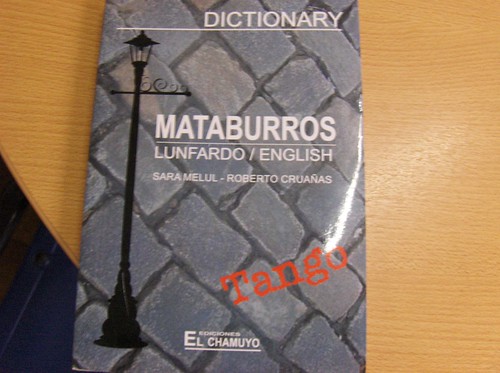
A 200-page dictionary of Lunfardo
The collected Father Brown stories (in Spanish)
A CD of Astor Piazzolla selections (20 tracks), with accompanying 100-page booklet about his life and work
A CD of Osvaldo Publiese selections (20 tracks), with accompanying 100-page booklet about his life and work
The Sibelius 2nd Symphony and various orchestral works (68 minutes), with accompanying 48-page booklet about his life and work
The Rachmaninov 2nd and 3rd piano concertos, with accompanying 48-page booklet (80 minutes)
10 volumes (each illustrated, 48 pages in length) from the Biblioteca del Conocimiento series , covering topic as diverse as "Human Beings", to "Physics: Energy and Motion", to "Literature: from Romanticism to the Present"

Let me tell you, a world in which it is possible to get a CD of the Sibelius 2nd Symphony (some of the most joyful music ever composed), for under 2 bucks is OK in my book.

¡Dear God, I'm doomed as doomed can be!

Wednesday, August 27, 2008

Tuber Abuse

Our research has determined that tuber abuse is rampant here in Argentina. In the name of "gastronomic excellence", it is routine practice to kidnap whole gardens of sleeping potatoes, to haze them by forcing them to imbibe large quantities of alcohol until they are drunk, to gouge out their eyes with unimaginable cruelty, finally killing them by repeated bludgeoning with nasty instruments left over from the Spanish Inquisition. All in the name of bringing the tasty side-dish "smashed potatoes" to the diner's table.

tuber abuse

¿Won't you help put an end to these barbaric practices?
¡Join the smashed potato boycott now!

Tuesday, August 26, 2008

Princess Twinkly

I had planned to bring you further ruminations about Buenos Aires today, honestly. But I've added an hour of individual classes to my daily schedule, so that I didn't get home tonight until 6:30pm. So you will have to wait a while for your dose of pseudo-profundities.

But I feel confident that you will forgive my failure to blather on about B.A. when you visit this link, brought to my attention by my good friend Paul B.

http://rathergood.com/princess_twinkly/

Hasta luego, chicos and chiclets!

Sunday, August 24, 2008

¡¡Hay un montón de fotos!!

la_boca_domíngo 145


Bessie (or, as she is known hereabouts, Isabel) would like you to know that 150* new photos have just been loaded to David's Flickr account.

These are accessible at:

http://www.flickr.com/photos/gaelstat/,

but have yet to be organized into any coherent grouping. Go ahead, check them out! They are pretty fun.

*: all taken today, almost all in La Boca.

THE OTHER OLYMPIC GAMES


Way cuter, if you ask me! Guinea pig archery, what's not to love?

La vida cotidiana : la ciudad

I've been postponing writing about Buenos Aires itself because the topic somewhat overwhelms me. Truly, of all the cities I've spent time in, this has to be one of the most stimulating. Which is a good thing, but I have so many impressions, and there are so many sensations to try to capture, that it's hard to get down in any coherent form. So, forgive me if I resort to the slightly random bulleted list option, rather than aiming for any kind of linear narrative.

There is a slightly frenetic buzz to the city that is maybe best captured by the local version of a 7-11 store in the U.S.:


OPEN 25 HOURS!!!


It's almost like there's a kind of hyper-industry, an excess of entrepreneurial spirit, that maybe results from relatively recent experience with economic catastrophe, and an ongoing sense of potential instability. It manifests itself in all kinds of little details. Thus, for example, the local tobacconist on the corner will not be restricted to selling sweets, tobacco and newspapers: there will also be a couple of tables in case someone wants to have a coffee and doughnut, as well as a couple of "locutorios" (phone booths to make long-distance calls), and often as not a couple of booths dedicated to internet connections at the back of the shop. Similarly, even the tiniest of cafés in the city center transforms to a lunch place from 11:30 to 3:00, even if only to offer three or four "menús del día". Furthermore, it's entirely normal to see the waiters from such establishments scurrying along the sidewalk, making full-service deliveries (complete with linen and silverware) to local offices. Invariably, whenever I've taken a taxi and engaged the driver in detailed enough conversation for him to know where I'm from, he has pressed his card on me, reminding me that he is available for airport service. On my way to school every morning, I pass the main court building, outside of which it's not uncommon to see distinguished elderly gentlemen (retired lawyers?) selling law texts on the sidewalk.

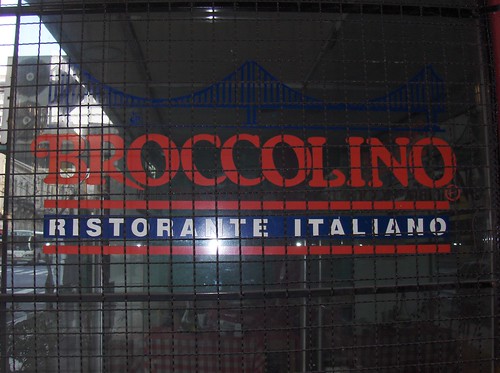
People, with the exception of the loathsome, snotty waiter at the vile "Broccolino" restaurant,

the loathsome BROCCOLINO restaurant

have been universally charming, and extremely helpful. This covers not only the teachers and staff at school, but also the charming Dr Gualtieri and her assistant, assorted waiters and attendants in shops, the doormen in the building, taxi-drivers and random passers-by. I am beguiled by the people of Buenos Aires.

I am less charmed by the pavements of Buenos Aires, which pose a significant health hazard to all and sundry. If you come here, be warned - these sidewalks are lethal! In two weeks, I've already witnessed three full-fledged spreadeagle accidents, and uncountable near-misses. Compared to the lurking pitfalls of the porteño footpaths, the quaint cobblestone streets of Guanajuato were a cakewalk.

Prices are almost uniformly ridiculously low. My most common experience is that I will look at the price of something, go through an initial thought process that it's a little bit on the high side, then make the realization "Oh, wait! That's the price in pesos". Dividing by 3 makes everything a lot more pleasant. The only exception to date, oddly enough, has been the price of stamps: to send a postcard to the U.S. costs 5 pesos, which is about $1.66 U.S., a bit on the high side. But, as I mentioned in a previous post, spending more than $20 U.S. for dinner is a challenge.

Further impressions to follow.

El Príncipe Feliz

I should have known better. Yesterday evening my options were:

1. Join the assorted 19- and 20-year olds for a so-called "Buenos Aires pub crawl", which promised - for less than twenty bucks - free drinks and appetizers at each of no fewer than four bars, followed by V.I.P. entry to a "hot club" in the city center.

2. A relaxing dinner alone, with an opportunity to catch up on some Spanish reading.

OK, I'm a wuss. My 51-year old liver and I chose option 2.

The root of the problem was my choice of reading material. Rather than eat to the accompaniment of the bloodless prose of Borges's "Ficciones" (which, I hasten to add, are just fine if you are in the right kind of mood), I opted instead to bring along a Spanish translation of collected stories of Oscar Wilde: "El Fantasma de Canterville y Otros Cuentos". I had bought the book earlier in the day, for its nice simple prose - a fine choice for non-native speakers like myself. So my dinner courses were punctuated by intermittent sections of "El Príncipe Feliz" (The Happy Prince).

Problem was, I'd forgotten the effect this particular story has on me. As a kid, I could never make it to the end without bawling my eyes out. And sure enough, the Spanish translation had lost none of the tale's emotional wallop. By the time my espresso was served, when the swallow dies and the prince's heart breaks in two, well - let's just say I had to go to the men's room to compose myself.*

The Happy Prince: reading it in public is a bit like watching "Brokeback Mountain" with the lights on - a recipe for embarrassment.

Damn you, Oscar Fingal O'Flahertie Wills Wilde! And I mean that in the best possible way.

* I'm all better now, I swear.

**************************************************************************

Tráeme las dos cosas más preciosas de la ciudad -- le dijo Dios a uno de sus ángeles.
Y el ángel le trajo el corazón de plomo y el ave muerte.
Has escogido bien -- dijo Dios -- porque en el jardín del Paraíso este pajarillo cantará eternamente y en mi ciudad de oro del Príncipe Feliz me glorificará.

Bring me the two most precious things in the city -- God said to one of his angels.
And the angel brought him the heart of lead and the dead swallow.
You have chosen well -- said God -- because this little bird will sing for eternity in the gardens of Paradise, and the Happy Prince will bring me glory in my City of Gold.

Saturday, August 23, 2008

At the odontóloga's office

As I've mentioned many times on this blog, one of the joys of overseas travel is the way that just being in a foreign country can take something that would be tedious at home and transform it into something exciting and different - instant adventure, if you will. A case in point was my visit to the dentist earlier today. Readers will recall that the most exciting episode of last Sunday evening's tango spectacle debacle occurred when the Mentos I was chewing lifted a filling right out of one of my lower left molars. That's right: Mentos -- "the freshmaker" and "the toothbreaker".

As a result, 11 a.m. today found me in the office of the efficient Dottora Paula Gualtieri, who took care of my little dental emergency with great charm and professionalism. (In the course of trying to reach Dr Paula during the week, I did end up chatting with her father on the phone for five minutes. Though it seemed inappropriate to ask him directly, it seems highly unlikely that the family is in any way related to the infamous General "Malvinas" Gualtieri. Just in case anyone was wondering.)

There were some notable differences between this morning's appointment and a typical dentist's visit in San Francisco:

  • In the ten years that I've been going to Doctor Victor in S.F., neither he, nor his dental hygienist, has ever greeted me by kissing me on the cheek.
  • Judging by the numbering system that Doctor Paula was using for my dental chart, Argentine patients appear to have 48 teeth. Something I hadn't personally noticed up until now, but you can be damned sure I will be on the lookout for those toothy porteños from now on.
  • For what it cost to replace the filling ("el empaste"), I would barely be allowed in the building where Doctor Victor's office is located. 100 pesos. That's 33 US dollars, children. For 30 minutes of the dentist's and her assistant's time. I felt almost embarrassed.

There were some similarities as well:

  • Apparently, it is a global requirement for all dentists to give you a free toothbrush, a tiny tube of toothpaste, and a leaflet showing you how best to brush your teeth, before allowing you to leave the office.
  • You're never done. By definition, there's always something else. Whether it's the poking around your mouth with sharp pointy metal tools, or an innate ability to spot budding caries from 500 meters (I lean toward the former explanation), every dentist wants you back in that chair.

I consented to one more visit, because - I have to admit - I had been wondering if that surface irregularity I could feel with my tongue might not be a new "hueco" starting up. So, by the time I leave Argentina, it's possible I may have racked up nearly 100 bucks in dental bills. Will I be endeavoring to recuperate this expenditure from Kaiser Permanente? I doubt it, somehow. Life is way too short....

On my way home from the dentist, I wandered along Avenida Rivadavia (the Buenos Aires equivalent of Toronto's Yonge Street - it's very long) for about 40 of its 100 blocks. I didn't have my camera with me, but maybe it's just as well.

Friday, August 22, 2008

Schpring-Schprong Biscuits!!

Coming shortly - OPERATION BAKED GOODS continues!! Watch this space carefully.

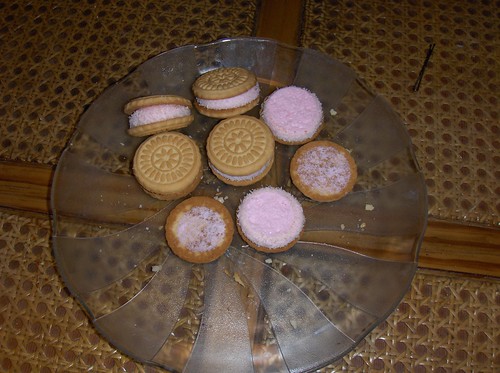
schpring-schprong biscuits!!!

The term “schpring-schprong biscuit” refers to any of three biscuit varieties (Kimberley, Mikado, and coconut cream) made by the Jacob company, each of which contains a type of coconut marshmallow filling, which has a kind of springy consistency, from which the name derives.

If you would like to see pictures, try this link

http://gaelstat.com/Documents/december2005quizexplanations.doc

The above Argentine efforts remain a poor shadow of the real thing, but are not the last word on the topic. I will return to this very important subject.

Taming the Photostream

Some of you may have noticed that I've been making relatively indiscriminate use of my little HP R827 in recent weeks. I make no particular apology for this - what's the harm, after all? But it does mean that my Flickr photostream is becoming less navigable. The total number of images is rapidly approaching the thousand mark. Realizing that not everyone wants to wade through every single image that I have uploaded, I will try to be a little more proactive about organizing the photos into sets, which may be a little more user-friendly for those of you just browsing. I won't make any rash promises, but here are links to the first two Buenos Aires sets (I'm repeating the link to the tango set, just for completeness):

http://www.flickr.com/photos/gaelstat/sets/72157606875016250/ (Signs and Windows)

http://www.flickr.com/photos/gaelstat/sets/72157606819220655/ (Colores del Tango)

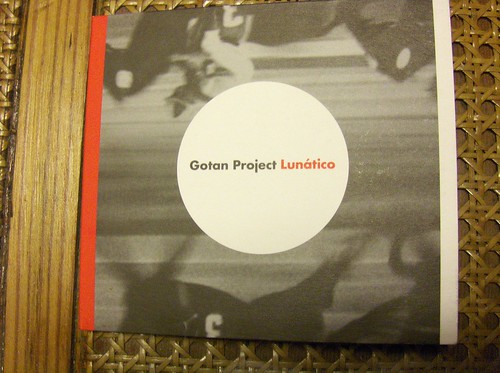
Gotan Project

Upon Rodrigo's recommendation, I've been listening to the music of Gotan Project, specifically their 2006 CD, Lunático. I highly recommend it. The first and final tracks in particular (Amor Porteño and Paris, Texas) are remarkably fine. But the entire album is pretty terrific:


GOTAN PROJECT

Admiral Brown

Yesterday evening, the waiter in my favorite local restaurant was anxious to tell me all about Admiral Brown, the famous Argentine patriot who was born in Ireland. As usual, my ignorance was shocking. So here, as an antidote to your possible ignorance, is a section from the Wikipedia entry on the mariner in question:

Admiral William Brown* (also known in Spanish as: Guillermo Brown) was born in Foxford, County Mayo, Ireland on June 22, 1777 and died in Buenos Aires, Argentina on March 3, 1857. Brown's victories in the Independence War, the Argentina-Brazil War, and the Guerra Grande in Uruguay earned the respect and appreciation of the Argentine people, and today he is regarded as one of Argentina's national heroes. Creator and first admiral of the country's maritime forces, he is commonly known as the "father of the Argentine Navy". Over 1200 streets, throughout Argentina, are named for him.


See, this blog aims not only to entertain, but to inform and to educate as well.


*: not to be confused with the fictional Richmal Crompton character "Just William".

Thursday, August 21, 2008

La vida cotidiana : en la escuela

Don Quijote's global reach doesn't actually extend as far south as the 35th parallel so, even though I arranged and paid for my classes here through dQ headquarters in Salamanca, the school is not a don Quijote school per se, but has so-called "sister status". What this appears to mean in practice is that they follow much the same format for classes - that is, morning classes have more of an emphasis on covering formal grammatical constructs, while afternoon classes are devoted to conversation.

Two changes are evident though, both of them entirely positive, in my view. The first is that they are less strict about sticking only to grammar-related stuff in the morning, and will substitute watching a film, or - if the mood of the class is such that it seems like a good idea - just let the conversation unfold (this willingness to abandon the strict grammatical curriculum is particularly helpful at the more advanced levels). The second, extremely welcome change, is that - for students taking six hours class a day, instead of going straight through from 9 to 3, with just two 20-minute breaks, we actually get a whole hour for lunch at 1pm, reconvening at 2pm. I can't emphasize enough how much more civilized this is.

So far, the teachers have been uniformly excellent - better than many of the dQ teachers I've had over the past year. They are highly enthusiastic, very good at managing class participation, and seem much more imaginative in their use of multi-media and their choice of materials to discuss during class. I'm really liking it a lot, and am learning a lot.

It's a relief as well that, each time when I return to class, I appear to be forgetting a lower percentage of what I had learned previously. I've started to read pretty extensively, starting with Argentine authors like Borges and Robert Arlt ("el juguete rabioso"), as well as my near-daily dose of my old favorite, "El País".

The only slight snag is that, unlike at the various dQ schools, the demographics of the student body are much more homogeneous, and I appear to be the only student over 30 in the whole place. Which is fine - it's not as if there's any kind of age-apartheid, or anything. It's just that - well - have you spent 30 hours a week in a classroom with a bunch of 19-year olds recently?

They're sweet as all get out and everything. But, Lord, at times - they are just sooooooooo damned young.

At times it makes me wish for the glib certainties of youth again. But - then again - maybe not!

Wednesday, August 20, 2008

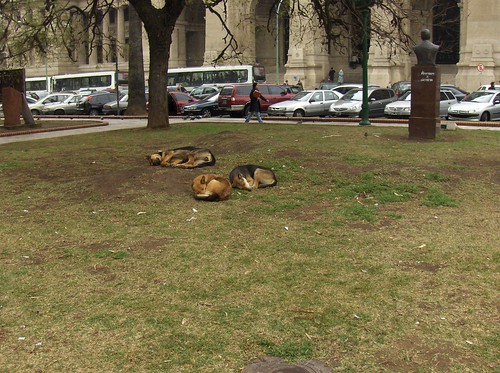
Tres perritos porteños

Let sleeping dogs lie


I promise I will have something of substance to blog about later on, but starvation sends me out in search of dinner. In the meantime, here are three sleepy pooches I captured earlier in the day.

Hasta pronto, chicos!

Tuesday, August 19, 2008

Strike Threat Averted

I hope everyone will be happy to know that my temporary mal humor of yesterday is a thing of the past, and I am no longer threatening industrial action. I put it all down to the temporary discombobulation that accompanies a three-day weekend in a strange city. Yesterday afternoon's walk around the Abasto district, documented in the preceding post, thoroughly reinvigorated me.

So please forgive any peevishness on my part. This blog will continue unabated. In fact, just try shutting me up.

Which is not to say that your comments are unwelcome - the more the merrier.

But now I have to go do my homework. Which has to do with midget Argentine serial killers of the early 20th century. It doesn't get any better than this!!

(And yes, arrangements are under way to replace the filling that fell prey to Sunday evening's ill-advised Mentos. Let it be a cautionary lesson to all my readers)

Monday, August 18, 2008

Pictures galore

davids_pictures_august_18_2008 007

I've been out sacar-ing photos like a maniac, and uploading them to Flickr fairly indiscriminately, I'm afraid. I did try to bring a little order to today's efforts, by subsetting out a collection:

Colores del Tango .

Enjoy!

Strike Threat

OK, readers! Here's the deal. I know that you are out there, reading this blog. Statistics tell me so. But if you want me to keep posting with any frequency at all, you're going to need to make yourselves heard.

I've posted something like 15 times in the past week, and all I get in response is a single comment.

Is that the best you can do? I sincerely hope not.

Remember, I'm the one here who is thousands of miles from friends and family. So a line of encouragement would be not only welcome - it would be a common courtesy.

Because the silent treatment can work both ways. And if that seems like a threat, so be it. But use your imagination and put yourself in my position. It's frankly dispiriting to feel that one is simply typing into the damned void with every post.

Macho Posturing as an Art Form

tango palace on Av de 9 julio


Yesterday evening I attended an "espectáculo de tango" at the Borges Cultural Center (not what is shown in the photo above). Probably the most exciting part of the evening was when I managed to dislodge a filling while ill-advisedly chewing a Mentos (a hazard that somehow gets downplayed in those zany commercials of theirs). So I'm sure that some future post will deal with life in an Argentine dentist's office.

But anyway - yes - the tango. Well, avid readers of this blog will recall that, where THE DANCE is concerned, I am something of a philistine. There was that unfortunate giggling episode at the flamenco performance in Sevilla last year, induced by the deadly seriousness of the performers and the mild whorishness of the female dancer's costume. Of course, THE TANGO takes itself very seriously as an art form as well, nowhere more than aquí in Buenos Aires. Though at least the costumes weren't as overtly whorish.

The performance lasted an astonishing 90 minutes, roughly 7 of which, in my view were worth the price of entry (10 US dollars, so I'm not really complaining about that). That is, there were roughly seven minutes in which one was mesmerized by the dancing. Problem is, in order to spin things out into a "spectacle" of 90 minutes, there had to be some kind of gimmick. The gimmick was this: there were 3 men and 3 women on stage (and the usual chairs, to be used as clichéd props). Elementary combinatorics shows that this allows for a total of six possible pairings (in the macho world of the tango, don't look for any non-normative coupling). So, the added entertainment value was to watch as assorted couples formed and reformed, or batted their eyelashes, or sulked, for a total of 90 minutes.

Well, excuse me for saying so, but that kind of inane musical chairs is about as interesting to watch as Heidi and Spencer on "The Hills". Or wondering which cheerleader will go to the prom with which jock. At least the cheerleaders and jocks don't mope around with expressions of mock solemnity as if their pet parrot had just died.

So, for the seven minutes or so that the dancers actually danced the tango - that part was great! The rest was forgettable, yawn-inducing padding. But I know that you will want to hear my impressions expressed in verse. So here goes:

WARNING --- DOGGEREL ALERT --- IMMEDIATELY AHEAD
(continue at your own risk)


Truth be told, I'd rather watch a particularly hairy orang-utan go
apes**t crazy over finding the ripest, the juiciest, the most perfect, mango
than submit to watching another macho, but secretly fruity, Argentine man go
sneer at his partner as he drags her across the floor in that faintly misogynistic ritual known hereabouts as THE TANGO

There's more, but I'm not sure my gentle readers have done anything to deserve it. Oh, OK, if you insist:

Everyone raves: "as soon as you can, go
see a show; it beats everything, even the music of jazz great Django
Reinhart; don't go alone, get together a gang, go
in a group." But here's the thang, tho'*
I know it's heresy to say it I can think of a dozen things I'd rather do -- catch up on my Jack London, read Call of the Wild again, or maybe Fang. Oh...
I know it qualifies me as a philistine but fact is I'd rather curl up with the budget proposal of a particularly earnest Quango**,
listen to Mirella Freni singing Cio-Cio San, go
see Robert Downey starring as Iron Man, go
watch Brando find new uses for butter in that last Parisian tango.
Heck! Even take classes in how to throw a boomerang. Oh!
Please spare me all the fuss and fandango.
Fact is: there's almost nothing I want to do less than sit through another unintentionally hilarious performance of Argentines and Tinas going through that argy-bargy ritual they call THE TANGO.

*: poetic licence.

**: Quango = Quasi non-governmental organization.

(OK: I've been slightly exaggerating my antipathy here, for entertainment purposes. Fact is, the parts of the show where they actually were dancing the tango were riveting. It's just the padding I found underwhelming)

Sunday, August 17, 2008

Two Argentine Challenges

Bifteck on the hoof

Bessie above reminds me of one of two challenges I have yet to master here in Buenos Aires -- to spend more than 20 US dollars for my dinner (without resorting to obvious cheating strategies, such as ordering a dessert I know that I would have no possibility of eating).

The second challenge is to cross the Avenida de 9 Julio (as a pedestrian) within a single change of the traffic lights. I can manage all but the last two lanes, but in the interests of survival, I have no intention of making that final mad dash against the non-flashing red pedestrian light.

But who knows, perhaps trying to fulfil the first challenge will help with the second? That is, all the extra protein may help build the stamina needed to make it across those final two lanes in time.

He who must not be named

One of the shameful aspects of coming to a country with a rich recent history like Argentina's, is that one is immediately confronted with one's own lamentable ignorance. On Wednesday in class, we saw a documentary, "La Republica Perdida" ("The Lost Republic"), covering the country's history from rougly 1928 to 1983, and I was brought face to face with the fact that I didn't know Evita from Isabel Perón. So I've been boning up on a little paperback "Breve historia de la Argentina" (by José Luis Romero) ever since.

One aspect of the more recent history (the book stops in the mid-90's) which we also learned about in class, and which I find completely hilarious, is the following. The Argentines have a word called "yeta", (pronounced "Shetta", to rhyme with "Jetta"), which can be loosely translated as a jinx, or someone who brings bad luck. Other synonyms for this same concept are "mufa" and "semáforo" (the latter word also means a traffic light). I seem to remember an X-Files episode based on a similar premise, but that's another story.

Anyway, it turns out that the former ill-fated, palindromic president of the Republic, the much-reviled (for his big-business, World Bank, U.S. capitalism-pleasing ways) Carlos Menem, who was in power during the lead-in to the economic collapse of December 2001*, is held in such superstitious contempt that most Argentines refuse to mention him by name (believing it to bring bad luck), so that he is now universally referred to only as "el yeta", in a kind of Voldemortian reverse homage.

*: After the increasingly agitated pot-and-pan-beating demonstrations (or "cacerolazos") by housewives, and members of the lower and middle classes, in the Plaza de Mayo, he had to be airlifted by helicopter from the Casa Rosada, thereby initiating the crisis, and the so-called "semana de los cinco presidentes", which - perhaps in unconscious recall of the Italian origins of many Argentine politicians - had the country experience five presidents in as many days.

Even now, our teacher Carolina has yet to mention his name, referring to him only as "El Yeta". It cracks me up every time.

Saturday, August 16, 2008

Defunct professions

Economists like to cite "buggy whip maker" as an example of a profession whose career prospects were dimmed, and ultimately quenched, by the inexorable march of technological progress. Some other jobs which have become obsolete:

  • leech collector
  • harbinger
  • powder monkey
  • match girl
  • mudlark
  • child chimney sweep
  • loblolly boy
  • featherie maker
  • faggot maker
  • doctor maker
  • maiden maker
  • sprigger
  • spragger
  • legger
  • pugger

Of course, many of these jobs existed long before OSHA regulations were in effect. So a few side effects were to be expected. I will return to this topic in a future post. For now, let us just be glad that the incidence of cancer of the scrotum has decreased, along with the waning use of children as chimney sweeps.

I am 8 years old!!!

Hotel Colon

Or why else do I find this hotel name so hilarious?

I'm imagining a mystery story: "Revenge of the Colon". Chic young socialite Pamela Ffrench-Sealyham-Bassett, heiress to a large petfood-licorice-allsort conglomerate and her aristocratic fiancé, Geoffrey Ponsonby-Ffeatherstonehaugh (pronounced "Chumley"), 11th Earl of the Falklands, check in to the Hotel Colon, and are never heard from again. Could it be death from gradual meat intoxication, the inevitable result of a diet completely devoid of cruciferous vegetables? Or are there more sinister forces at work in the bowels of the Hotel Colon?

Why not buy the book (available soon in the famed "Malvinas Mysteries" series?) and find out for yourself?*

*Hollywood agents: please contact this blog directly to discuss screen treatment options.

Friday, August 15, 2008

Hours of Geekish Fun

Sometimes I'm almost ashamed at how little it takes to bring me hours of delirious pleasure. The latest example would be this totally awesome Lunfardo-English dictionary (or mataburros), a steal at 25 pesos. Lunfardo is, of course, the local Buenos Aires patois, with roots in the argot of prisoners, and parallels to the French Verlan. For instance, "tordo" for 'doctor', obtained by an inversion of the syllables; the procedure itself is referred to as "vesre", by inversion of the syllables of revés.

lunfardo-english dictionary


Time considerations forbid me from going on at great length this evening (though you may expect me to return to this particular treasure trove at intervals). But two of my favorite entries so far include:

raviol: a small packet of cocaine

and the hilariously translated

darle margaritas a los chanchos: which you or I might think means "to cast pearls before swine", but which the dictionary earnestly assures us means, "to waste something on someone", literally, "to feed margaritas to the pigs".

And with that unforgettable image of the tequila-swilling porkers, we shall have to leave things for tonight.