Wednesday, September 2, 2009

Griping about la gripe

Though the threat has yet to materialize, the topic of swine flu is never far from the headlines. There was a summit of American heads of state in Bariloche this past weekend, and the main headline that resulted had to do with the fact that one of the fearless leaders came down with the flu as a result. Though everyone should know better, the press here still insist on referring to it as 'la gripe porcina'.

At the school there is a proliferation of placards instructing us on how to wash our hands properly:

september2009 047

september2009 046

With or without gel, it's clearly a much more complicated sequence of operations than one had previously realized.

I regret to report that I have already been told by at least two people who should know better that they intend to avoid contracting the flu by eliminating pork consumption.

Sigh.

Tuesday, September 1, 2009

God, how I love Buenos Aires

You have no idea how much. Really.
It's such a joy to be here.

D.

Obligatory virtual tour

I am staying in an apartment located at the intersection of Avenida Callao and Calle Lavalle. An address which, when pronounced in the local accent, involves enough shushing and sputtering to make a speaker of "pure" Castilian shudder.

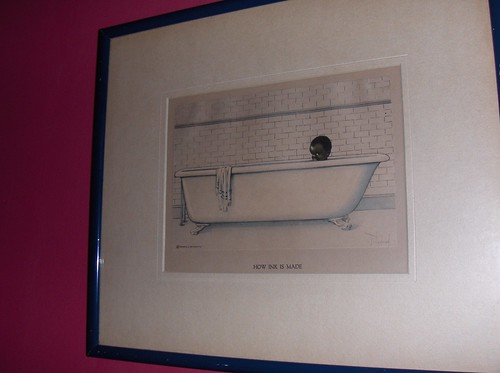
The apartment is very elegant, and the location couldn't be more central. What passes for 'art' in the kitchen might raise a few eyebrows stateside, however:

non-PC kitchen art

Feel free to take the complete virtual tour by clicking

here


Ongoing tally of Borges pieces covered in class so far this visit: 1.

Monday, August 31, 2009

Back on the pampas again!

Actually, that's not strictly true, as Buenos Aires is not exactly pampas country. But you will excuse a little poetic licence due to my exhilaration at being back in B.A.

Where the weather has been very weird thus far. But more of this anon.

Let's just say that I am overjoyed to be back, and that I probably learned more in today's classes than during my entire stay in Santiago.

For now, it's good night. I will keep you posted. I promise.

Friday, August 14, 2009

Two Advantages of Leaving Early

The ability to eat all the remaining rum raisin ice-cream in one sitting, and actually feel virtuous about it. Because nobody likes an ice-cream waster.

Lowered* gift expectations. Obviously, an early departure makes severe inroads into the already paltry amount of time available for souvenir shopping. So it's refrigerator magnets all around, and you should all be damned grateful that you get anything at all.

*: If you hadn't already lowered yours, consider this post your cue.

Leaving Santiago

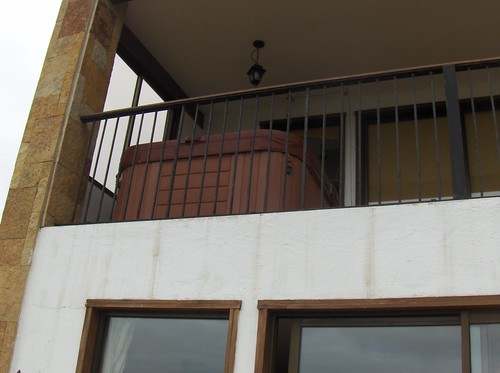
Well, Santiago wasn't all beer and skittles. But there were some definite high points - the visit to Neruda's home in Valparaiso, the wonderful postal and pre-Columbian museums, the party at Brad's uncle Norman's home on Sunday, this week's awesome overnight trip with Norman and Gloria to Cachagua, where we stayed at their beach condo (where I lost my hot tub virginity in their fine jacuzzi):

jacuzzi

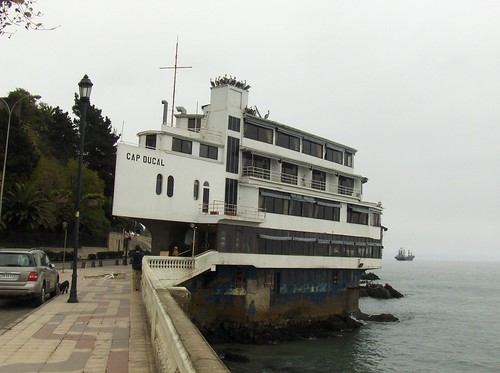
lunch at the pelican-covered restaurant in Vina del Mar on Wednesday:

birdies on the roof

dinner at the fine 80's video restaurant, innumerable pisco sours, the hamster movie, Ice Age 3, a couple of fine movies that I saw at school, including this morning's fascinating documentary about the 'golpe de estado' on September 11th 1973, two excellent symphony concerts, and the prospect of a third one this evening (a program of tango music, which will put me in the mood for Argentina).

Though my time here was certainly not dull, it will be nice to be home again.

Change in Plans

I am cutting my time short here in Chile to take care of some things at home before continuing on to Buenos Aires at the end of the month. Accordingly, I will be leaving tomorrow evening and am scheduled to get back to San Francisco around midday on Sunday.

As I consider the two weeks I will be at home just an unscheduled leg of my original trip, I will continue to post from home during my time in San Francisco. To those in the Bay Area, I look forward to the chance to catch up next week or the week after.

Thursday, August 13, 2009

To my awesome co-author

One of the undoubted highlights of my professional career as a biostatistician was the year I spent writing a monograph together with my good friend and colleague, Marie Davidian. Mind you, I doubt that either of us would have viewed it as a highlight at the time, but I think both of us are actually still quite proud of the result.

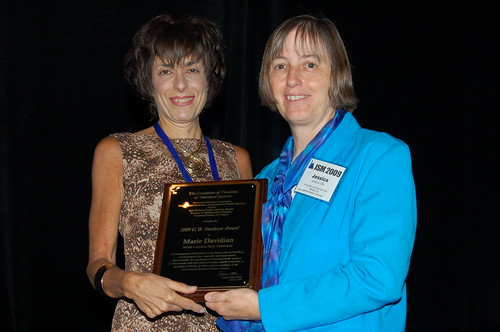
Marie went on to become one of the brightest stars in the statistical firmament. Quite fittingly, her brilliance was acknowledged earlier this month at the annual meeting of the Joint Statistical Societies in Washington DC. A gathering I was quite frankly happy to miss, though I would like to have seen her pick up her Snedecor Award:

Marie receiving the 2009 Snedecor Award

Marie received the award, the top honour in biostatistics, 'for fundamental contributions to the theory and methodology of longitudinal data, especially nonlinear mixed effects models; for significant contributions to the analysis of clinical trials and observational studies; and for leadership as president of ENAR, as editor and as a member of the International Biometrics Society council.' The award, established in 1976, honors an individual who was instrumental in the development of statistical theory in biometry. The award is for a noteworthy publication in biometry within three years of the data of the award. Since 1991 the prize has been given every other year, in odd years, and consists of a plaque and a cash award.

But the woman's talents don't stop there. The immediately following weekend, there she was, with her husband Butch, knocking their socks off in New Orleans, in a frenzy of ballroom dancing excellence, of which this snippet (where she won first prize in her class in the Viennese waltz) is just one example:

Marie and Butch (Viennese waltz)

I've always felt enormously lucky to count Marie among my close friends. This post is dedicated to her, with all my love and admiration.

Monday, August 10, 2009

Photos galore - with actual people!

Yesterday, we were invited to Brad's uncle's. Where there was a terrific fiesta in full swing, in celebration of "el dia de los ninos".

Plenty of pictures here .

Saturday, August 8, 2009

At the pre-Columbian musuem

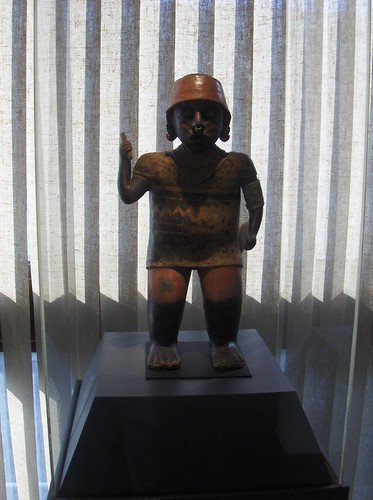
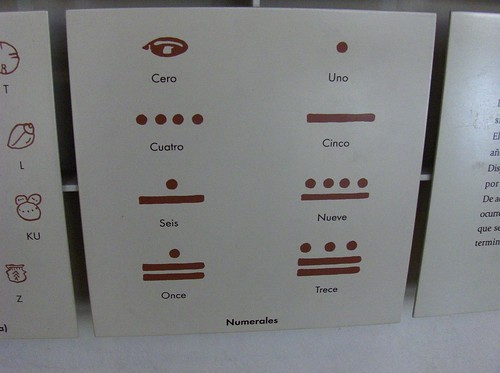
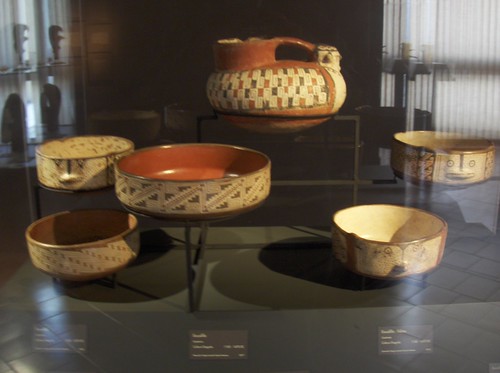
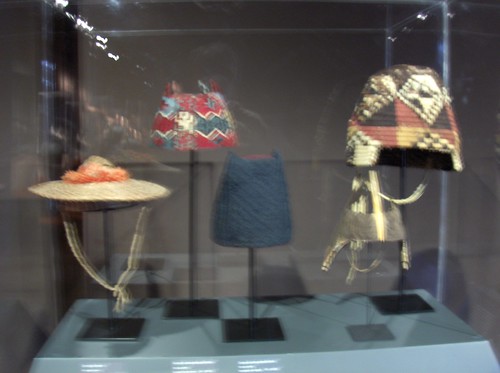
A little group of us from school went yesterday afternoon in lieu of class. And a fine museum it turned out to be - spacious, well laid out, full of some really nifty stuff. Although the setup was not ideal for taking pictures (no flash allowed, and it's very hard to get the exposure long enough without wobbling in such circumstances), I did manage a few.

In my mind, I had been spelling the name of the museum as 'pre-Colombian', which makes no sense when you think about it; the correct spelling is that in the title of this post, as its contents were all artefacts from the time before the European 'discovery' of the Americas. I really enjoyed the visit. Here were some of my favorite exhibits -

Intimidating, but cool

preColumbian statistics

pre-Columbian statistics

cool preColumbian ceramics

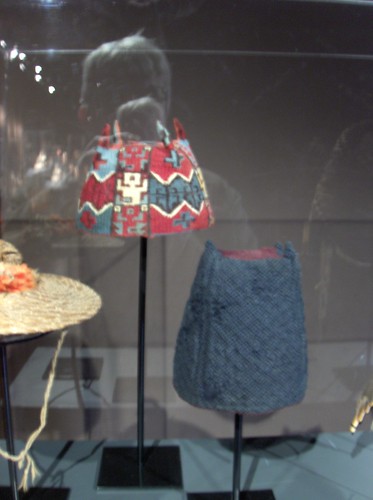
stylin' pre-columbian headgear

I crave one of these little horned hats!

The totally stylin' pre-Columbian headgear was da bomb! Especially the little pointy-horned hats! You have no idea how much I crave one of these.

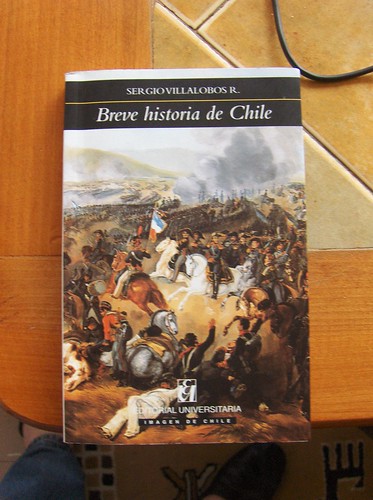
A book to be thrown aside with great force

Dreadful excuse for a book

Who knew jellyfish could write? I'd use the word "emasculated" to describe the author of this pathetic "short history of Chile" if it weren't obvious that to do so would be a grievous inaccuracy. Sergio Villalobos Rivera never had cojones to begin with. Hell, on the evidence, SVR doesn't even have a backbone. Which may warrant the creation of a new bookshelf in my collection - one for "written by invertebrates".

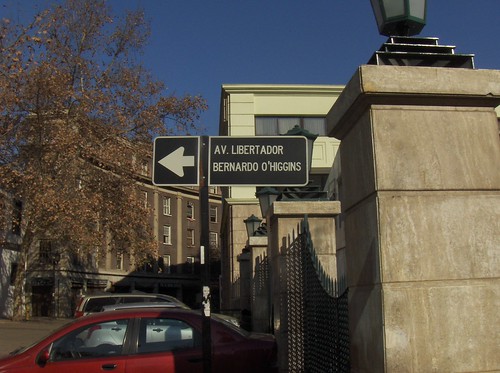
OK, OK. Let me back up. All I was looking for was a "brief history of Chile", as the title of this execrable "book" promised. Enough to get me oriented, so that I wouldn't feel like a complete tourist-bozo during my weeks here in Santiago. Enough to distinguish Ambrosio O' Higgins from his progeny, Bernardo. And maybe to figure out just why the latter is known all about town as "El libertador", even to the extent of having Santiago's main drag named after him. (Understanding why and when the O' Higginses left Ireland would have been lagniappe, as would any available information about Viscount Mackenna, after whom the street where my school is located is named).

Now, believe me, I understand completely that your average reader of this blog probably gives a flying Wallenda about the history of Chile. (Though if you were a U.S. citizen of voting age back in 1973, you might want to ask yourself if such insouciance is wholly justifiable, know what I'm saying?). But please bear with me here. If I don't get some of the incensitude that this "book" has provoked off my chest, I may just blow a gasket. And I shudder to think what Kaiser Permanente's coverage of gasket replacement in a Latin American capital might be.

What's so appalling about this book? Well, everything, really. Here's a short list:

* Despite its 200-page length, it's virtually devoid of information. There's a plethora of generic, meaningless, illustrations which help to take up space, but add nothing whatsoever. Examples: page 78, woodcuts of "mujeres chilenas" in quasi-national garb; page 73, drawing of generic pirate ships; page 66, peasants using wooden ploughs; page 67, a generic grain mill; page 117, drawing of a gentleman in the costume of the era; page 124 drawing of an impoverished peasant; page 114, a ball in the governor's palace; page 93, woodcut of the "building of the tribunal of the consulate", page 58, daily life under the conquistadors. Any of these freaking illustrations could be inserted into the history of any 'brief history" of any Latin American country and nobody would be any the wiser.

* Such text as there is in the book has the texture of cotton wool. Cliche follows platitude follows cliche follows platitude. After a couple pages, you have to stop, because you can actually feel your brain rotting inside your head.

* That spineless quality, alluded to earlier. The fall of the government of Allende is dispatched in less than a paragraph. the atrocities that followed under Pinochet get fewer than 3 lines, including the desultory observation that "more than 3000" people died. The closest Sergio ("Medusa") V-R comes to expressing anything approximating a point of view is to allow that the political situation in 1973 was "very confusing".

"Bah, humbug!", say I. If you are incapable of formulation an opinion, dumbass, then you are not qualified to be writing history books.

On the plus side, I only paid $8 for this piece of basura. But, to put it another way - I PAID 8 DOLLARS FOR THIS PIECE OF TIME-WASTING RUBBISH?

Caveat lector. If, for whatever reason, you are interested in learning more about the history of Chile, be assured you won't find anything pertinent here.

Gaaaaah! Fade, to the sound of gaskets blowing....

Friday, August 7, 2009

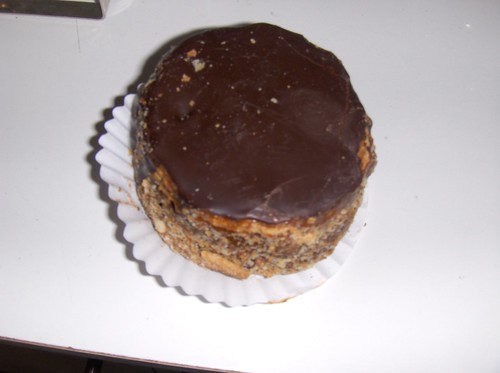
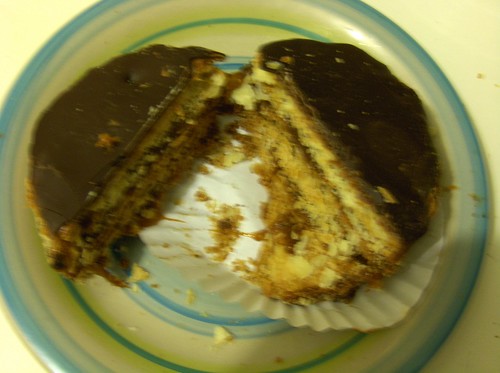
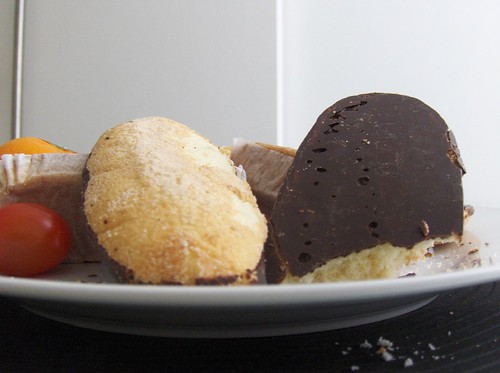
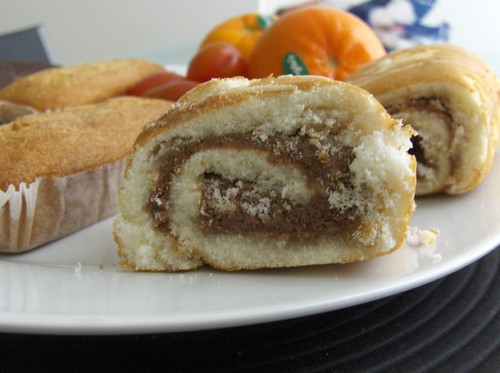
Operation Baked Goods (Santiago Update)

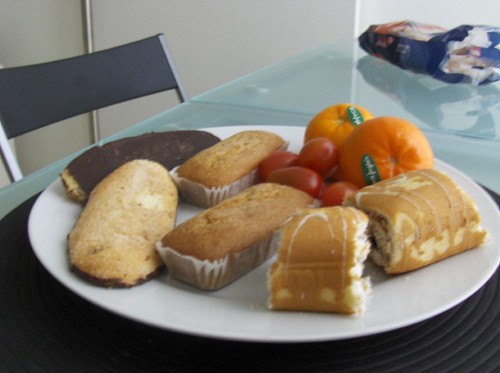
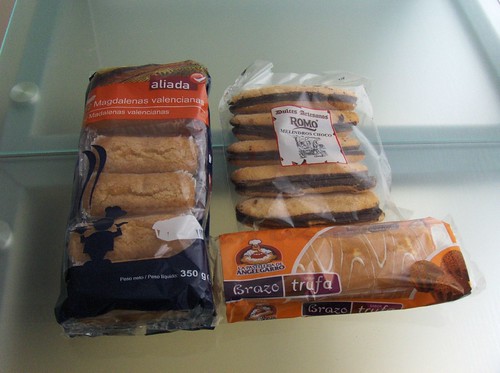
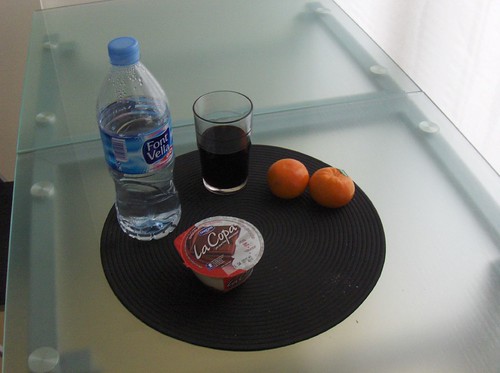
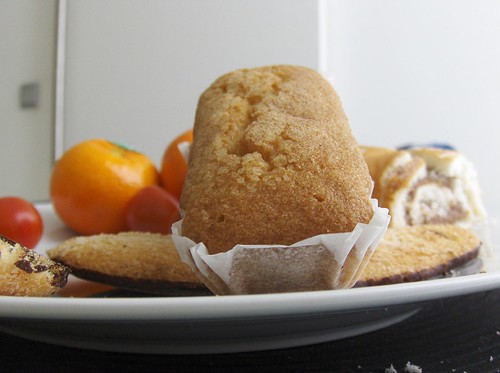
A surprisingly strong showing from the Chilean capital, as suggested by these pictures:

agosto 045

agosto 048

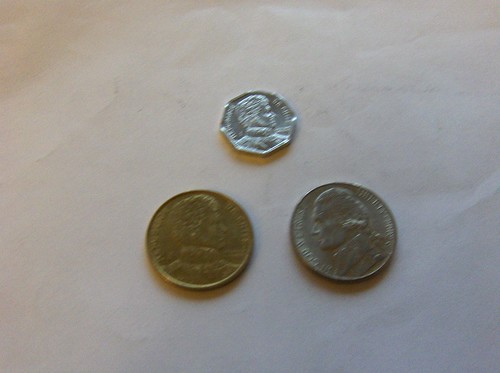
Obligatory coin update

possibly the least valuable coin in existence

Witness the coin near the top of this photo. It is a Chilean peso and must be, by my reckoning, one of the least valuable coins in existence. 540 of these might buy you a U.S. dollar, if the exchange rate is favorable. One wonders why they even bother minting them.

The gentleman whose profile is featured on the coin in question appears to be Bernardo O' Higgins (my eyesight is not good enough to be able to tell with certainty), who is also known around these parts as "El Libertador". I will have more to say about Bernardo, and his pa, Ambrosio O' Higgins, in a future post.

santiago1 101

Thursday, August 6, 2009

Home, sweet (former), home

Since I appear to be in full-blown nostalgia mode, here is a picture of the house I grew up in, taken when my sister and I were revisiting old haunts during our visit to Ireland in May

house we grew up in

It's the red-roofed bungalow in the background.

Hooters comes to Starbucks

The downtown shopping area in Santiago's city centre approximates what you would find in any major metropolis - several blocks of relatively pleasant pedestrianized streets, flanked by department stores, fast food restaurants, specialty shops of various kinds. Including many coffeeshops.

Should you enter one of these latter establishments in search of a cuppa joe, however, there the resemblance ends. Because Santiago is host to a phenomenon that, to my knowledge, is duplicated in no other world capital - that known as 'cafe con piernas' - literally 'coffee with legs'. Enter one of these downtown cafes and you will be greeted by the sight of clusters of lecherous businessmen being served their coffee by baristas decked out in what can only be described as the Latin American equivalent of the Playboy bunny suit. They may not have the little bobtail, but there is at least as much fresh female flesh on display.

Where does this somewhat odd custom originate? Thus far, despite the best efforts of our MOTP research staff, no satisfactory explanation has been found.

Hey, we just report the facts on this blog. We don't control them.

The plain people of Ireland: You don't have any, you know, pictures, do you, by any chance?
MOTP management: How did I know this would get your attention, ye salacious wretches!? No, I do not. Now, be quiet, before I alert Nuala.
The plain people of Ireland: Yerra, sure, there's no need for that. We were just asking, like.
MOTP management: Sigh.

Remembrance of times past

As I sit here, nursing my cup of instant Nescafe espresso, sweetened with several heaping spoons of sugar, and a shot of condensed milk, fiddling with the menacing "heating system" (see earlier post for photographic details), I am strongly reminded of my days as an undergraduate at that fine institution of higher learning, University College, Cork. Perhaps it's the unabashed 70's flavour of the rented apartment, (tiled floor, inadequate heating, generally shoddy construction, furniture that is straight from the seventies, both in its design and colouring). The Nescafe definitely acts as some kind of Proustian trigger, as does the chocolate biscuit I am eating as accompaniment.

Throughout the seventies, there was what appeared to be an unending ad campaign by Cadbury's on Irish TV for one kind of chocolate-covered biscuit confection after another, usually depicting some demoralized kind of bank clerk woman, who would arrive home to her somewhat bleak-looking lodgings, only to give herself up to a moment of instant, orgasmic bliss as she bit in to whatever chocolatey treat was being peddled. The subliminal message was entirely clear, and as subtle as a bulldozer - even if your life is completely humdrum and you live in a hellhole, there is sweet instant relief to be found in a Cadbury's product. It is hardly coincidental that the space given over to sweets and biscuits in your average Irish supermarket of the era would have astounded even the most jaded American consumer. The subsequent havoc wrought on Irish dentition in people of my generational cohort is likely to keep future archaeologists speculating for many a long year.

So here I sit, half-thinking I should be studying for my honours maths exams in September. Only by turning on the TV, tuned to the latest breaking news on CNN Chile, am I able to dispel the overpowering sense of deja vu.

Truth be told, there's something oddly comforting about the whole situation.

Wednesday, August 5, 2009

La vida cotidiana en Chile

Isolated observations:

A standard feature on menus around here is to go all out and order your main course "a lo pobre". This means that your chunk of meat or fish will come garnished with a couple of fried eggs, some onions, and a heap of french fries. Though it can be suprisingly tasty, it doesn't seem like the healthiest of options. Overall, food here is inexpensive and pretty good, though unadventurous (which I personally am in favor of). Vegetables and salads don't feature prominently, though the situation is nowhere near as extreme as it was in Argentina last year.

The infirmity formerly known as swine 'flu has obviously done a number on travel to Chile (and from what I can gather, to Argentina as well). Enrolment at school is at an all-time low, and most restaurants do not seem to be thriving either. Though, presumably one has to make allowance for the fact that it is the dead of winter. (Note to self: why this habit of visiting the southern hemisphere right in the middle of winter - it would be entirely possible to avoid the oppressive summer heat by e.g. travelling in the spring or fall).

I had begun to give up on newspapers here altogether (the local dailies are pretty uninteresting, for the most part, being a little too local for my taste), when after a week I had still been unable to track down a copy of "El Pais" (which was ubiquitous and cheaply available both in Buenos Aires and in Mexico). Finally, this morning, I snagged a copy at a downtown kiosk while showing Brad around. But - que horror - I had to pay about $4 for a copy of yesterday's paper. And a pretty watered-down copy at that. Oh well, things will improve on this front once I get to Buenos Aires.

Brad arrived last night in the middle of the night, after an exhausting flight. We both agree that it's taken longer to get here than anywhere else either of us has ever been. But, to end with a resounding cliche, no pain, no gain.

Tuesday, August 4, 2009

Book Review : Mrs Dalloway

In a remote region of my mind there exists a bookcase. It’s labeled “authors I really should read more of”, and it is – as you might imagine – gigantic. There’s a philosophy corner, where Plato, Kant, and Wittgenstein, among others, are engaged in a bull session for the ages. A.S. Byatt, and Grace Paley share a shelf with Turgenev, Chekhov, and Gogol, right next door to China Mieville, Roberto Bolano, Haruki Murakami and Salman Rushdie. Up on one of the higher shelves there’s the Nobel niche – Nadine Gordimer, Doris Lessing, Iris Murdoch, Octavio Paz are hanging out with Saul Bellow and Isaac Bashevis Singer. Becket has a spot there, but he usually prefers the French quarter, boozing it up with Balzac, Rabelais, Dumas, Hugo, and Colette. And that’s not even the half of it.

Let's be clear. This is a virtual bookcase. It exists only in my mind. Which is a good thing - because it's so completely chock-a-block that, if it existed physically, it would immediately collapse under its own weight. Even thinking about it triggers all kinds of guilt-related synapses. How can I consider myself a true reader when I haven’t read Rabelais? When my acquaintance with Dumas and Hugo is based solely on Saturday morning cartoons and heartwarming Broadway musicals? All the hip kids have read Bolano – why haven’t I?

Sporadically, as some kind of vague gesture in the fight against entropy, I try to tidy things up a little by removing a few authors. This requires me to actually read at least one work by the authors in question, to determine whether they merit transfer to the “authors I want to read more of” shelf or get consigned to the “a little goes a long way” depository. Last month, against all expectations, Henry James made the transition from the “should read more” to the “want to read more” shelf, on the basis of “The Ambassadors”.

Recently, I came across a bargain copy of “Mrs Dalloway”, so I figured it was time to give Virginia Woolf a try. I’d tried “To the Lighthouse” a few times, but never managed to get through it. I’m glad to report that “Mrs Dalloway” was a treat from start to finish – I loved this book. Which is a little unusual, because normally I tend to prefer novels where the plotting is strong, and there is no plot to speak of in “Mrs D”. It was written in 1924, just two years after the publication of “Ulysses”. Joyce may have been the first to use stream-of-consciousness, but it’s hard to argue that he did so successfully – large chunks of "Ulysses" are essentially unreadable, and for much of the book he seems primarily concerned with showing off his own cleverness.

In “Mrs Dalloway”, Woolf gets stream-of-consciousness right. In a deliberate break from established literary tradition, the structure of the book is unorthodox. The action is minimal: the book simply tracks the progress of the main characters across a single day in post World War I London. The narrative changes point of view continuously throughout the book, presenting the different characters’ thoughts and reactions. What amazed me about the book is its richness – though it seems as if we learn very little about a given character in any particular episode in the story, by the end we realize that Woolf’s characterization is brilliant. None of the main characters in the story is particularly likeable, but they are all completely credible and vividly realized. I’m not sure how exactly Woolf pulls this off – some kind of combination of presenting just the salient detail and inviting the reader inside the characters’ heads. Maybe it’s just alchemy. But she certainly manages to make the (often mundane) details of the characters’ lives interesting.

The other aspect of the book that delighted me was the writing. Although the “stream-of-consciousness” narrative entails occasionally complex sentence structure, it’s fairly easy to read, and there are many passages that are simply terrific.

I’m really not explaining this very coherently. I don’t quite know why I liked “Mrs Dalloway” as much as I did. I’ve never read anything else like it. In the end, maybe that’s reason enough for you to consider giving it a shot.

Monday, August 3, 2009

Book Review : "The Scarlet Pimpernel"

I read this concurrently with Victoria Woolf's "Mrs Dalloway". Mrs D. has no plot to speak of -- its virtues are in the characterization and the writing. "The Scarlet Pimpernel" is the direct opposite - its whole point is the plot. The characters are more or less your generic swashbuckling regulars, and the writing ranges from tolerable to truly atrocious.

But perhaps it's a little unfair to burden "The Scarlet Pimpernel" with exalted literary expectations. First and foremost, it's an adventure story. And a damned good one. The Baroness can't be faulted for her handling of the plot - it's hard to see how it could be improved. Great setup, excellent pacing, satisfying ending.

Now, a picky, caviling person might be tempted to find fault with certain aspects of the telling of the story - the unremitting evil of the satanic bad guy, the unbridled nobility of all those British gents, all those revolutionary froggies spouting "Sacres aristos!", with their British counterparts expostulating "Zounds!" and "Odd's life!" in every other line of dialog. Others might complain about this, but I don't. See, for this kind of story, I like my villains villainy. I lap up the cliched historical detail. If there hadn't been a scene with coarse Parisian proles knitting at the guillotine, I'd have felt cheated. And any swashbuckling aristocrat story worth its salt had better have some nobleman whose last name begins with ff. So I enjoyed these aspects of the book just fine.

I'd only have two gentle criticisms for the Baroness:
1. Was it absolutely necessary to name the doddering Jewish character Reuben Goldstein? The word "overkill" didn't cross your mind at all?
2. Why did you make Marguerite such a half-wit? A woman that slow on the uptake wouldn't be able to dress herself in the morning. Though I could imagine her being played by Anne Heche.

But, all things considered, "The Scarlet Pimpernel" is a fine book, well worth giving a whirl. I can see no particular reason to read any of its many sequels, however.

Book Review: "The Ambassadors" by Henry James

This is Daisy Fuentes Miller, reporting to you live from the set of MTV’s “Real World Gay Paree”. Six strangers, from totally different backgrounds, thrown together, forced to live under the merciless glare of the Hankcam, which documents their every move for posterity. Let’s see what happens when the gloves come off, and things get real.

Strether: Hi. I’m Strether. I’m engaged to Chad’s mom. She’s pissed at him, and sent me over to bring him back to Connecticut to run the family business. Paree sure seems like an awesome party town.
Chad: This is the Chadster. I don’t wanna go back to Connecticut. I’m dating this totally hot older lady. Who’s a countess. She’s been giving me some private life coaching lessons. If you know what I mean.
Countess: ‘allo. Zis is Marie. you can call me Countess Cougar. Sacre bleu, but you American boys are fine!
Strether: Damn, that countess is one hot MILF. Chad – no rush about going home. We should just hang out here in Paris and par-tay!

6 weeks later -

Sarah: This is Sarah, Chad’s older sister. What the f*** is going on here? Strether, you’ve been over six weeks already. Mother sent me over. She wants you both to haul ass back to Connecticut, pronto. (You can ignore my fat philistine slob of a husband, Jim. He’s only here to provide a cheap diversion as a lazy stereotype and adds nothing to the plot)
Chad: Chill, sis. This is my girlfriend Marie. Ain’t she smokin? Did I mention she’s a countess?
Sarah: Filthy French slut! Chad, Mother expects you to do your duty.
Strether: Dude, don’t go! It’s a trap.
Sarah: You be quiet! And you can forget about marrying Mother. Which means you’ll die lonely and poor.
Strether: Bite me. Your mother always was one uptight bitch, anyway. I’ll just stay on here. Maybe catch a little menage-a-trois action with Chad and the Countess.
Chad : Not gonna happen, dude! Sis, tell Mom to take the job and shove it. I’m having too much fun tapping aristocratic ass here in Paree. Screw Connecticut.

2 weeks later -

Strether (alone in the confessional room): So Sarah and Jim are on the way back home, with no hanging Chad. My life is totally screwed up. But at least I can be happy about getting Chad to do the right thing, to avoid the money trap, and to choose life!

2 weeks later -

Chad (alone in the confessional room, very drunk): You know, I’ve always thought that advertising was where the future is at..... And, there's no two ways about it, Marie's boobs have definitely been showing some major saggage .... Operator! Get me the number for the Cunard line, please.

Fade, to the sound of Strether whimpering pathetically, off-camera. (Marie, of course, goes on to star in the breakout Bravo series, “Real Housewives of the 4th arrondissement”).

********************************************

OK, I'll come clean and admit that I’ve had a definite prejudice against Henry James for as long as I can remember. But reading Colm Toibin’s “The Master” last month made me think I should give him another try. “The Ambassadors” certainly confirmed my belief in the brilliance of Toibin’s accomplishment. It also changed my opinion of James – though I doubt I’ll ever achieve fanboy status, it was a far more interesting read than I had anticipated. In “The Master”, Toibin gives us a portrait of James in mid-career, focusing on the period between 1895 and 1900. It’s eerily well done – it’s almost as if he were channeling the spirit of James. Although Toibin is an avowed fan, his depiction of the author seems scrupulously honest and right on the mark. The picture of Henry that emerges is not entirely flattering – that of someone who is fascinated by the workings of the very privileged segment of society into which he was born, with a keen, almost obsessive, eye for the subtleties and complexities of the relationships among the various players, and the talent, determination (and free time) to document it in his writing. Even if that came at a certain emotional cost. In James’s case, that cost appears to have been an inability (or unwillingness) to form truly deep emotional attachments. There seems to have been a pattern of his withdrawing emotionally whenever another person threatened to come too close. This was a man who lived far too much of his life in his own head.

It shows in the writing, of course. Every detail of every character’s action, no matter how minor, is picked apart and analyzed. Characters are presented as being engaged in endless analysis and speculation about how to interpret the actions and motives of others. And if it takes a page and a half to pin down the precise nuance of A’s reaction to a casual snub by B, then so be it – James always assumes that the reader has both the time and interest to stay with him. The odd thing is that, although this can be a little offputting at the beginning, ultimately it becomes kind of hypnotic. He is so clearly fascinated by the inner world of his characters that he ultimately draws you in. The plot of “The Ambassadors” is wafer-thin. But the author’s focus on the psychology of his characters is so intense (and so believable) that one is motivated to keep on reading. This was not a dull book.

Much is made of Henry James’s style, and I just don’t get it. This is a man who never met a subordinate clause he didn’t like, with a definite preference for the baroque. Hemingway he’s not. But his penchant for convoluted sentences means that he’s not particularly easy to read. On any given page, there is likely to be at least one sentence that you will have to read three times over, and still not be sure you understand what he was trying to say. (He has a way of nesting negative particles in his various subordinate clauses that is particularly evil – I’d find myself counting them on my fingers, trying to figure things out). Stylistically, the writer he reminds me most of is Thomas Mann, who also had a penchant for long, complicated sentences. At least James wasn’t writing in German, so there is a limit to how convoluted things get. Personally, I don’t consider opacity to be a virtue. YMMV.

A book that was far more interesting than I had anticipated, and which definitely changed my mind about Henry James.


My true colours are just dust in the wind

The original post scheduled for this slot - some pseudo-profound musings about the poetry of Pablo Neruda - has been pre-empted, and will be brought to you at a later date.

But earlier this evening, I ventured forth, with the original intent of going to see "La Edad de Hielo III" (Ice Age 3) at the Cine Hoyt. When I actually got to the cinema, however, it became obvious to me that I wasn't quite up for yet another movie with cute talking 3-dimensional animals, so I wandered off in search of dinner instead.

And found what turned out to be, despite its unlikely appearance, the perfect restaurant. Not so much because of the delicious filet mignon and accompanying house salad (an excellent value at only $14, including the delightful pisco sour aperitif). Not even because of the extremely charming waiter (just the right degree of solicitude, without any of that intrusive hovering that the sight of a foreigner can sometimes provoke). No, the genius of this particular establishment was to be found on the television screens, which showed a loop of all the best MTV videos you've seen in your life.

Starting with Simon and Garfunkel ("hello darkness, my old friend"), moving on through various classics ("Careless Whisper", John Bon Jovi emoting his sweaty heart out, Cyndi Lauper, Phil Collins, "Lady in Red"), it was an instant transport back to the period of one's life when these songs MATTERED. All of a sudden, I was back in the cluster home in Chapel Hill, sitting slackjawed in front of the large-screen TV, watching video after video, secure in the guilty pleasure of ignoring the untackled dissertation topic that awaited me in the bedroom. Something, I regret to report, that I did for a period of at least six months, before conscience and the indignation of my out-of-town thesis adviser finally forced me to go cold turkey on the music videos and turn my reluctant attention to the subject of robust estimation in heteroscedastic regression models.

But what a fine six months they were. And how amazing to find the cheap power of those music videos in no way diminished. Like so many emotional triggers, they just kept firing tonight. As Phil Collins might have put it, there was "something in the air".

I thought for sure, when that apotheosis of emotionally manipulative pseudo-profundity, Kansas's "Dust in the Wind", came on, that the evening had reached its zenith. But no, just as the mozero served my cafe cortado, there she was:

"Turn around...."

Surely not? How awesomely perfect!

"Turn around, bright eyes ...."

Yes indeed, gentle reader. It was Bonnie herself, with the full 7-minute version.

"We're living in a powder keg, giving off sparks ..."

And just like that, this blogger's heart was totally eclipsed. I'm a complete wreck, I tell you. But in the best, happiest, most blissful, sense.

Hasta pronto, mi chiquititas!

Sunday, August 2, 2009

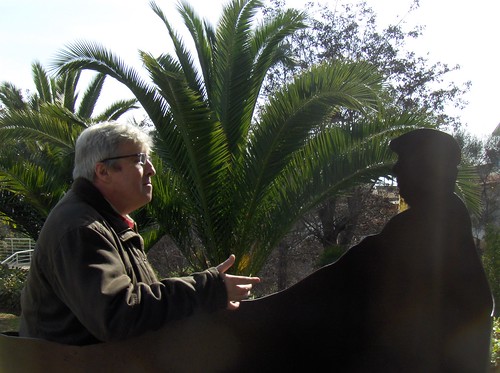
Pablo y yo

Pablo y yo

Discussing some of the finer points of his poetry with Pablo Neruda in the garden of his home in Valparaiso.

Saturday, August 1, 2009

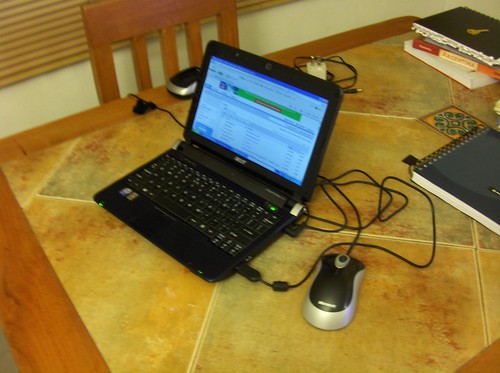
Product placement

My fine ACER notebook

This post is just a quick shout-out to acknowledge the vital role that my fine ACER notebook computer plays in my travels. Brad made me aware of the ACER when he came to visit me in Madrid in March, and I wasted no time in buying one when I got back to the U.S. It's beautifully compact, meets all my needs, has an 8-hour battery life - and at only $350 from Amazon, I consider it a steal. (I did have to equip mine with a mouse, however, given my general lack of trackball agility).

So far I've convinced Emer (my sister) and Paddy to join the ACER club. Maybe you should consider one yourself, for your next trip. You'll wonder how you ever managed without one.

{End blatant product placement. Though if anyone at ACER would like to sponsor this blog.... Oh, never mind! Wouldn't want to compromise my editorial independence...}

The plain people of Ireland: Begob, but that's a handsome machine, no two ways about it.
The management: Why am I not surprised that you would be pleased by shiny gadgetry?

Santiago (continued)

On the plus side:

  • Excellent public transport - easy to use and navigate, and remarkably cheap (about 70 cents to ride anywhere on the system - bus or subway)
  • Excellent supermarkets - well-stocked and well-staffed, and people are extremely helpful
  • Excellent symphony orchestra - after the rigors of Thursday night, last night's concert (Mozart's overture to "The Magic Flute", Richard Strauss's concerto for oboe and small orchestra, and Brahms's second symphony) was extremely comforting. And the price ($14 for an orchestra seat, fourth row center) was certainly right.
  • Generally low cost of living - in general, prices for food and general commodities seem to be pegged at roughly 60 to 70% of those in the U.S. so, while it's not as cheap here as in Buenos Aires, it's certainly very affordable. And certain things (movie tickets, symphony tickets, museum entry) are markedly cheaper than at home.
  • People are extremely friendly and helpful. With the notable exception of the bastard who tried to steal my camera, and that one waitress on thursday evening, everyone has been extraordinarily helpful.

Marginal to neutral:

  • The school, I'd have to say, is not quite what I had expected. It may be that I have hit it at an all-time enrolment low (the number of students in total seems to be no more than about 20, 90% of whom are Brazilian), but the level of instruction has not been all that impressive. As an example, I really could have done without the hour and twenty minutes class time spent on punctuation exercises on Wednesday. Not that comma placement is not important, but it hardly makes for riveting class time. My other minor gripe (which I am assured will be remedied next week) is that I ended up having the same professor for all six hours of daily class time this week, which is hardly optimal. There also appears to be a complete dearth of facilities such as books or DVDs to borrow - every other school I've attended at least had the rudiments of a lending library and other resources for students.
    The mitigating factor is that all of the staff are genuinely nice and very responsive, so that it feels churlish to criticize. It seems likely that limited enrolment is having an effect on the available resources.

Firmly in the negative column:

  • I'm sorry, but there is no way around this. East Berlin - meet your match. This has to be the physically ugliest city I have ever been in. Offered as supporting evidence - I can think of no other city I've been in where there appear to be no postcards on sale. I've scanned multiple kiosks throughout the city, and postcards of Santiago are conspicuous by their absence. I mean, that's got to be considered pretty weird, right? Other than the Plaza de Armas, right in the city center, vistas are pretty grim, though there are occasional uplifting views of the Andes in the distance. This afternoon, I went out with my camera, and here are some of the resulting photos. I don't think I was choosing unduly unrepresentative views:


santiago1 091

santiago1 108

santiago1 103

santiago1 085

This is the apartment building where I live. Let's just say, it's functional.

santiago1 094

Not the guy who tried to bite me. But it could be his cousin.

Am I irredeemably shallow for wishing for something a little more aesthetically pleasing? Possibly. But so be it.

But never mind. Tomorrow it's on to Valparaiso for the day, which I'm assured is far more picturesque.

To his coy mistress

Yes, yes. I hear your mute criticism. This blog lacks poetry. and, you know what? I couldn't agree more. So, to add a little class to what has been an intermittently whiny week, here's Marvell's version of "Carpe diem". (It's not coming completely out of left field - this poem did come up during class discussion on Wednesday)

To his Coy Mistress

Had we but world enough, and time,
This coyness, Lady, were no crime
We would sit down and think which way
To walk and pass our long love's day.
Thou by the Indian Ganges' side
Shouldst rubies find: I by the tide
Of Humber would complain. I would
Love you ten years before the Flood,
And you should, if you please, refuse
Till the conversion of the Jews.
My vegetable love should grow
Vaster than empires, and more slow;
An hundred years should go to praise
Thine eyes and on thy forehead gaze;
Two hundred to adore each breast,
But thirty thousand to the rest;
An age at least to every part,
And the last age should show your heart.
For, Lady, you deserve this state,
Nor would I love at lower rate.

But at my back I always hear
Time's wingèd chariot hurrying near;
And yonder all before us lie
Deserts of vast eternity.
Thy beauty shall no more be found,
Nor, in thy marble vault, shall sound
My echoing song: then worms shall try
That long preserved virginity,
And your quaint honour turn to dust,
And into ashes all my lust:
The grave's a fine and private place,
But none, I think, do there embrace.

Now therefore, while the youthful hue
Sits on thy skin like morning dew,
And while thy willing soul transpires
At every pore with instant fires,
Now let us sport us while we may,
And now, like amorous birds of prey,
Rather at once our time devour
Than languish in his slow-chapt power.
Let us roll all our strength and all
Our sweetness up into one ball,
And tear our pleasures with rough strife
Through the iron gates of life:
Thus, though we cannot make our sun
Stand still, yet we will make him run.

Andrew Marvell, 1621-1678

OK. I admit it. I've always had a certain fondness for those metaphysical poets. Marvell may not be quite at the level of Donne, but "To his Coy Mistress" is a delight from start to finish.

The plain people of Ireland: What is this? This blog is nothing but recycled poetry and whining.

The management; I understand how that impression could arise, but here at MOTP central we are actively working on the problem. Have a little patience, my little empanaditas!

Thursday, July 30, 2009

If it weren't so pathetic, it'd almost be funny

First things first. Let me assure everyone, I AM JUST FINE. Just majorly outraged. But things here are rapidly approaching farce levels. On my way to dinner earlier tonight,(where the service was as charming as a rusty nail), I survived (a) an effort to steal my camera (unsuccessful, but leaving me with severe wrist burn from the camera cord) and (b) five minutes later, having one of the mangy wild dogs that roam the pavements of the city sink his filthy fangs into my sleeve (nowhere near penetration of skin, given the many layers I was wearing).

But by my count, that's two strikes. One more, and I'll be on the plane to Buenos Aires before you can say "Pinochet".

Santiago, consider this a warning that you are ON NOTICE! There are certain outrages up with which I shall not put.

On the home front

We had a few home improvements since my trip to Ireland in May. (Pretty much all the credit for these is due to Brad, God bless him)

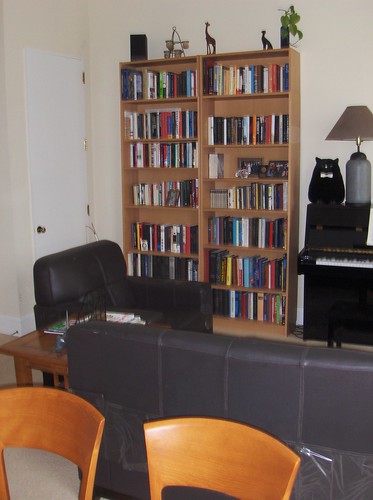
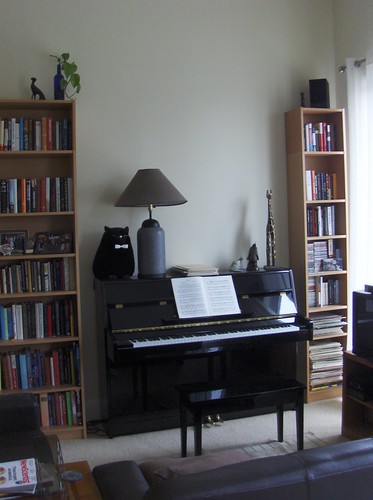
bookshelves!

New bookshelves in the living room, as well as a new couch and armchair (suitably Natasha-proofed)

june2009 114

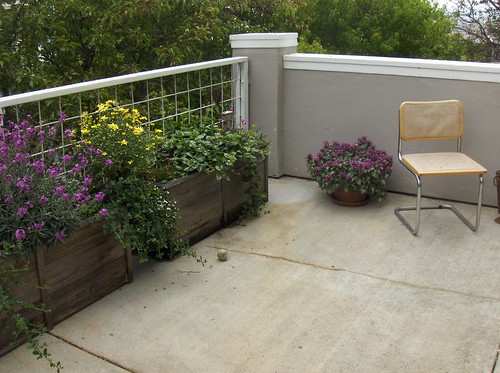
A riot of color out on the deck!

june2009 115

june2009 116

the deck

june2009 119

riotous color

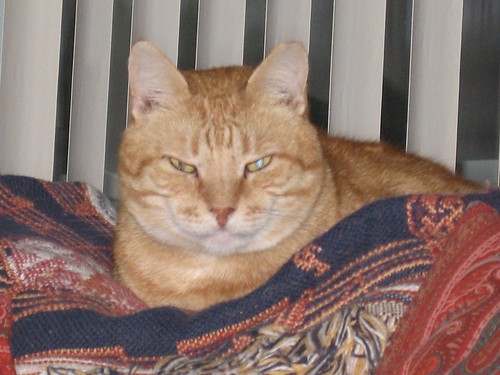
Sadly, the deck is now off-limits to Boris, after his BIG ESCAPE CAPER in June. He is not particularly happy about this, as you might imagine.

Boris the belligerent

More about Santiago

Well, after my slightly ill-natured first post from Chile, I feel obliged to give this update, just to say that everything is now going much better. Things have warmed up, both literally and figuratively. Classes are going well - yesterday we went on an afternoon excursion to the Villa Grimaldi, which deserves its own separate entry (I will get to it in due course); last night I went to see the delightful Fuerza-G, with most convincing 3-D hamsters. Tomorrow evening I have a ticket to the symphony (with a fine middlebrow program of Mozart, Strauss, and Brahms - none of that Stockhausen stuff), and Sunday there is an excursion to Valparaiso. So things are looking up, even if I am still terrified by the gas heater in the apartment.

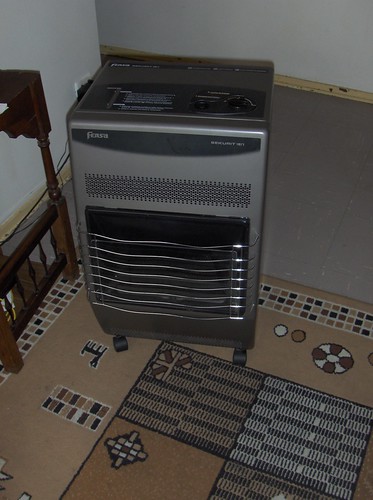
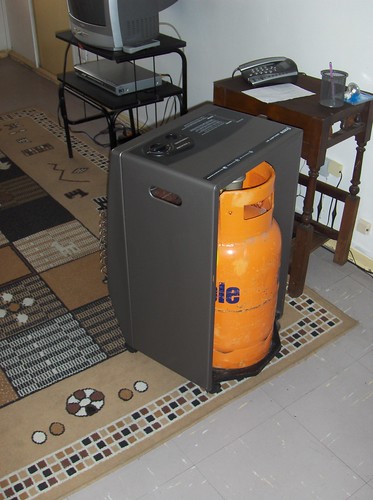
Terrifying heating option (front)


Terrifying heating option (back)

Fortunately, Brad arrives next week for ten days, so all I have to do is not blow myself up or gas myself between now and Wednesday. As he is a god as far as all tbings mechanical go, I'm sure he will sort everything out.

To be clear, I can actually get the heater going, just at an enormous psychic and emotional cost. As I have noted previously in this blog, the mechanical aspects of the physical world are not exactly my forte. It may be difficult for some readers to imagine being terrified by machines and gadgets, but for some of us, this is an everyday reality.

More photos shortly, as soon as I can get them uploaded.

An unexpected conversation

One of the joys of foreign travel is that you often end up having the weirdest conversations, the kind that you could never imagine. Bordering on the surreal. Such as this little snippet, which you might have overheard yesterday evening, had you been lurking in the lobby of my apartment building. (As background, earlier in the evening, the doorman had been very helpful in explaining to me how to get to the movie theater, so that when I got back, I felt I owed him at least a partial report on how things went) -

Concierge-dude: ¿Qué tal la pelicula? De qué se trató?
Me: Bueno. Trató de un grupo de hamsteres, que eran agentes especiales del FBI. Y también hubo un topo que tenía planes de dominar el mundo, y un cientifico loco. Pero los hamsteres podían salvar el mundo, por que eran hamsteres muy especiales .. Eran la FUERZA-G

(There were these hamsters who were special agents for the FBI, and a mole with plans of world domination, and this mad scientist .... )

I don't know which of us was laughing harder. Maybe you had to be there.

Tuesday, July 28, 2009

Dateline Santiago

I imagine that it will become clear to me at some later point why visiting Santiago in the dead of winter seemed like such a good idea. I may need to thaw out first though.

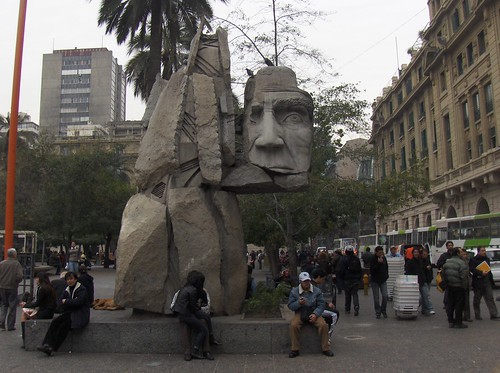
plaza de armas, santiago

Here's the requisite picture to show I've arrived. More to follow, once I have regained my equilibrium and a modicum of good humor. Which is to say, once I've slept off the effects of the long trip and warmed up a little. Assuming that's actually possible.

The good news. School is great, and everyone is extremely helpful and charming. Which almost compensates for the extraordinary ugliness of the city. We're talking seriously ugly, alas - think East Berlin in the 1970s.

But hey - it keeps things interesting. Now, I have to go fiddle with the terrifying gas heater before my blood actually congeals. I haven't been this cold since my childhood back in Ireland.

Hasta luego, my little empanadas!

Friday, April 17, 2009

Drogging While Blunk

Well, gentle readers, we knew it would come to this. But I feel that I can retain a certain amount of dignity by pointing to the fact that there have been 507 posts, written while I was completely sober, before this one. Where I am definitely - hic! - not.

There are two clearly identifiable factors which have led to this situation. In no particular order, they are:

april_17 001

Alex, my absolutely charming Parisian classmate with the unpronounceable Basque surname,

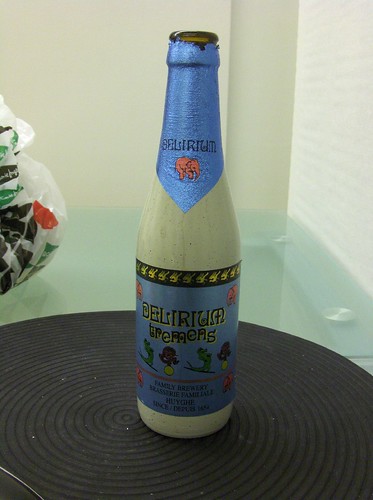
delirium tremens 002

Any beer which features dancing pink elephants on the bottle is not to be taken lightly.

Anyhow, it seemed like the most natural thing in the world to join Alex for a farewell beer or three after class. After three inferior Spanish beers, it seemed even more sensible to continue our drinking session in the apartment with some infinitely superior Belgian beer, before meeting up with some of the other students at eight o' clock to continue drinking.

In retrospect, it might have been a good idea to build in more food opportunities into our plan.

But not to worry, eight hours later, I am home safe and sound. (Alex and the others were last seen in some delightful, nameless, smoky bar in the Lavapiés district).

Why blog in an obviously intoxicated state? Well, because, for one reason or another, I can't remember when I've had as much fun as I've had this week. With today being a particular highlight. I am happy to be heading home, because two months away is a long time. But it seems important to record for posterity, just how much of a blast I've had here in Madrid. It's been a gift, the entire time.

And if I can't take the time out to acknowledge that on this blog, then I shouldn't be blogging in the first place.

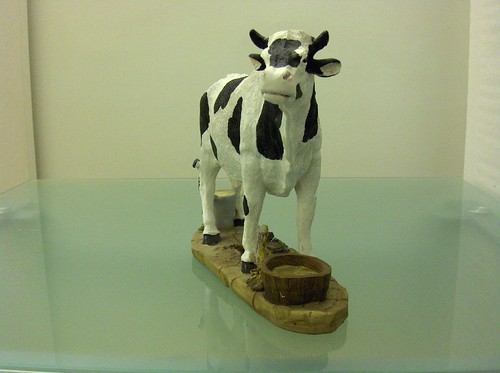
Another happy note is that when Alex saw Elsie,

Elsie looking ... well... bovine

it was love at first sight. So that I can now leave Madrid, knowing that Elsie will be left in a loving home.

I am *so* happy right now. (And not nearly as drunk as I pretend to be. But definitely tipsy).

My flight leaves Madrid tomorrow at around 4:30 pm. God willing, I should arrive back in San Francisco on Sunday evening, after breaking my journey by staying overnight chez Paddy in Alexandria.

Signing out for this particular blogstage.

Abrazos.

Wednesday, April 15, 2009

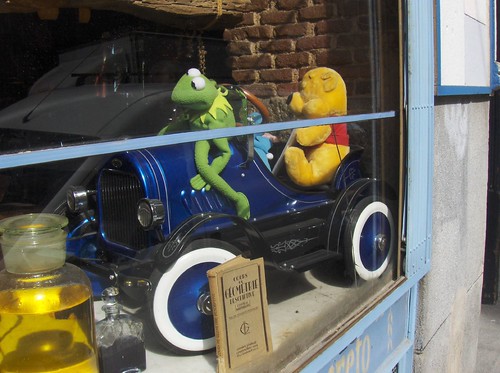
Kermit and Pooh go for a Ride

april_15 001

Tales of the Pampas (Search Engine Poetry)

Poetry constructed using only search engine terms by which people arrived at this blog. The only modification I have made is to change the punctuation in a few places.

1. Speak to me Jimmy !!!

Tony's fat.
Tubermensch.
Pig of the sea.
"What would I look like 4 stone lighter?"
The unfeasibly tall Greek billionaire.
Sinuous trophy wife.

2. On the Pampas Vocabulary Activities

Reina Sofia metrosexual,
Jet lagged hamster,
Static strips for motion sickness,
Raves on the pampas.
Sweaty men.
Beef extract.
Pampas meat.

Pampas meat?
Guinea pigs, baby!!!

3. The Case of the Marmalade Cat

Los Gatos deaths.
Desiccation syndrome.
Bagpiper's lung fungus.
Fat coma.
Caisson disease constipation.
Camilla Windsor accident.
Marmalade cat.
Cat of doom.

4. Does Travel Broaden the Mind or is it just a Waste of Time and Money?

Four reasons why travelling broaden the mind.
Raccoons in space.
Guanajuato strip clubs.
Hello Kitty, Chapel Hill.
Segovia aquaducks.


5. Mainly on the Plain

Pandas in action.
Squid and frog.
Two-headed bunny.
Doctor Ruth.
Traceable jackalope.
Puddy tats.
Laundercats.
Javelina siege.
Itzcuintli dog with me.

Hideous, ugly, animals.
Keep track of your flock.

Ethel the aardvark goes quantity surveying.
Don Quixote goes to the movies.

The rain in Spain falls mainly on the plain
And there is love,
But also pain.
And the rain.

Tuesday, April 14, 2009

Susan Boyle

Someone over on the Salon TableTalk board alerted me to this link:

http://www.youtube.com/watch?v=9lp0IWv8QZY

Two years ago, I blogged about Paul Potts, who went on to win that year's "Britain´s Got Talent" contest. The video in the link has that same heartwarming quality - you may tear up a bit watching it. The best part is watching the judges' reactions.

Thanks to Inara for pointing me to the link in question.

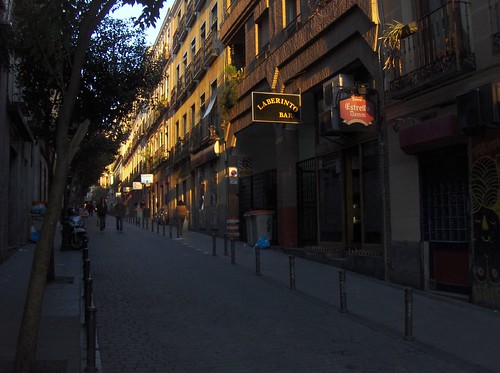
Streets of Malasaña

I have created a new Flickr photoset here . Almost all of the photos were taken on my way to and from school.


april14 041

Enjoy!

Monday, April 13, 2009

The cost of living

Yesterday, I wrote a post about the economic crisis ("la crisis") affecting Spain, and suggested that its effects were not all that obvious here in Madrid. On a related note, I thought it might be interesting to provide some anecdotal data about the cost of living here, from a personal point of view.

The first thing to note is that the exchange rate is a little more favorable now than it was two years ago. Given that prices of many items appear not to have changed perceptibly (perhaps a 5% increase in things like the price of a newspaper, cup of coffee, or a beer, which is offset by the improvement in the exchange rate), I have no sense that things have gotten more expensive. In fact, since I had paid for my three main expenses - travel to and from Spain, seven weeks of classes, and two months rental of the apartment - upfront, the amount that I spend weekly is relatively low. Definitely lower than my day-to-day expenses in San Francisco (though obviously certain monthly expenses in SF - mortgage, utilities, phone and DSL service, health insurance and the like - continue in my absence).

But daily expenditures here don't amount to all that much. I generally have breakfast in the break between my first two classes - 2€ for coffee and a pastry. Then, at 3pm, after my conversation class is finished, it's time for lunch (my favorite couple of hours in the day). A couple of days a week I will generally eat lunch with some of the other students, or some of the teachers in the school; three days a week I eat lunch on my own, with time to read the newspaper at leisure and mark my vocabulary words. Lunch in Madrid is definitely the best value going. Almost every restaurant or bar offers a fixed price, three-course meal, beverage included, for somewhere between 9 and 12€ (1 euro = roughly $1.30). Often, I will finish at around 4:45 or so, which leaves a couple of hours until my 7pm culture class. Having eaten a full lunch during the day, going out to dinner seems pointless, so I generally pick up the makings of a light meal to prepare at home (maybe another 5€). Which ends up at around $25 a day for food. Going to the movies is also fairly cheap (5 to 7€, depending on the time of day). The newspaper is 1.10€ during the week, double that on Sunday. The metro, and city buses, are a steal - you can get a 10-trip ticket for less than 7€. So that I seem to end up using the cash machine far less often here than at home.

Hotels are also pretty reasonable. Obviously, it's possible to spend a lot of money, if you choose a particularly fancy hotel. But, to give a reference point, the Ateneo, the three-star hotel where Paddy stayed during both visits here, which is right near the city center (but very quiet), offers a double room, single occupancy, for just 75 to 80€ a night (the desk guy was so smitten with Paddy that he comped her several free breakfasts at the buffet, though it technically wasn't included in her room rate).

So, if you haven't yet made travel plans this year, maybe you should consider España.

Sunday, April 12, 2009

Ruthless Rhymes for Easter

Little Willie

Little Willie, feeling mean
Pushed his sister through a screen
Mother stopped his innovations
Said it made for strained relations.

Willie and three other brats
Ate up all the Rough-On-Rats;
Papa said, when Mama cried,
"Don't worry, dear, they'll die outside."

Necessity

Late last night I slew my wife,
Stretched her on the parquet flooring;

I was loath to take her life,

But I had to stop her snoring.


Calculating Clara


O'er the rugged mountain's brow

Clara threw the twins she nursed,

And remarked, "I wonder now

Which will reach the bottom first?"


"Ruthless Rhymes for Heartless Homes"
"Col. D. Streamer" (pseudonym of Harry Graham)


La Crisis

So, although Thursday and Friday were official holidays (and Madrid was deserted, making me doubly glad that I didn't push myself to go to Bilbao), Spain did get a new government this week. On Tuesday, accompanied by the usual fanfare and gobbledygook, Prime Minister Zapatero announced a major reshuffle of his cabinet. The main change appears to be that the new cabinet is composed of more hardline socialists, and that - for the first time in the country's history - a woman will head up the Ministry of Economics. Specifically, this woman, Elena Salgado:


(picture found here )

As an article in today's "El País" points out, she will have her work cut out for her. Unemployment here in Spain is creeping up inexorably towards the 4 million mark, assorted banks have failed and had to be bailed out within the past six months -- it's the same, sad, familiar story as everywhere else.

When we were in Andalucia last week, the signs of "la crisis" were obvious. Other than one other couple, we appeared to be the only guests in the hotel. Cafés and bars were relatively deserted. It was a marked contrast to two years ago, when I was in Seville at pretty much the same time of the year and the place was bustling with tourists. Here in Madrid, signs of the crisis are not as immediately evident, but are fairly obvious once you keep your eyes peeled. One example that comes to mind is that both churches that I pass on the way to my 7pm class have long lines of folks waiting for the soup kitchens to open at 7 o'clock. Something that, if it was happening two years ago, I have no recollection of seeing.

Nonetheless, there are still crowds of shoppers at El Corte Inglés, and pretty much everyone managed to get out of town this weekend, so whatever the true dimensions of "la crisis", it doesn't yet appear to have hit the madrileño middle classes very hard.

Future Plans (and Champagne)

It occurs to me that I have blogged very little about my day-to-day life here in Madrid during this trip, so I thought I'd try to remedy that as I head into my final week. I think part of the reason is because I've been so happy here - somehow calamity and adversity seem to make for better blogfodder than day-to-day contentedness. It has been a wonderful trip, providing further confirmation for the observation that it does me a power of good to get up off my rear end and get out of San Francisco. Those winter reading marathons are enjoyable in their own way, and raise my profile over on the goodreads site, but nothing beats actually getting out of the apartment and out of the city. As always, even the mundane stuff is more fun when you do it in a foreign city and in a foreign language.

The only problem is that I'm not sure how long I can continue to use learning Spanish as a pretext for my travels. Although classes at Don Quijote have been enjoyable, and my Spanish has continued to improve, the inescapable truth is that the gains at this point are somewhat marginal, at best. This time around I placed directly into the highest level, where I had the distinct feeling most of the time of being well ahead of my classmates, at least as far as speaking ability is concerned. I slacked off a bit on the grammar this time, largely out of boredom, but also due to a certain degree of laziness. As always, the teachers at dQ have been wonderful; I wouldn't say the same for my classmates, a few of whom I actively dislike. Though it's tempting to elaborate, I will leave it at that, because I don't want to offend anyone unnecessarily who might end up reading this blog. I'm just glad that I didn't sign up to stay through the advanced DELE exam in mid-May, because faced with the option of preparing for it with the particular group assembled in Madrid, I would have had to flee to Salamanca.

Anyway, I think I can justify one more trip to Latin America (with maybe a side trip of a week or two to Costa Rica), probably in the July-September time frame. I very much want to go back to Buenos Aires, as well as seeing more of Argentina, and would like to spend some time in Chile as well. The Don Quijote school in Cuzco, in contrast, at an elevation of 11,000 feet, holds no particular attraction. After that, I will be faced with a major decision - either try to put my knowledge of Spanish to practical use by, e.g. seeking a visiting academic position in a Spanish-speaking location (something I intend to look into seriously as soon as I get back to SF), or start afresh with a new language, most probably French. Interestingly, one thing that doesn't tempt me in the slightest is going back to practice statistics within the biopharmaceutical sector - I spent a very enjoyable 25 years doing that, but have no particular desire to do it again. And, though it's taken me two years to reach this point, I also no longer feel guilty about not wanting to go back. But I do need something to get me out of San Francisco, even if it's for only half the year, as I have a definite tendency to fall into a rut if I stay there too long.

Anyway, the plan for the immediate future* is to go back and take care of my taxes, go down to visit my friends Peggy and Andy in Southern California round the beginning of May. Then fly to Scotland and Ireland to visit friends and relatives there, and to meet up with my sister Emer and her husband Dale, later on in May. In June I hope to spend some time on the east coast (DC, Baltimore, New York, Chapel Hill) to catch up with friends there, before taking a longer trip to Latin America, starting in July. The big question is what happens after that, but right now I'm happy enough to map things out six months at a time.

I know, I know. Everybody should have such problems. Trust me, I count my blessings every day.

*: Major props are due to Paddy, Katie, and Adam for helping me shape this plan, and for making it clear in no uncertain terms that if I showed further signs of falling into a vegetative rut in San Francisco that they would personally mount an intervention to save me from myself. I love them all dearly, more than they can possibly know.

The plain people of Ireland: Yes, yes. That's all very interesting, but aren't you forgetting something? Isn't there some occasion you want to mark?
MOTP: ?! Oh, yes. Sure. Happy Easter to all my readers.
The plain people of Ireland: Not that. Something else, maybe?
MOTP: Ah, yes. Of course. It's champagne ye're after isn't it? Well, have a pew and join me in a glass to celebrate this, the quinquecentennial post on this blog.
The plain people of Ireland: Yerra, we thought you'd never ask. Still, five-hundred, that's not too shabby at all.
Fade to the sound of ribald celebration.

Saturday, April 11, 2009

Fake Words (Corporate Edition)

  • Exxonerate: to display excessive leniency towards companies charged with environmental pollution.
  • Michelinzer Torte: a fruit tart with a strange, rubbery consistency.
  • Aviscerate: to total one's rental car; alternatively, to steal the engine out of a parked rental car.
  • Benettoner: multi-hued all-purpose toner for color copiers.
  • Go for a Halliburton: to absquatulate, to pull a disappearing act after embezzling huge sums of money.
  • Firestonewalling: to block an opponent's passage by erecting a barrier of old tires; the burning of tires as a form of civil disobedience during a gay rights demonstration.
  • Cingularity: a communications black hole.
  • Chrysleriana: Schumann's recently discovered "Detroit suite" for piano.
  • Heinekenning: a characteristic feature of 19th century German romantic poetry. Example: Hopfenblut, or "hop's blood", meaning "beer".
  • Dijon Vu: the feeling you've tasted this mustard before. (I cannot take credit for this, alas)

and a few other, non-corporate, terms -

  • Feefifobia: fear of giants.
  • Fobia: fear of misspeled words.
  • Bentholaryngomania: an obsession with the movie "Deep Throat".
  • Ichthyodigitalophagist: an eater of fish fingers.
http://news.bbc.co.uk/1/hi/uk/4282290.stm
  • Sherpes: a viral infection endemic to the Himalayas.
  • Blandau: An undistinguished four-wheeled carriage; the antithesis of the hansom cab. Not quite as passive-aggressive as the sulky.
  • Warmageddon: the likely result of uncontrolled climate change.

Mountweazels

Ever heard of Lillian Virginia Mountweazel, the famous photographer who perished prematurely in a terrible accident while on assignment for "Combustibles" magazine?

Or did she? In fact, mountweazel was an infamous "fake" entry in an edition of the New Columbia Encyclopedia, inserted as a deliberate trap to catch potential lexicological plagiarists. The name has since become synonymous with any similar trap, generally a fake word or name devised by reference-book editors to trap plagiarists. In the world of cartography, it is not uncommon to invent non-existent streets, or to place non-existent curves in existing streets, with the same purpose in mind.

Another recent example in the world of dictionaries is the "word" esquivalience. From Wikipedia:

Esquivalience, according to the August 29, 2005 New Yorker article "Ink: Not a Word" by Henry Alford, is a fictitious entry in the New Oxford American Dictionary (NOAD), which was designed and included to protect copyright of the publication. The word was invented by Christine Lindberg, one of the editors of the NOAD. It was leaked that the dictionary had put in a fake word in the letter "e" and Alford set out to find the word. It was discovered after review of a short list by several experts. When the editor, Erin McKean, was contacted she admitted that it was indeed a fake word and had been in since the first edition, in order to protect the copyright of the CD-ROM edition.

The word is defined as "the wilful avoidance of one's official responsibilities."

Other examples, in similar vein, include the delightful (but completely imaginary) food items: funistrada, buttered ermal, and braised trake.

Funistrada is an imaginary food name invented by the U.S. armed forces to see if participants of written food surveys were paying attention or just answering randomly. In a 1974 survey respondents ranked funistrada higher than eggplant, instant coffee, apricot pie, harvard beets, canned lima beans, grilled bologna, and cranberry juice. Two other imaginary foods fared less well - buttered ermal and braised trake.

A more dangerous food item is the infamous Swedish lemon angel, whose recipe calls for combining lemon juice and baking soda; if attempted, the result is the same as making a vinegar-and-baking-soda volcano.

Maybe it would be best just to stick to lamb for Easter lunch.

More about this subject can be found under the Wikipedia article on fictitious entries: http://en.wikipedia.org/wiki/Fictitious_entry

The Hazards of Reading Hamlet

From "The New York Times", December 27th, 1907:

POURED LEAD INTO HIS EAR.; Belief Is That Conkling Had Been Reading "Hamlet."
Special to The New York Times.
MIDDLETOWN, N.Y., Dec. 26. -- James H. Conkling, a prominent business man of this city, is in a critical condition in Thrall Hospital, suffering from the effects of molten lead, which, it is believed, he himself poured into his right ear with suicidal intent.

Full story here, in pdf format

Book Review : How to Live (Henry Alford)

Third in a series of three reviews of books which address some of the issues associated with aging.

How to Live: A Search for Wisdom from Old People (While They Are Still on This Earth)

A more accurate title for this book would be "Growing Old Gracefully", as it's obvious that the question Alford is really interested in is "How should we come to terms with our own mortality?" He decides the best way to find out is to ask a bunch of elderly people, then try to distil key life lessons from the resulting conversations. Framing this process as a “search for wisdom” doesn't help particularly, and occasionally causes him to get sidetracked into some fairly unproductive academic discussions. It’s not surprising that encouraging people to talk about their own lives works far better than asking them about “wisdom” in the abstract, an approach which, predictably, yields mostly just bland generalities.
As a general rule, his success is inversely proportional to the fame of the interviewee. Conversations with Harold Bloom* and Edward Albee lead to unhelpful pseudo-profundities like “wisdom is a perfection that can either absorb or destroy us”, and pointless exchanges about the dictionary definition of “wisdom”. A series of meetings with actress Sylvia Miles reveal little more than her apparently bottomless self-infatuation. The most interesting thing that is gleaned from self-styled guru Ram Dass’s pontification on “wisdom” and “spirituality” is his admission that he doesn’t plan to attend his own brother’s funeral. This, quite rightly, bothers Alford, though he later suggests that Dass is redeemed by the calm acceptance he displays in the aftermath of a disabling stroke. It’s unclear whether this reflects Alford’s innate generosity of spirit, or an unwillingness to admit to himself how worthless his pilgrimage to meet with Dass has been. Sandra Tsing Loh has already written more about her eccentric father than anyone might possibly want to know, so Alford’s decision to include further anecdotes about Mr Loh’s dumpster-diving and public urination is baffling.

* I should add that the most memorable response Alford elicits, in an otherwise fairly ho-hum interview with Bloom, is in answer to the simple question “What have you gained with age?” Bloom: “A healthier respect and affection for my wife than I used to have...” (smiles) “Next May will be our fiftieth anniversary”. Somehow that moment of sweetness makes one forgive Professor Bloom many of his more pompous utterances over the years.
Fortunately for Alford, and for the reader, his conversations with less well-known senior citizens are more rewarding. The best chapters of this book are those in which Alford describes meetings with ‘ordinary’ senior citizens: Charlotte Prozan, a San Francisco psychotherapist he met on a cruise organized by The Nation; Althea Washington, a 75-year old retired schoolteacher who lost her husband and her house in Hurricane Katrina; Setsuko Nishi, 86-year old professor emerita of sociology at Brooklyn College and CUNY; Doris Haddock (aka Granny D), who staged a 3000-mile walk across America in support of campaign finance reform back in 1999, when she was still a spry octogenarian.
Most affecting of all are the author’s conversations with his own mother and stepfather. In what comes as an obvious shock, shortly after he interviews each of them, his mother (aged 79 at the time) asks for a divorce. Alford’s account of the events that follow, and the reverberations throughout the family, is remarkable for his ability to navigate obviously treacherous emotional territory without ever becoming exploitative or judgemental. In all of his writing, one senses that Alford is fundamentally a true mensch, a really decent guy. It’s part of what makes his work so enjoyable, and it really serves him well here. His writing about his family is funny and moving (never exploitative: David Sedaris, please take note), and is one of the best parts of this book.

Interspersed among the conversations are the results of Alford’s auxiliary research – what various philosophers have to say about wisdom, what other cultures have to offer on the subject. There is also a (desultory) consideration of deathbed confessions and famous last words as possible sources of insight. These are, at best, intermittently amusing.

This book is a departure from Alford’s previous work, the two collections “Big Kiss” and “Municipal Bondage”, humorous essays reminiscent of, and often much funnier than, the work of David Rakoff and David Sedaris. Though his choice of subject here doesn’t afford him the chance to be as hilariously funny as he was in the earlier books, he is witty and engaging throughout. The interviews with Bloom, Dass, and Albee would have benefited from a little less deference: one gets the sense that Alford was holding his natural snark in check. “How to Live” doesn’t quite have the mischievous exuberance that made “Municipal Bondage” such a joy to read, but it does have compensating virtues of it own, particularly the interviews with ‘ordinary seniors’ and Alford’s extremely moving writing about his own family.

I had expected Henry Alford to be charming. Who knew he could be wise as well?

****: Four stars out of a possible five.

Book Review : Deaf Sentence (David Lodge)

David Lodge is not a flashy writer, but he is an extremely good one. Superficially, his predilection for working the same, relatively narrow, ground (he is a master of the academic novel) might seem constricting. But each of his novels delivers fresh insights, with his signature blend of intelligence, wit, and genuine affection for his characters.

"Deaf Sentence" is no exception. Although it's not as hilariously funny as some of his earlier books, it is - like all of his work - compulsively readable, and ultimately very moving, in an understated kind of way. Lodge's description of the various indignities that deafness brings is hilariously funny and so utterly convincing that you know it has to be based on first-hand experience. There is far more wisdom about aging in this unassuming story by Lodge than, for example, in Julian Barnes's recent, migraine-inducing, bloviation about his own mortality.

When I think of the trio of Julian Barnes, Martin Amis, and David Lodge (I try to think of Christoper Hitchens as little as possible), restaurant analogies come to mind. Amis is the risk-taking molecular gastronomist, brashly confident of his own genius, and hey - if the diners don't always appreciate the flashiness, that’s not his problem. To his credit, when he’s on target, he can be sublime. But the brilliance is hit-or-miss. Barnes is closer to Amis than he might care to admit, thought perhaps not writ quite so large. In general, the quality of his work doesn’t fluctuate quite as much, but he is still capable of succumbing to navel-gazing, and cleverness (or perhaps his consciousness of his own cleverness) is definitely his Achilles heel. You’ll be served some extraordinary meals chez Barnes, but there will be an occasional inedible mess. At the risk of beating this analogy to death, David Lodge, perhaps at the cost of never reaching the Olympian heights attained sporadically by the others, never disappoints, reliably serving hearty nourishing comfort food that leaves the reader satisfied and looking forward to the next visit.

That might sound like damning with faint praise, but is actually meant as the highest compliment. I can think of very few novelists working today who are consistently such a delight to read. He joins a very short list of authors (Margaret Drabble in early and mid-career, Anne Tyler) whose work is reliably intelligent, thought-provoking and interesting without being flashy. Such craftsmanship is rare and not something one should take for granted. I look forward to each new novel by Lodge, and thus far have never been disappointed.

****: Four stars out of a possible five.

Book Review : Nothing to be Afraid Of (Julian Barnes)

MASSIVE FURBALL ALERT!!!!

In this massive eructation of self-indulgent, rambling, repetitive prose, Julian Barnes contemplates his mortality. At considerable, punishing, length. Where does it get him? To paraphrase another writer: And the end of all his exploring is to arrive where he began. Despite the purgatorial length of this hideous hairball of a book, he never really arrives at any conclusion. The reader isn't even offered the courtesy of a chapter break. The book just meanders on with no evident direction until (mercifully) it finally just peters out.

"But surely", I hear you ask, "this is Julian Barnes, a man of such wit and erudition, he cannot fail to be delightful company along the way".

That’s what I thought, gentle reader, but I was mistaken. I believe the relevant phrase is epic fail. The biographical stuff is faintly interesting at best, and Barnes – obviously a very private man – is careful to avoid anything genuinely revealing about his personal life. Anecdotes about various friends and acquaintances, and their thoughts about death, are tediously pointless. They are rendered all the more irritating by Barnes’s referring to the people involved as ‘P’, ‘S’, ‘A’ etc., a device that should have been outlawed after the death of Kafka, and that lends the text all the crackling excitement of a proof from Euclid. Barnes's rehashing of what other writers have written about death is equally soporific.

This is a baffling and irritating book. There is no apparent reason for it to exist at all - if Mr Barnes has nothing to say to us, why not leave us in peace? Whatever made him feel impelled to torment us with these vacuous scribblings? Reading this book feels exactly like watching your favorite cat cough up a particularly dense, matted hairball. It takes forever, and you feel vicariously exhausted when it’s all over. I know that, in mediaeval times, magical healing properties were attributed to such animal hairballs, or bezoars. But the best that can be said for this one is that you won’t have to clean up the carpet afterwards.

Try Henry Alford’s infinitely more engaging “How to Live” instead.

*: One out of five possible stars.

So relieved this is over

No, not my stay in Madrid, which has fortunately got one more week to go.
This:

easter menagerie 019

http://www.flickr.com/photos/gaelstat/sets/72157616629394578/

Yes, I know. What seemed like fun at the outset just ended up being kind of creepy. We live and learn.

Friday, April 10, 2009

OPERATION BAKED GOODS - EASTER UPDATE

april10 018

It was a cold, rainy Friday here in Madrid. The city is deserted. So what better occasion to stage another exciting test-off in the ongoing saga of "OPERATION BAKED GOODS"?

Three entrants were included in this experimental session, each purchased at the basement supermarket in El Corte Inglés, each in the 1.00€ to 1.40€ price bracket. Our three contestants are shown below:

april10 012

Larger, individual, photos may be found here , and as neighboring photos in the Flickr stream.

As always, strict safety measures were implemented during the testing session, with adequate fluid supplies at the ready to deal with any rapid-onset desiccation incidents:

april10 022

This foresight proved to be well-grounded during the testing of the magdalena valenciana, seen below

april10 020

Although the semi-enrobement in chocolate prevented the Romo "melindras choco" from reaching quite the same silica-gel desiccation levels as the vile magdalena valenciana, truth be told, they fared only marginally better. You wouldn't feed them to your mother-in-law.

april10 021

Remarkably, there was a clear winner:

april10 019

Yes, folks. Although the pastry chefs of Vienna, indeed of all of Northern Europe, still need not quake in their boots, the fact of the matter is that the "brazo trufa", or chocolate-truffle flavored Swiss roll, from the pasteleria of Angel Garro, was surprisingly tasty and - I never thought I would type these words in an edition of OBG - deliciously MOIST.

So it emerges as the clear winner.

Thursday, April 9, 2009

Pack my box with five dozen liquor jugs!

Observe that fine sentence in the title of this post. Notice anything in particular? Yes -- it's a pangram. It contains all twenty-six letters in the standard English alphabet.

Not all languages are as profligate with letters. As is well-known, the Hawaiian language gets by using only 12 letters of the Roman alphabet: a, e, i, o, u, h, k, l, m, n, p, w, sometimes augmented by the symbol ʻ, to denote a glottal stop.

There is not, to my knowledge, any particular shortage of letters in the alphabets of the different Scandinavian languages. Nonetheless, they sometimes appear to demonstrate a distinct element of parsimony, as far as letters are concerned. Particularly where sheep are involved, if the following examples are anything to go by:

Take this Swedish sentence, for instance:

Far, Får får får? Nej, inte får får får, får får lamm.
Father, do sheep have sheep? No, sheep don't have sheep, sheep have lambs.


But the Swedes have nothing on Icelandic speakers as far as not wasting letters is concerned. Anyone might be forgiven for thinking that the following "sentence" was the result of some unfortunate keyboard malfunction, or possible feline intervention.

Ái á Á, á á í á.

But, no! It appears that this actually means something (again, some kind of intrafamilial conversation about sheep). My sources inform me that it conveys the following vital information:

Grandfather from "Á" farm has a sheep in a river.

It hardly seems credible. But this is not an April 1st posting.

It would be remiss of me to finish this post without linking to the infamous Onion "vowel drop" article:

http://ifaq.wap.org/society/voweldeployment.html

The odd thing is, despite The Onion's claim at the bottom of the link above, I found it impossible to find the original article on their site. Their search engine is for the birds, if it can't even find what is probably their single best-known (and best) article of all time.

Given the state of the Icelandic economy, it seems that they might profit from some kind of deal with one of the Balkan countries.

Change One Letter : Liturgical Edition

Gloria in excelsis feo*:
Talk about ugly! Betty has nothing on Gloria.

Fixit, Dominus:
In this hilarious new NBC sitcom, Jesus needs all his carpentry skills, when he takes a job as super in the apartment building on Melrose Place.

Scredo:
The Apostles' Screed.

Stab at Mater:
The prequel to "Psycho".

A Mighty Fortress is our Bod:
A new chain of fitness centers opens in the Bible Belt.

Neater my God to Thee:
A new housecleaning service opens in the Bible Belt.

Jesu, Joey of Man's Desiring:
An unfortunate typo in the score of a musical cantata gives rise to one of Australia's more bizarre marsupial-worshipping cults.

Tantum Eggo:
This new, low-cholesterol, egg substitute tastes so good it's almost sacramental.

Flux Aeterna:
Oops! Looks like Heraclites has been "improving" the scriptures again.

Diets Irae:
An inside look at the infamous IRA hunger strikes in Long Kesh internment facility.

Tub Admirum:
I really like your bathroom fixtures!

Nagnus Dei:
All that bleating is really starting to get on my nerves.

(*: Gloria is extremely ugly)

Stack Cats & Taco Cat