Saturday, August 1, 2009

Santiago (continued)

On the plus side:

  • Excellent public transport - easy to use and navigate, and remarkably cheap (about 70 cents to ride anywhere on the system - bus or subway)
  • Excellent supermarkets - well-stocked and well-staffed, and people are extremely helpful
  • Excellent symphony orchestra - after the rigors of Thursday night, last night's concert (Mozart's overture to "The Magic Flute", Richard Strauss's concerto for oboe and small orchestra, and Brahms's second symphony) was extremely comforting. And the price ($14 for an orchestra seat, fourth row center) was certainly right.
  • Generally low cost of living - in general, prices for food and general commodities seem to be pegged at roughly 60 to 70% of those in the U.S. so, while it's not as cheap here as in Buenos Aires, it's certainly very affordable. And certain things (movie tickets, symphony tickets, museum entry) are markedly cheaper than at home.
  • People are extremely friendly and helpful. With the notable exception of the bastard who tried to steal my camera, and that one waitress on thursday evening, everyone has been extraordinarily helpful.

Marginal to neutral:

  • The school, I'd have to say, is not quite what I had expected. It may be that I have hit it at an all-time enrolment low (the number of students in total seems to be no more than about 20, 90% of whom are Brazilian), but the level of instruction has not been all that impressive. As an example, I really could have done without the hour and twenty minutes class time spent on punctuation exercises on Wednesday. Not that comma placement is not important, but it hardly makes for riveting class time. My other minor gripe (which I am assured will be remedied next week) is that I ended up having the same professor for all six hours of daily class time this week, which is hardly optimal. There also appears to be a complete dearth of facilities such as books or DVDs to borrow - every other school I've attended at least had the rudiments of a lending library and other resources for students.
    The mitigating factor is that all of the staff are genuinely nice and very responsive, so that it feels churlish to criticize. It seems likely that limited enrolment is having an effect on the available resources.

Firmly in the negative column:

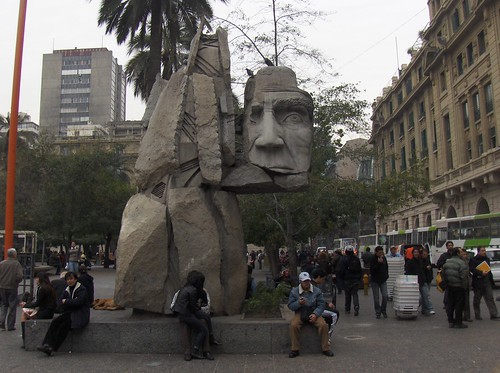
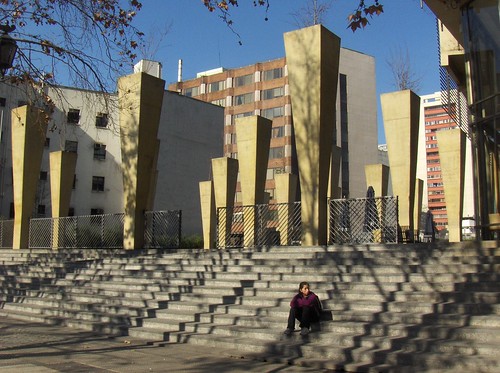
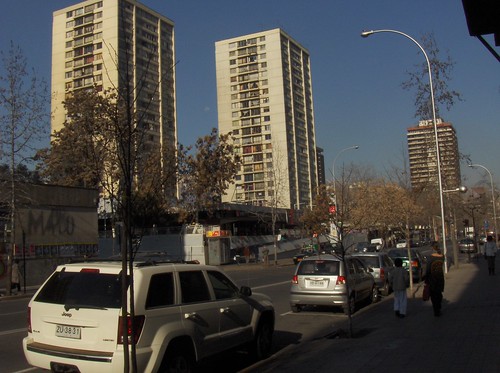
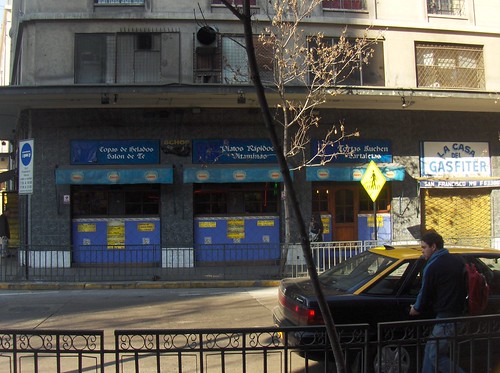
  • I'm sorry, but there is no way around this. East Berlin - meet your match. This has to be the physically ugliest city I have ever been in. Offered as supporting evidence - I can think of no other city I've been in where there appear to be no postcards on sale. I've scanned multiple kiosks throughout the city, and postcards of Santiago are conspicuous by their absence. I mean, that's got to be considered pretty weird, right? Other than the Plaza de Armas, right in the city center, vistas are pretty grim, though there are occasional uplifting views of the Andes in the distance. This afternoon, I went out with my camera, and here are some of the resulting photos. I don't think I was choosing unduly unrepresentative views:

santiago1 091

santiago1 108

santiago1 103

santiago1 085

This is the apartment building where I live. Let's just say, it's functional.

santiago1 094

Not the guy who tried to bite me. But it could be his cousin.

Am I irredeemably shallow for wishing for something a little more aesthetically pleasing? Possibly. But so be it.

But never mind. Tomorrow it's on to Valparaiso for the day, which I'm assured is far more picturesque.

To his coy mistress

Yes, yes. I hear your mute criticism. This blog lacks poetry. and, you know what? I couldn't agree more. So, to add a little class to what has been an intermittently whiny week, here's Marvell's version of "Carpe diem". (It's not coming completely out of left field - this poem did come up during class discussion on Wednesday)

To his Coy Mistress

Had we but world enough, and time,
This coyness, Lady, were no crime
We would sit down and think which way
To walk and pass our long love's day.
Thou by the Indian Ganges' side
Shouldst rubies find: I by the tide
Of Humber would complain. I would
Love you ten years before the Flood,
And you should, if you please, refuse
Till the conversion of the Jews.
My vegetable love should grow
Vaster than empires, and more slow;
An hundred years should go to praise
Thine eyes and on thy forehead gaze;
Two hundred to adore each breast,
But thirty thousand to the rest;
An age at least to every part,
And the last age should show your heart.
For, Lady, you deserve this state,
Nor would I love at lower rate.

But at my back I always hear
Time's wingèd chariot hurrying near;
And yonder all before us lie
Deserts of vast eternity.
Thy beauty shall no more be found,
Nor, in thy marble vault, shall sound
My echoing song: then worms shall try
That long preserved virginity,
And your quaint honour turn to dust,
And into ashes all my lust:
The grave's a fine and private place,
But none, I think, do there embrace.

Now therefore, while the youthful hue
Sits on thy skin like morning dew,
And while thy willing soul transpires
At every pore with instant fires,
Now let us sport us while we may,
And now, like amorous birds of prey,
Rather at once our time devour
Than languish in his slow-chapt power.
Let us roll all our strength and all
Our sweetness up into one ball,
And tear our pleasures with rough strife
Through the iron gates of life:
Thus, though we cannot make our sun
Stand still, yet we will make him run.

Andrew Marvell, 1621-1678

OK. I admit it. I've always had a certain fondness for those metaphysical poets. Marvell may not be quite at the level of Donne, but "To his Coy Mistress" is a delight from start to finish.

The plain people of Ireland: What is this? This blog is nothing but recycled poetry and whining.

The management; I understand how that impression could arise, but here at MOTP central we are actively working on the problem. Have a little patience, my little empanaditas!

Thursday, July 30, 2009

If it weren't so pathetic, it'd almost be funny

First things first. Let me assure everyone, I AM JUST FINE. Just majorly outraged. But things here are rapidly approaching farce levels. On my way to dinner earlier tonight,(where the service was as charming as a rusty nail), I survived (a) an effort to steal my camera (unsuccessful, but leaving me with severe wrist burn from the camera cord) and (b) five minutes later, having one of the mangy wild dogs that roam the pavements of the city sink his filthy fangs into my sleeve (nowhere near penetration of skin, given the many layers I was wearing).

But by my count, that's two strikes. One more, and I'll be on the plane to Buenos Aires before you can say "Pinochet".

Santiago, consider this a warning that you are ON NOTICE! There are certain outrages up with which I shall not put.

On the home front

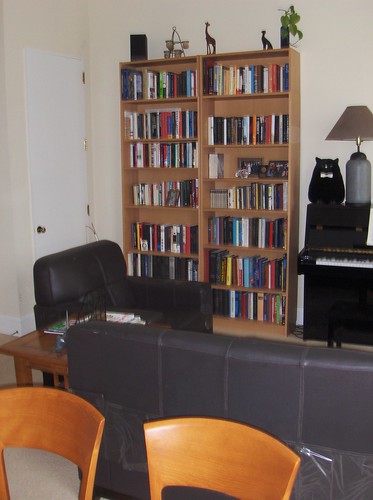
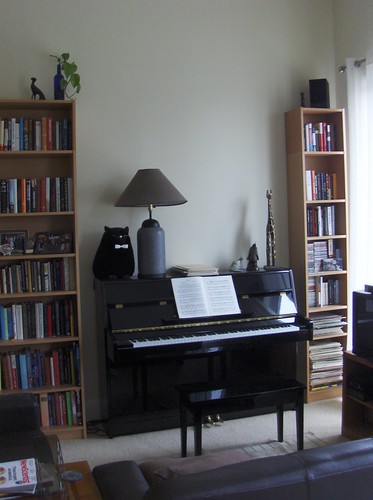
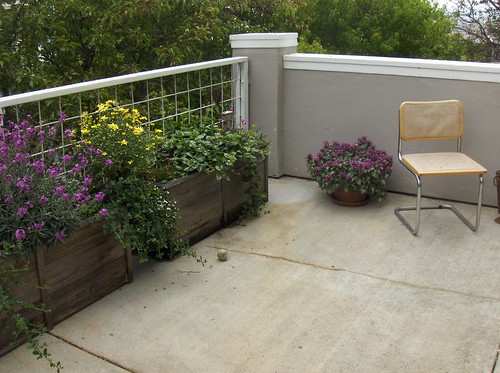
We had a few home improvements since my trip to Ireland in May. (Pretty much all the credit for these is due to Brad, God bless him)

bookshelves!

New bookshelves in the living room, as well as a new couch and armchair (suitably Natasha-proofed)

june2009 114

A riot of color out on the deck!

june2009 115

june2009 116

the deck

june2009 119

riotous color

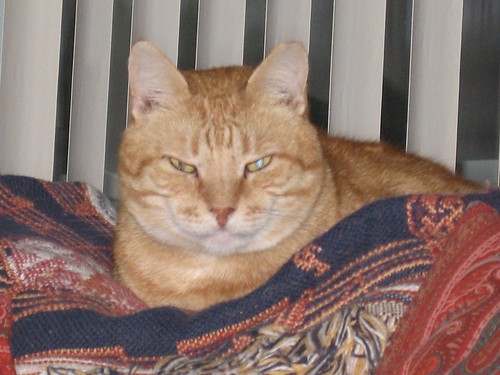
Sadly, the deck is now off-limits to Boris, after his BIG ESCAPE CAPER in June. He is not particularly happy about this, as you might imagine.

Boris the belligerent

More about Santiago

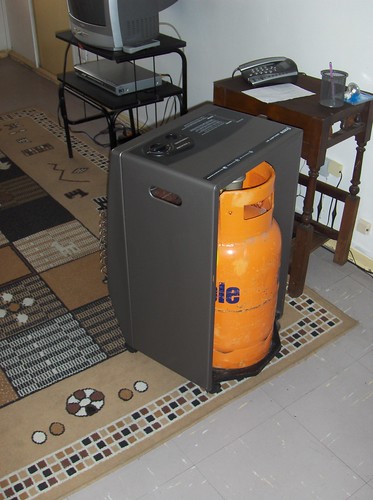
Well, after my slightly ill-natured first post from Chile, I feel obliged to give this update, just to say that everything is now going much better. Things have warmed up, both literally and figuratively. Classes are going well - yesterday we went on an afternoon excursion to the Villa Grimaldi, which deserves its own separate entry (I will get to it in due course); last night I went to see the delightful Fuerza-G, with most convincing 3-D hamsters. Tomorrow evening I have a ticket to the symphony (with a fine middlebrow program of Mozart, Strauss, and Brahms - none of that Stockhausen stuff), and Sunday there is an excursion to Valparaiso. So things are looking up, even if I am still terrified by the gas heater in the apartment.

Terrifying heating option (front)


Terrifying heating option (back)

Fortunately, Brad arrives next week for ten days, so all I have to do is not blow myself up or gas myself between now and Wednesday. As he is a god as far as all tbings mechanical go, I'm sure he will sort everything out.

To be clear, I can actually get the heater going, just at an enormous psychic and emotional cost. As I have noted previously in this blog, the mechanical aspects of the physical world are not exactly my forte. It may be difficult for some readers to imagine being terrified by machines and gadgets, but for some of us, this is an everyday reality.

More photos shortly, as soon as I can get them uploaded.

An unexpected conversation

One of the joys of foreign travel is that you often end up having the weirdest conversations, the kind that you could never imagine. Bordering on the surreal. Such as this little snippet, which you might have overheard yesterday evening, had you been lurking in the lobby of my apartment building. (As background, earlier in the evening, the doorman had been very helpful in explaining to me how to get to the movie theater, so that when I got back, I felt I owed him at least a partial report on how things went) -

Concierge-dude: ¿Qué tal la pelicula? De qué se trató?
Me: Bueno. Trató de un grupo de hamsteres, que eran agentes especiales del FBI. Y también hubo un topo que tenía planes de dominar el mundo, y un cientifico loco. Pero los hamsteres podían salvar el mundo, por que eran hamsteres muy especiales .. Eran la FUERZA-G

(There were these hamsters who were special agents for the FBI, and a mole with plans of world domination, and this mad scientist .... )

I don't know which of us was laughing harder. Maybe you had to be there.

Tuesday, July 28, 2009

Dateline Santiago

I imagine that it will become clear to me at some later point why visiting Santiago in the dead of winter seemed like such a good idea. I may need to thaw out first though.

plaza de armas, santiago

Here's the requisite picture to show I've arrived. More to follow, once I have regained my equilibrium and a modicum of good humor. Which is to say, once I've slept off the effects of the long trip and warmed up a little. Assuming that's actually possible.

The good news. School is great, and everyone is extremely helpful and charming. Which almost compensates for the extraordinary ugliness of the city. We're talking seriously ugly, alas - think East Berlin in the 1970s.

But hey - it keeps things interesting. Now, I have to go fiddle with the terrifying gas heater before my blood actually congeals. I haven't been this cold since my childhood back in Ireland.

Hasta luego, my little empanadas!

Friday, April 17, 2009

Drogging While Blunk

Well, gentle readers, we knew it would come to this. But I feel that I can retain a certain amount of dignity by pointing to the fact that there have been 507 posts, written while I was completely sober, before this one. Where I am definitely - hic! - not.

There are two clearly identifiable factors which have led to this situation. In no particular order, they are:

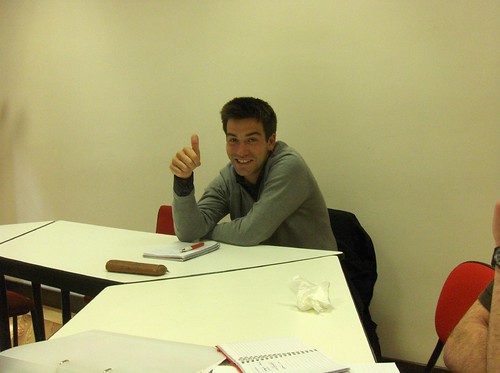
april_17 001

Alex, my absolutely charming Parisian classmate with the unpronounceable Basque surname,

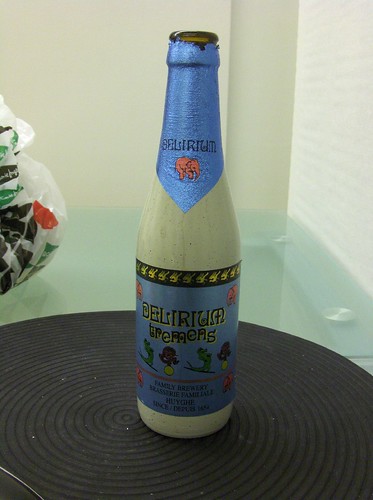
delirium tremens 002

Any beer which features dancing pink elephants on the bottle is not to be taken lightly.

Anyhow, it seemed like the most natural thing in the world to join Alex for a farewell beer or three after class. After three inferior Spanish beers, it seemed even more sensible to continue our drinking session in the apartment with some infinitely superior Belgian beer, before meeting up with some of the other students at eight o' clock to continue drinking.

In retrospect, it might have been a good idea to build in more food opportunities into our plan.

But not to worry, eight hours later, I am home safe and sound. (Alex and the others were last seen in some delightful, nameless, smoky bar in the Lavapiés district).

Why blog in an obviously intoxicated state? Well, because, for one reason or another, I can't remember when I've had as much fun as I've had this week. With today being a particular highlight. I am happy to be heading home, because two months away is a long time. But it seems important to record for posterity, just how much of a blast I've had here in Madrid. It's been a gift, the entire time.

And if I can't take the time out to acknowledge that on this blog, then I shouldn't be blogging in the first place.

Another happy note is that when Alex saw Elsie,

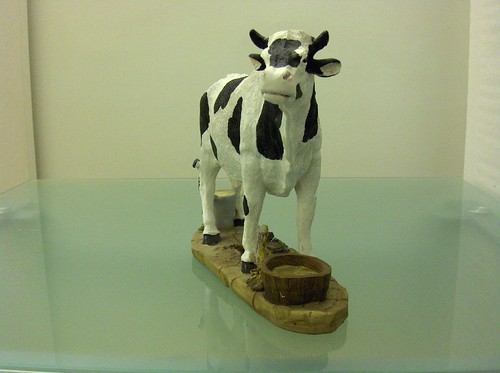
Elsie looking ... well... bovine

it was love at first sight. So that I can now leave Madrid, knowing that Elsie will be left in a loving home.

I am *so* happy right now. (And not nearly as drunk as I pretend to be. But definitely tipsy).

My flight leaves Madrid tomorrow at around 4:30 pm. God willing, I should arrive back in San Francisco on Sunday evening, after breaking my journey by staying overnight chez Paddy in Alexandria.

Signing out for this particular blogstage.

Abrazos.

Wednesday, April 15, 2009

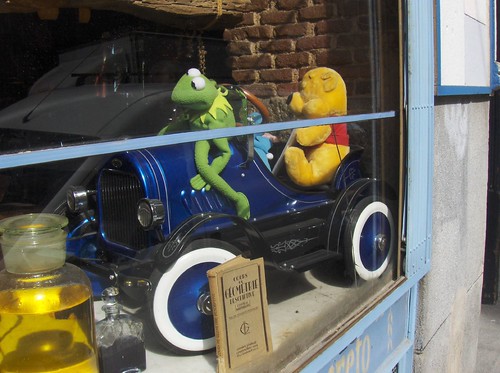
Kermit and Pooh go for a Ride

april_15 001

Tales of the Pampas (Search Engine Poetry)

Poetry constructed using only search engine terms by which people arrived at this blog. The only modification I have made is to change the punctuation in a few places.

1. Speak to me Jimmy !!!

Tony's fat.
Tubermensch.
Pig of the sea.
"What would I look like 4 stone lighter?"
The unfeasibly tall Greek billionaire.
Sinuous trophy wife.

2. On the Pampas Vocabulary Activities

Reina Sofia metrosexual,
Jet lagged hamster,
Static strips for motion sickness,
Raves on the pampas.
Sweaty men.
Beef extract.
Pampas meat.

Pampas meat?
Guinea pigs, baby!!!

3. The Case of the Marmalade Cat

Los Gatos deaths.
Desiccation syndrome.
Bagpiper's lung fungus.
Fat coma.
Caisson disease constipation.
Camilla Windsor accident.
Marmalade cat.
Cat of doom.

4. Does Travel Broaden the Mind or is it just a Waste of Time and Money?

Four reasons why travelling broaden the mind.
Raccoons in space.
Guanajuato strip clubs.
Hello Kitty, Chapel Hill.
Segovia aquaducks.


5. Mainly on the Plain

Pandas in action.
Squid and frog.
Two-headed bunny.
Doctor Ruth.
Traceable jackalope.
Puddy tats.
Laundercats.
Javelina siege.
Itzcuintli dog with me.

Hideous, ugly, animals.
Keep track of your flock.

Ethel the aardvark goes quantity surveying.
Don Quixote goes to the movies.

The rain in Spain falls mainly on the plain
And there is love,
But also pain.
And the rain.

Tuesday, April 14, 2009

Susan Boyle

Someone over on the Salon TableTalk board alerted me to this link:

http://www.youtube.com/watch?v=9lp0IWv8QZY

Two years ago, I blogged about Paul Potts, who went on to win that year's "Britain´s Got Talent" contest. The video in the link has that same heartwarming quality - you may tear up a bit watching it. The best part is watching the judges' reactions.

Thanks to Inara for pointing me to the link in question.

Streets of Malasaña

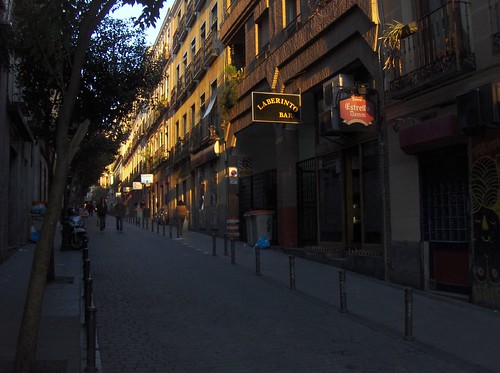
I have created a new Flickr photoset here . Almost all of the photos were taken on my way to and from school.


april14 041

Enjoy!

Monday, April 13, 2009

The cost of living

Yesterday, I wrote a post about the economic crisis ("la crisis") affecting Spain, and suggested that its effects were not all that obvious here in Madrid. On a related note, I thought it might be interesting to provide some anecdotal data about the cost of living here, from a personal point of view.

The first thing to note is that the exchange rate is a little more favorable now than it was two years ago. Given that prices of many items appear not to have changed perceptibly (perhaps a 5% increase in things like the price of a newspaper, cup of coffee, or a beer, which is offset by the improvement in the exchange rate), I have no sense that things have gotten more expensive. In fact, since I had paid for my three main expenses - travel to and from Spain, seven weeks of classes, and two months rental of the apartment - upfront, the amount that I spend weekly is relatively low. Definitely lower than my day-to-day expenses in San Francisco (though obviously certain monthly expenses in SF - mortgage, utilities, phone and DSL service, health insurance and the like - continue in my absence).

But daily expenditures here don't amount to all that much. I generally have breakfast in the break between my first two classes - 2€ for coffee and a pastry. Then, at 3pm, after my conversation class is finished, it's time for lunch (my favorite couple of hours in the day). A couple of days a week I will generally eat lunch with some of the other students, or some of the teachers in the school; three days a week I eat lunch on my own, with time to read the newspaper at leisure and mark my vocabulary words. Lunch in Madrid is definitely the best value going. Almost every restaurant or bar offers a fixed price, three-course meal, beverage included, for somewhere between 9 and 12€ (1 euro = roughly $1.30). Often, I will finish at around 4:45 or so, which leaves a couple of hours until my 7pm culture class. Having eaten a full lunch during the day, going out to dinner seems pointless, so I generally pick up the makings of a light meal to prepare at home (maybe another 5€). Which ends up at around $25 a day for food. Going to the movies is also fairly cheap (5 to 7€, depending on the time of day). The newspaper is 1.10€ during the week, double that on Sunday. The metro, and city buses, are a steal - you can get a 10-trip ticket for less than 7€. So that I seem to end up using the cash machine far less often here than at home.

Hotels are also pretty reasonable. Obviously, it's possible to spend a lot of money, if you choose a particularly fancy hotel. But, to give a reference point, the Ateneo, the three-star hotel where Paddy stayed during both visits here, which is right near the city center (but very quiet), offers a double room, single occupancy, for just 75 to 80€ a night (the desk guy was so smitten with Paddy that he comped her several free breakfasts at the buffet, though it technically wasn't included in her room rate).

So, if you haven't yet made travel plans this year, maybe you should consider España.

Sunday, April 12, 2009

Ruthless Rhymes for Easter

Little Willie

Little Willie, feeling mean
Pushed his sister through a screen
Mother stopped his innovations
Said it made for strained relations.

Willie and three other brats
Ate up all the Rough-On-Rats;
Papa said, when Mama cried,
"Don't worry, dear, they'll die outside."

Necessity

Late last night I slew my wife,
Stretched her on the parquet flooring;

I was loath to take her life,

But I had to stop her snoring.


Calculating Clara


O'er the rugged mountain's brow

Clara threw the twins she nursed,

And remarked, "I wonder now

Which will reach the bottom first?"


"Ruthless Rhymes for Heartless Homes"
"Col. D. Streamer" (pseudonym of Harry Graham)


La Crisis

So, although Thursday and Friday were official holidays (and Madrid was deserted, making me doubly glad that I didn't push myself to go to Bilbao), Spain did get a new government this week. On Tuesday, accompanied by the usual fanfare and gobbledygook, Prime Minister Zapatero announced a major reshuffle of his cabinet. The main change appears to be that the new cabinet is composed of more hardline socialists, and that - for the first time in the country's history - a woman will head up the Ministry of Economics. Specifically, this woman, Elena Salgado:


(picture found here )

As an article in today's "El País" points out, she will have her work cut out for her. Unemployment here in Spain is creeping up inexorably towards the 4 million mark, assorted banks have failed and had to be bailed out within the past six months -- it's the same, sad, familiar story as everywhere else.

When we were in Andalucia last week, the signs of "la crisis" were obvious. Other than one other couple, we appeared to be the only guests in the hotel. Cafés and bars were relatively deserted. It was a marked contrast to two years ago, when I was in Seville at pretty much the same time of the year and the place was bustling with tourists. Here in Madrid, signs of the crisis are not as immediately evident, but are fairly obvious once you keep your eyes peeled. One example that comes to mind is that both churches that I pass on the way to my 7pm class have long lines of folks waiting for the soup kitchens to open at 7 o'clock. Something that, if it was happening two years ago, I have no recollection of seeing.

Nonetheless, there are still crowds of shoppers at El Corte Inglés, and pretty much everyone managed to get out of town this weekend, so whatever the true dimensions of "la crisis", it doesn't yet appear to have hit the madrileño middle classes very hard.

Future Plans (and Champagne)

It occurs to me that I have blogged very little about my day-to-day life here in Madrid during this trip, so I thought I'd try to remedy that as I head into my final week. I think part of the reason is because I've been so happy here - somehow calamity and adversity seem to make for better blogfodder than day-to-day contentedness. It has been a wonderful trip, providing further confirmation for the observation that it does me a power of good to get up off my rear end and get out of San Francisco. Those winter reading marathons are enjoyable in their own way, and raise my profile over on the goodreads site, but nothing beats actually getting out of the apartment and out of the city. As always, even the mundane stuff is more fun when you do it in a foreign city and in a foreign language.

The only problem is that I'm not sure how long I can continue to use learning Spanish as a pretext for my travels. Although classes at Don Quijote have been enjoyable, and my Spanish has continued to improve, the inescapable truth is that the gains at this point are somewhat marginal, at best. This time around I placed directly into the highest level, where I had the distinct feeling most of the time of being well ahead of my classmates, at least as far as speaking ability is concerned. I slacked off a bit on the grammar this time, largely out of boredom, but also due to a certain degree of laziness. As always, the teachers at dQ have been wonderful; I wouldn't say the same for my classmates, a few of whom I actively dislike. Though it's tempting to elaborate, I will leave it at that, because I don't want to offend anyone unnecessarily who might end up reading this blog. I'm just glad that I didn't sign up to stay through the advanced DELE exam in mid-May, because faced with the option of preparing for it with the particular group assembled in Madrid, I would have had to flee to Salamanca.

Anyway, I think I can justify one more trip to Latin America (with maybe a side trip of a week or two to Costa Rica), probably in the July-September time frame. I very much want to go back to Buenos Aires, as well as seeing more of Argentina, and would like to spend some time in Chile as well. The Don Quijote school in Cuzco, in contrast, at an elevation of 11,000 feet, holds no particular attraction. After that, I will be faced with a major decision - either try to put my knowledge of Spanish to practical use by, e.g. seeking a visiting academic position in a Spanish-speaking location (something I intend to look into seriously as soon as I get back to SF), or start afresh with a new language, most probably French. Interestingly, one thing that doesn't tempt me in the slightest is going back to practice statistics within the biopharmaceutical sector - I spent a very enjoyable 25 years doing that, but have no particular desire to do it again. And, though it's taken me two years to reach this point, I also no longer feel guilty about not wanting to go back. But I do need something to get me out of San Francisco, even if it's for only half the year, as I have a definite tendency to fall into a rut if I stay there too long.

Anyway, the plan for the immediate future* is to go back and take care of my taxes, go down to visit my friends Peggy and Andy in Southern California round the beginning of May. Then fly to Scotland and Ireland to visit friends and relatives there, and to meet up with my sister Emer and her husband Dale, later on in May. In June I hope to spend some time on the east coast (DC, Baltimore, New York, Chapel Hill) to catch up with friends there, before taking a longer trip to Latin America, starting in July. The big question is what happens after that, but right now I'm happy enough to map things out six months at a time.

I know, I know. Everybody should have such problems. Trust me, I count my blessings every day.

*: Major props are due to Paddy, Katie, and Adam for helping me shape this plan, and for making it clear in no uncertain terms that if I showed further signs of falling into a vegetative rut in San Francisco that they would personally mount an intervention to save me from myself. I love them all dearly, more than they can possibly know.

The plain people of Ireland: Yes, yes. That's all very interesting, but aren't you forgetting something? Isn't there some occasion you want to mark?
MOTP: ?! Oh, yes. Sure. Happy Easter to all my readers.
The plain people of Ireland: Not that. Something else, maybe?
MOTP: Ah, yes. Of course. It's champagne ye're after isn't it? Well, have a pew and join me in a glass to celebrate this, the quinquecentennial post on this blog.
The plain people of Ireland: Yerra, we thought you'd never ask. Still, five-hundred, that's not too shabby at all.
Fade to the sound of ribald celebration.

Saturday, April 11, 2009

Fake Words (Corporate Edition)

  • Exxonerate: to display excessive leniency towards companies charged with environmental pollution.
  • Michelinzer Torte: a fruit tart with a strange, rubbery consistency.
  • Aviscerate: to total one's rental car; alternatively, to steal the engine out of a parked rental car.
  • Benettoner: multi-hued all-purpose toner for color copiers.
  • Go for a Halliburton: to absquatulate, to pull a disappearing act after embezzling huge sums of money.
  • Firestonewalling: to block an opponent's passage by erecting a barrier of old tires; the burning of tires as a form of civil disobedience during a gay rights demonstration.
  • Cingularity: a communications black hole.
  • Chrysleriana: Schumann's recently discovered "Detroit suite" for piano.
  • Heinekenning: a characteristic feature of 19th century German romantic poetry. Example: Hopfenblut, or "hop's blood", meaning "beer".
  • Dijon Vu: the feeling you've tasted this mustard before. (I cannot take credit for this, alas)

and a few other, non-corporate, terms -

  • Feefifobia: fear of giants.
  • Fobia: fear of misspeled words.
  • Bentholaryngomania: an obsession with the movie "Deep Throat".
  • Ichthyodigitalophagist: an eater of fish fingers.
http://news.bbc.co.uk/1/hi/uk/4282290.stm
  • Sherpes: a viral infection endemic to the Himalayas.
  • Blandau: An undistinguished four-wheeled carriage; the antithesis of the hansom cab. Not quite as passive-aggressive as the sulky.
  • Warmageddon: the likely result of uncontrolled climate change.

Mountweazels

Ever heard of Lillian Virginia Mountweazel, the famous photographer who perished prematurely in a terrible accident while on assignment for "Combustibles" magazine?

Or did she? In fact, mountweazel was an infamous "fake" entry in an edition of the New Columbia Encyclopedia, inserted as a deliberate trap to catch potential lexicological plagiarists. The name has since become synonymous with any similar trap, generally a fake word or name devised by reference-book editors to trap plagiarists. In the world of cartography, it is not uncommon to invent non-existent streets, or to place non-existent curves in existing streets, with the same purpose in mind.

Another recent example in the world of dictionaries is the "word" esquivalience. From Wikipedia:

Esquivalience, according to the August 29, 2005 New Yorker article "Ink: Not a Word" by Henry Alford, is a fictitious entry in the New Oxford American Dictionary (NOAD), which was designed and included to protect copyright of the publication. The word was invented by Christine Lindberg, one of the editors of the NOAD. It was leaked that the dictionary had put in a fake word in the letter "e" and Alford set out to find the word. It was discovered after review of a short list by several experts. When the editor, Erin McKean, was contacted she admitted that it was indeed a fake word and had been in since the first edition, in order to protect the copyright of the CD-ROM edition.

The word is defined as "the wilful avoidance of one's official responsibilities."

Other examples, in similar vein, include the delightful (but completely imaginary) food items: funistrada, buttered ermal, and braised trake.

Funistrada is an imaginary food name invented by the U.S. armed forces to see if participants of written food surveys were paying attention or just answering randomly. In a 1974 survey respondents ranked funistrada higher than eggplant, instant coffee, apricot pie, harvard beets, canned lima beans, grilled bologna, and cranberry juice. Two other imaginary foods fared less well - buttered ermal and braised trake.

A more dangerous food item is the infamous Swedish lemon angel, whose recipe calls for combining lemon juice and baking soda; if attempted, the result is the same as making a vinegar-and-baking-soda volcano.

Maybe it would be best just to stick to lamb for Easter lunch.

More about this subject can be found under the Wikipedia article on fictitious entries: http://en.wikipedia.org/wiki/Fictitious_entry

The Hazards of Reading Hamlet

From "The New York Times", December 27th, 1907:

POURED LEAD INTO HIS EAR.; Belief Is That Conkling Had Been Reading "Hamlet."
Special to The New York Times.

MIDDLETOWN, N.Y., Dec. 26. -- James H. Conkling, a prominent business man of this city, is in a critical condition in Thrall Hospital, suffering from the effects of molten lead, which, it is believed, he himself poured into his right ear with suicidal intent.

Full story here, in pdf format

Book Review : How to Live (Henry Alford)

Third in a series of three reviews of books which address some of the issues associated with aging.

How to Live: A Search for Wisdom from Old People (While They Are Still on This Earth)

A more accurate title for this book would be "Growing Old Gracefully", as it's obvious that the question Alford is really interested in is "How should we come to terms with our own mortality?" He decides the best way to find out is to ask a bunch of elderly people, then try to distil key life lessons from the resulting conversations. Framing this process as a “search for wisdom” doesn't help particularly, and occasionally causes him to get sidetracked into some fairly unproductive academic discussions. It’s not surprising that encouraging people to talk about their own lives works far better than asking them about “wisdom” in the abstract, an approach which, predictably, yields mostly just bland generalities.

As a general rule, his success is inversely proportional to the fame of the interviewee. Conversations with Harold Bloom* and Edward Albee lead to unhelpful pseudo-profundities like “wisdom is a perfection that can either absorb or destroy us”, and pointless exchanges about the dictionary definition of “wisdom”. A series of meetings with actress Sylvia Miles reveal little more than her apparently bottomless self-infatuation. The most interesting thing that is gleaned from self-styled guru Ram Dass’s pontification on “wisdom” and “spirituality” is his admission that he doesn’t plan to attend his own brother’s funeral. This, quite rightly, bothers Alford, though he later suggests that Dass is redeemed by the calm acceptance he displays in the aftermath of a disabling stroke. It’s unclear whether this reflects Alford’s innate generosity of spirit, or an unwillingness to admit to himself how worthless his pilgrimage to meet with Dass has been. Sandra Tsing Loh has already written more about her eccentric father than anyone might possibly want to know, so Alford’s decision to include further anecdotes about Mr Loh’s dumpster-diving and public urination is baffling.

* I should add that the most memorable response Alford elicits, in an otherwise fairly ho-hum interview with Bloom, is in answer to the simple question “What have you gained with age?” Bloom: “A healthier respect and affection for my wife than I used to have...” (smiles) “Next May will be our fiftieth anniversary”. Somehow that moment of sweetness makes one forgive Professor Bloom many of his more pompous utterances over the years.

Fortunately for Alford, and for the reader, his conversations with less well-known senior citizens are more rewarding. The best chapters of this book are those in which Alford describes meetings with ‘ordinary’ senior citizens: Charlotte Prozan, a San Francisco psychotherapist he met on a cruise organized by The Nation; Althea Washington, a 75-year old retired schoolteacher who lost her husband and her house in Hurricane Katrina; Setsuko Nishi, 86-year old professor emerita of sociology at Brooklyn College and CUNY; Doris Haddock (aka Granny D), who staged a 3000-mile walk across America in support of campaign finance reform back in 1999, when she was still a spry octogenarian.

Most affecting of all are the author’s conversations with his own mother and stepfather. In what comes as an obvious shock, shortly after he interviews each of them, his mother (aged 79 at the time) asks for a divorce. Alford’s account of the events that follow, and the reverberations throughout the family, is remarkable for his ability to navigate obviously treacherous emotional territory without ever becoming exploitative or judgemental. In all of his writing, one senses that Alford is fundamentally a true mensch, a really decent guy. It’s part of what makes his work so enjoyable, and it really serves him well here. His writing about his family is funny and moving (never exploitative: David Sedaris, please take note), and is one of the best parts of this book.

Interspersed among the conversations are the results of Alford’s auxiliary research – what various philosophers have to say about wisdom, what other cultures have to offer on the subject. There is also a (desultory) consideration of deathbed confessions and famous last words as possible sources of insight. These are, at best, intermittently amusing.

This book is a departure from Alford’s previous work, the two collections “Big Kiss” and “Municipal Bondage”, humorous essays reminiscent of, and often much funnier than, the work of David Rakoff and David Sedaris. Though his choice of subject here doesn’t afford him the chance to be as hilariously funny as he was in the earlier books, he is witty and engaging throughout. The interviews with Bloom, Dass, and Albee would have benefited from a little less deference: one gets the sense that Alford was holding his natural snark in check. “How to Live” doesn’t quite have the mischievous exuberance that made “Municipal Bondage” such a joy to read, but it does have compensating virtues of it own, particularly the interviews with ‘ordinary seniors’ and Alford’s extremely moving writing about his own family.

I had expected Henry Alford to be charming. Who knew he could be wise as well?

****: Four stars out of a possible five.

Book Review : Deaf Sentence (David Lodge)

David Lodge is not a flashy writer, but he is an extremely good one. Superficially, his predilection for working the same, relatively narrow, ground (he is a master of the academic novel) might seem constricting. But each of his novels delivers fresh insights, with his signature blend of intelligence, wit, and genuine affection for his characters.

"Deaf Sentence" is no exception. Although it's not as hilariously funny as some of his earlier books, it is - like all of his work - compulsively readable, and ultimately very moving, in an understated kind of way. Lodge's description of the various indignities that deafness brings is hilariously funny and so utterly convincing that you know it has to be based on first-hand experience. There is far more wisdom about aging in this unassuming story by Lodge than, for example, in Julian Barnes's recent, migraine-inducing, bloviation about his own mortality.

When I think of the trio of Julian Barnes, Martin Amis, and David Lodge (I try to think of Christoper Hitchens as little as possible), restaurant analogies come to mind. Amis is the risk-taking molecular gastronomist, brashly confident of his own genius, and hey - if the diners don't always appreciate the flashiness, that’s not his problem. To his credit, when he’s on target, he can be sublime. But the brilliance is hit-or-miss. Barnes is closer to Amis than he might care to admit, thought perhaps not writ quite so large. In general, the quality of his work doesn’t fluctuate quite as much, but he is still capable of succumbing to navel-gazing, and cleverness (or perhaps his consciousness of his own cleverness) is definitely his Achilles heel. You’ll be served some extraordinary meals chez Barnes, but there will be an occasional inedible mess. At the risk of beating this analogy to death, David Lodge, perhaps at the cost of never reaching the Olympian heights attained sporadically by the others, never disappoints, reliably serving hearty nourishing comfort food that leaves the reader satisfied and looking forward to the next visit.

That might sound like damning with faint praise, but is actually meant as the highest compliment. I can think of very few novelists working today who are consistently such a delight to read. He joins a very short list of authors (Margaret Drabble in early and mid-career, Anne Tyler) whose work is reliably intelligent, thought-provoking and interesting without being flashy. Such craftsmanship is rare and not something one should take for granted. I look forward to each new novel by Lodge, and thus far have never been disappointed.

****: Four stars out of a possible five.

Book Review : Nothing to be Afraid Of (Julian Barnes)

MASSIVE FURBALL ALERT!!!!

In this massive eructation of self-indulgent, rambling, repetitive prose, Julian Barnes contemplates his mortality. At considerable, punishing, length. Where does it get him? To paraphrase another writer: And the end of all his exploring is to arrive where he began. Despite the purgatorial length of this hideous hairball of a book, he never really arrives at any conclusion. The reader isn't even offered the courtesy of a chapter break. The book just meanders on with no evident direction until (mercifully) it finally just peters out.

"But surely", I hear you ask, "this is Julian Barnes, a man of such wit and erudition, he cannot fail to be delightful company along the way".

That’s what I thought, gentle reader, but I was mistaken. I believe the relevant phrase is epic fail. The biographical stuff is faintly interesting at best, and Barnes – obviously a very private man – is careful to avoid anything genuinely revealing about his personal life. Anecdotes about various friends and acquaintances, and their thoughts about death, are tediously pointless. They are rendered all the more irritating by Barnes’s referring to the people involved as ‘P’, ‘S’, ‘A’ etc., a device that should have been outlawed after the death of Kafka, and that lends the text all the crackling excitement of a proof from Euclid. Barnes's rehashing of what other writers have written about death is equally soporific.

This is a baffling and irritating book. There is no apparent reason for it to exist at all - if Mr Barnes has nothing to say to us, why not leave us in peace? Whatever made him feel impelled to torment us with these vacuous scribblings? Reading this book feels exactly like watching your favorite cat cough up a particularly dense, matted hairball. It takes forever, and you feel vicariously exhausted when it’s all over. I know that, in mediaeval times, magical healing properties were attributed to such animal hairballs, or bezoars. But the best that can be said for this one is that you won’t have to clean up the carpet afterwards.

Try Henry Alford’s infinitely more engaging “How to Live” instead.

*: One out of five possible stars.

So relieved this is over

No, not my stay in Madrid, which has fortunately got one more week to go.
This:

easter menagerie 019

http://www.flickr.com/photos/gaelstat/sets/72157616629394578/

Yes, I know. What seemed like fun at the outset just ended up being kind of creepy. We live and learn.

Friday, April 10, 2009

OPERATION BAKED GOODS - EASTER UPDATE

april10 018

It was a cold, rainy Friday here in Madrid. The city is deserted. So what better occasion to stage another exciting test-off in the ongoing saga of "OPERATION BAKED GOODS"?

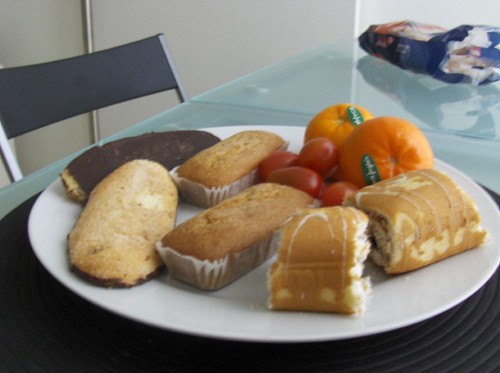
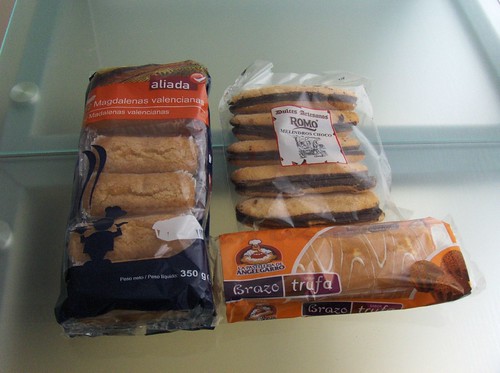
Three entrants were included in this experimental session, each purchased at the basement supermarket in El Corte Inglés, each in the 1.00€ to 1.40€ price bracket. Our three contestants are shown below:

april10 012

Larger, individual, photos may be found here , and as neighboring photos in the Flickr stream.

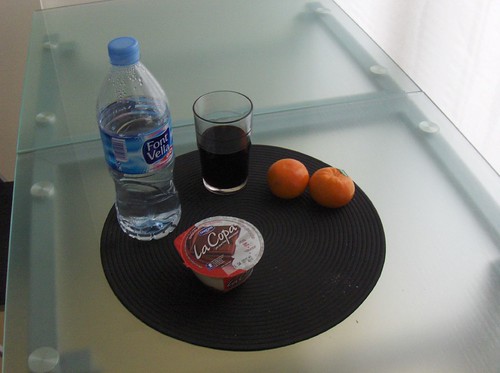
As always, strict safety measures were implemented during the testing session, with adequate fluid supplies at the ready to deal with any rapid-onset desiccation incidents:

april10 022

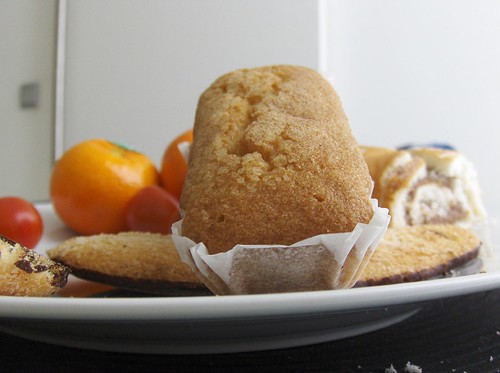
This foresight proved to be well-grounded during the testing of the magdalena valenciana, seen below

april10 020

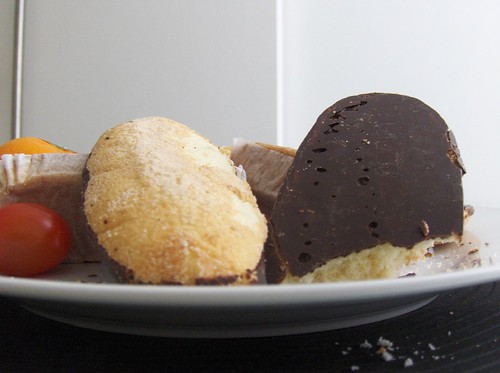
Although the semi-enrobement in chocolate prevented the Romo "melindras choco" from reaching quite the same silica-gel desiccation levels as the vile magdalena valenciana, truth be told, they fared only marginally better. You wouldn't feed them to your mother-in-law.

april10 021

Remarkably, there was a clear winner:

april10 019

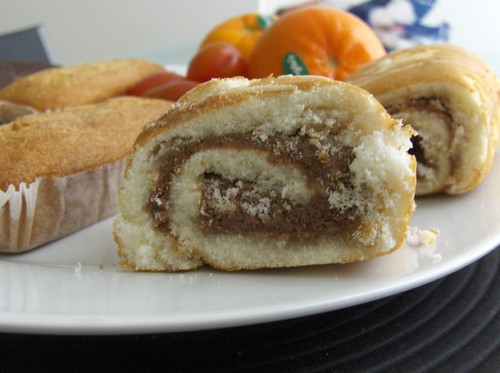
Yes, folks. Although the pastry chefs of Vienna, indeed of all of Northern Europe, still need not quake in their boots, the fact of the matter is that the "brazo trufa", or chocolate-truffle flavored Swiss roll, from the pasteleria of Angel Garro, was surprisingly tasty and - I never thought I would type these words in an edition of OBG - deliciously MOIST.

So it emerges as the clear winner.

Thursday, April 9, 2009

Pack my box with five dozen liquor jugs!

Observe that fine sentence in the title of this post. Notice anything in particular? Yes -- it's a pangram. It contains all twenty-six letters in the standard English alphabet.

Not all languages are as profligate with letters. As is well-known, the Hawaiian language gets by using only 12 letters of the Roman alphabet: a, e, i, o, u, h, k, l, m, n, p, w, sometimes augmented by the symbol ʻ, to denote a glottal stop.

There is not, to my knowledge, any particular shortage of letters in the alphabets of the different Scandinavian languages. Nonetheless, they sometimes appear to demonstrate a distinct element of parsimony, as far as letters are concerned. Particularly where sheep are involved, if the following examples are anything to go by:

Take this Swedish sentence, for instance:

Far, Får får får? Nej, inte får får får, får får lamm.
Father, do sheep have sheep? No, sheep don't have sheep, sheep have lambs.


But the Swedes have nothing on Icelandic speakers as far as not wasting letters is concerned. Anyone might be forgiven for thinking that the following "sentence" was the result of some unfortunate keyboard malfunction, or possible feline intervention.

Ái á Á, á á í á.

But, no! It appears that this actually means something (again, some kind of intrafamilial conversation about sheep). My sources inform me that it conveys the following vital information:

Grandfather from "Á" farm has a sheep in a river.

It hardly seems credible. But this is not an April 1st posting.

It would be remiss of me to finish this post without linking to the infamous Onion "vowel drop" article:

http://ifaq.wap.org/society/voweldeployment.html

The odd thing is, despite The Onion's claim at the bottom of the link above, I found it impossible to find the original article on their site. Their search engine is for the birds, if it can't even find what is probably their single best-known (and best) article of all time.

Given the state of the Icelandic economy, it seems that they might profit from some kind of deal with one of the Balkan countries.

Change One Letter : Liturgical Edition

Gloria in excelsis feo*:
Talk about ugly! Betty has nothing on Gloria.

Fixit, Dominus:
In this hilarious new NBC sitcom, Jesus needs all his carpentry skills, when he takes a job as super in the apartment building on Melrose Place.

Scredo:
The Apostles' Screed.

Stab at Mater:
The prequel to "Psycho".

A Mighty Fortress is our Bod:
A new chain of fitness centers opens in the Bible Belt.

Neater my God to Thee:
A new housecleaning service opens in the Bible Belt.

Jesu, Joey of Man's Desiring:
An unfortunate typo in the score of a musical cantata gives rise to one of Australia's more bizarre marsupial-worshipping cults.

Tantum Eggo:
This new, low-cholesterol, egg substitute tastes so good it's almost sacramental.

Flux Aeterna:
Oops! Looks like Heraclites has been "improving" the scriptures again.

Diets Irae:
An inside look at the infamous IRA hunger strikes in Long Kesh internment facility.

Tub Admirum:
I really like your bathroom fixtures!

Nagnus Dei:
All that bleating is really starting to get on my nerves.

(*: Gloria is extremely ugly)

Stack Cats & Taco Cat


Wednesday, April 8, 2009

Book Review : Don Quixote (Part I)

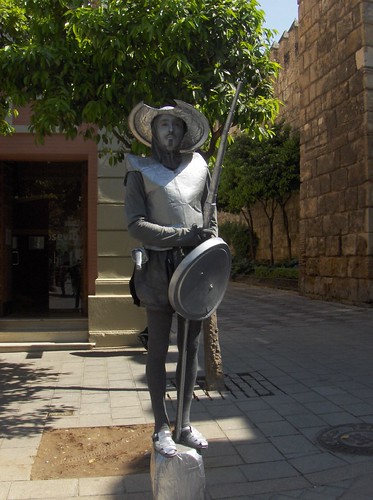
Quijote lookalike


RATING: ** (two stars, out of a possible five)

Let me start by saying that I really gave it my best shot. I can't think of another book that I've read as closely. Read it in Spanish AND in English. Even - to keep myself honest - tried summarizing as I went, in deathless doggerel ( QUIK QUIXOTE ). I've spent a month of my life with this book - it's been a mild obsession.

Why? Oh, I don't know. Can we ever satisfactorily explain why we choose to give ourselves over to any specific whim? I'm here, in Madrid. I'm studying Spanish at a school that's called "Don Quijote". The time just seemed right. And I had a strong feeling that it was going to be now or never.

But a coherent summary of my reaction eludes me, frankly. This book alternately amused me and bored me to tears. There are a couple of places where I laughed out loud. But mostly I just wanted it to be over. I wasn't about to quit. But it felt awfully like a penance, much of the time.

Some random observations, for which I am forced to resort to the dreaded list of bullet items:

1. The Spanish was often more fun to read than the English. Cervantes and Shakespeare were contemporaries (down to the urban legend (?) of having died on the same day). But Spanish has changed considerably less in the intervening 400 years than English. There were enough archaic words that I did feel reading the translation was a necessary check, but it was surprisingly straightforward in Spanish, and - traduttori, tradittori - one felt closer to the original story. So I definitely enjoyed that aspect of reading the book - it felt like a real confirmation that all the Spanish classes have paid off.

2. I have a good general understanding of the book's place in literary history, and so was willing to cut it some slack - that is to say, not to judge it as one would a modern novel. That said, I still can't avoid saying that I found it enormously clunky. The first couple of hundred pages were annoyingly episodic and formulaic - addled Don meets (a)windmills (b)yokels (c)sheep (d)funeral mourners - take your pick - is confused, through a hilarious misunderstanding (but see point 5 below) attacks them, gets the worst of the dustup, and ends in the ditch.

3. Things improved a little in the second half (of Book I), when some of the protagonists other than Don and Sancho start to appear on a recurring basis. But don't look for in-depth characterization, or much character development to speak of. Cervantes is no Shakespeare.
OK. Let me repeat that for the benefit of each and every one of my Spanish teachers, though I love them dearly. People - you are completely freaking delusional! CERVANTES IS NO SHAKESPEARE. When you make this comparison, you just make me want to resort to actual physical violence. I've read Shakespeare and, dudes, CERVANTES IS NO FREAKING SHAKESPEARE. There's more subtlety, insight, and depth of understanding of human nature in almost any single Shakespeare play (OK, "Titus Andronicus" is a little weird, but there are still over thirty to choose from) than in this entire first volume. Not to mention a superabundance of the most gorgeous language, though - to be fair - I can't quite judge Cervantes on this score.

4. When the plot isn't being all episodic, it's not really any great shakes either. Mick is altogether too heavy-handed with the AMAZING COINCIDENCE method of plot resolution. Man, you wouldn't believe who all happens to mosey on by the same remote Manchegan inn, just in time to tie up a dangling plot thread. I dunno. It all seems more than a little -- lazy.
Though I guess (and I feel like I'm really bending over backwards to give Mick the benefit of the doubt here - why is that - in retroactive justification of the time I invested reading this damned book?) maybe I'm applying modern criteria and expectations here. It's not as if all of Shakespeare's plots were entirely plausible either.

5. Humor. Ah, yes. One of literature's great comic masterpieces. Well, excuse me, if I fail to climb on this particular bandwagon. I'm sorry, but I just don't get it. Let's be quite clear - the humor, such as it is, is almost exclusively slapstick of the broadest kind. If you like watching circus clowns do pratfalls, or if your dream television weekend is a Three Stooges marathon, then maybe you´ll laugh like a drain. But if you don't really find slapstick all that hilarious, or don't take vicarious pleasure in taunting and jeering at a deranged person, you will, as I did, wonder what all the fuss is about. (Yes: I acknowledge that there is some wit in the book's initial premise - a person addled by too much book-reading. But lemme tellya, it gets old awful quick. It really does).
One goodreads reviewer tells us, with no apparent irony, that this is the funniest book he has ever read in his life. A statement that can only be literally true if he is a shut-in with no access to a library.

6. And on the subject of those ratings by other goodreads reviewers. De gustibus non disputandum est (i.e. diff'rent strokes..) and all that good stuff. But really, folks, I'm having a hard time swallowing it. An average rating of 4.69? 102 5-star ratings?
Might it not be possible, just faintly possible, that we have a slight case of what one might call "classic intimidation" going on? The (perhaps unconscious) fear that people may think less of one for not appreciating one of the world's designated literary classics? Did all these apparently rabid Quixote enthusiasts - and how can I put this delicately - ACTUALLY READ THE WHOLE BOOK? All of it, without cheating? All those pastoral poems by the love-besotted shepherds? The entire soporific "Tale of Foolish Curiosity"?
The limited empirical data available suggest that maybe close attention was not paid - a mere 9.9% of respondents chose the correct answer to the goodreads quiz question about the "fulling hammers".
Just sayin'. I has my doubts.

7. Because, here's the thing. Large swaths of this book are intrinsically unreadable. No, I mean it. You read a page. Your eyes glaze over. You try it again. Same phenomenon. Cycle and repeat.
I humbly submit that the stuff in which Cervantes is engaged in direct spoofing of the knight-errant genre - all the stuff about Amadis of Gaul, the Don's argument with the Canon, the priest's adjudication of the various volumes in the Don's library, not to mention the interminable pastoral interludes with lovelorn shepherds and damsels dressed as shepherdesses, could be considered interesting only by the most desperate of graduate students in need of a dissertation topic. For anyone not engaged in abstruse academic investigation it's a freaking snoozefest.

Did I enjoy "Don Quixote, Book I"? Only very sporadically. Do I consider it one of the world's great books? Absolutely not. Will I read Book II? Oddly enough, probably yes.

But not this trip. And probably not this year. Let the Don lie slumbering back home in La Mancha. Myself, I hope to travel to Chile in July, and Argentina in August. I think that other, more appealing, opportunities will arise to extend my knowledge of literature in Spanish.

So there you have it. Sorry. I told you that I probably wouldn't manage an entirely coherent review.

OPERATION BAKED GOODS - MILHOJAS EDITION

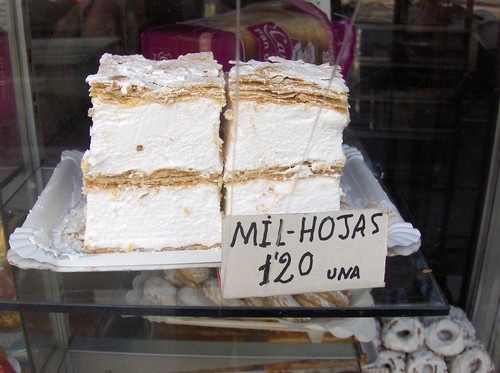
april8 003

I have to confess. This was a purely curbside investigation. Nothing whatsoever about the items shown in this picture convinced me that it was worth shelling out 1.20€ for an actual taste test. The desiccant properties of the mille-feuille part are evident, and even the most enormous glob of unappetizing Crisco (or whatever the HELL that stuff is) is not going to be enough to compensate.

Yes, dear readers. I give this a failing grade, without even trying it. So sue me! You can hardly expect OBG operatives to put our personal health at risk just to satisfy your prurient curiosity.

Don't forget to tune in for a special EASTER update from the OBG team!

Tuesday, April 7, 2009

Retratos de un Lobezno (Portraits of a Wolverine)

Portraits of Wolverine

The Van Gogh is clearly the best.

In the interests of fairness in media reporting, and because Hugh Jackman is messing up things for anyone interested in finding a picture of an actual wolverine on the internet, here is a link to such a picture:

Actual Wolverine Picture


He looks much cuter and less vicious than I had imagined.

Monday, April 6, 2009

Breakfast at the Rodilla Café

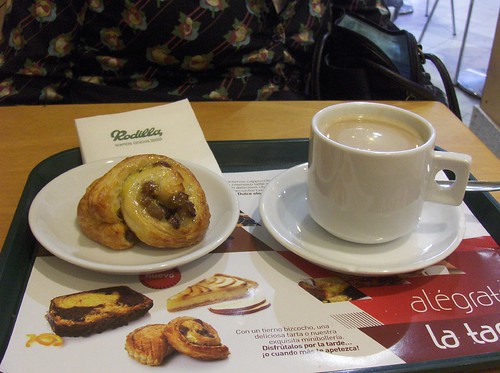
april6 001

An excellent value at only 2.20€ (slightly under $3) for the café con leche and two of those cute little snail pastries, or caracolas minis. The delightful appearance of this picture is in no small measure due to the expert food wrangling assistance provided by Paddy, pictured below.

april6 002

Even though I said I wouldn't post this picture of PB, it came out so nicely that I couldn't resist. Even as I type this, she is winging her way back to DC; I hope her journey was safe and stress-free.

I miss her already.

QQ 27 - 36

Chapter 27.

So priest and barber, squire and steed
Head out to save their friend in need
With subterfuge, and some cross-dressing.
Head out to where Don's still professing
His love for Dulz, and for the knightlife,
(Myself, I'd settle for a quiet life.)
They meet Cardenio (from before,
his tale's in Chapter 24).

Chapter 28.

Next things get, if not quite dramatic,
At least a bit soap operatic.
I'll simplify, to keep things short,
Though brevity is not Mick's forte.
Forgive me if I stoop to flashback
(I hope you won't be wanting cash back).

Card loved Lucy, thought he'd wed her.
Ferd saw Lucy, thought he'd bed her.
Lucy, distraught, seemed to choose bird in hand,
When she agreed to marry Ferdinand.
Card was distressed, went off his head.
Wished Ferdinand and Lucy dead.
Fled to mountains, rent his garments.
Hung out with sheep, was prey to varmints.

Meanwhile, poor Dot (that's Ferdy's ex),
Is fugitive too, cause back then sex,
Though practiced slyly, with abandon,
Was sanctioned only with a band on.
Needless to say, she's mad at Ferdy,
A trait she shares with our friend Cardy.

Chapter 29

Barber and priest meet Card and Dot.
Decide to change and improve plot
To rescue Don. With fair Dot's succor
Hatch a new plan designed to sucker
Don into helping our fair damsel.
No need for priest to dress like mademoiselle;
They've Dot for that. Plan works a treat.
Don falls for story -- very neat.


Chapter 30.

Next up in remote mountain pass
They find the thief who stole squire's ass.
Sancho is happy to see Dapple.
Even rewards him with an apple.


Chapter 31.

So priest and barber, squire and knight,
and Card and Dot, travel by night
Until at last they reach the inn.
There's rooms for all. They're in like Flynn!


Chapters 32 - 34.

They eat. They drink. Don goes to bed.
To rest his sleepy knightly head.
The others read a tale so boring
I can't sum up. It had me snoring.

I'm sorry. I can't. It's just too insanely boring.
Please don't make me.


Chapter 35.

In Don's bedroom, all hell breaks out;
They go to see what it's about.
Find Don in posture of defiance;
He thinks he's being attacked by giants.
Lays waste with sword, starts breaking things;
Before long, punctures inn's wineskins.
Red wine pours out -- a crimson flood,
The Don mistakes it for giants' blood.
They praise and calm befuddled knight
And try to settle in for the night.


Chapter 36.

But someone's heard a-knocking outside -
Looks like a nobleman. And his bride?
Well, golly gee! It's Ferd! And Lucy!
Looks like our story's getting juicy!

Remember Ferdy? (he's Dot's ex,
Who dumped her after having thex).
Remember Luce? (Cardenio's flame)
Dressed like a nun! So what's the game?

What happens next? I'll make it quick.
Spare you all of Mick's slick shtick.

Ferdy, who's mistreated both wenches,
Repents, resolves to be a mensch, as
Befits his noble rank and station.
Both pairs unite. Much jubilation!
Card and Lucy get quite sappy.
Dot and Ferdy -- just as happy.

I'll have the fish, please.

april6 006

april6 004

Two streets who really should get together more often.

Unfortunately, they cross paths only in my imagination. And now, perhaps, in yours as well.

Sunday, April 5, 2009

Book Review : King Lear

This is where Shakespeare takes off the gloves. He brings us right to the edge of the abyss, then kicks us over that edge. "King Lear" is the most devastating by far of the Shakespeare tragedies -- this is a play which leaves the reader shattered as the curtain falls.

The play has a kind of primal power, which I find hard to explain. The plot is fairly typically Shakespeare, perhaps a little more complicated than usual, mixing elements taken from legend and from the historical record. At the outset, Lear is a narcissistic, bullying despot. His two older daughters, Regan and Goneril, are a couple of bad seed cougars, both of whom lust after Edmund, an equally amoral hyena. Their goody-two-shoes sister Cordelia behaves with such one-note pointless stubbornness, it almost seems like she's not playing with a full deck. Over in the Gloucester household, Edmund (the bastard hyena) is plotting against both his brother Edgar and his father. Lear’s court is filled with lickspittle sycophants. Only two people have the guts to speak truth to power, and one of them wears the costume of a Fool. There's a nasty storm brewing on the heath.

Fasten your seatbelts - it's going to be a bumpy ride.

Characters in “King Lear” pay dearly for their weaknesses. Gloucester is blinded in order that he might see, but is denied any lasting happiness; after reconciling with Edgar, he dies. Lear will be driven insane before he finally learns to empathize with the poor and the meek. We watch him return from the brink of madness only to discover that’s not enough. Before the curtain falls, Shakespeare gives us what is arguably the most brutal scene in his entire work.

Enter Lear with Cordelia (dead) in his arms –

Howl, howl, howl! O, you are men of stone!
Had I your tongues and eyes, I’d use them so
That heavens vault should crack. She’s gone forever.


Even if, like me, you find Cordelia a saccharine, two-dimensional character*, this scene is shattering. Two pages later, after learning that his fool has hanged himself, Lear dies, broken-hearted. Edgar, Kent and Albany – literally the only characters still standing – are left to bury the dead and move on, as best they can.

Why do I find this the most affecting of Shakespeare’s plays? (I’ve seen seven different stage productions**, and two on TV, and it only gets more powerful upon repeated exposure.) I can’t really pin it down – it’s a combination of various elements. The characters are idiosyncratic, fully realised, and their behavior is highly relatable, so the play is convincing at the level of the individual protagonists. But the fable-like nature of the opening scene also confers a kind of universal quality to its message, and the themes explored within the play – abuse of power, relationships within families, responsibilities of parents and children, the breakdown of the natural order and its consequences, the human capacity for enormous cruelty – are no less relevant today than in Shakespeare’s time. The skillfully constructed parallel plotting of the Lear and Gloucester arcs adds to the power of the story, the breakdown in natural human behavior is further accentuated by the raw fury of the elements during the storm scenes, where Nature echoes Lear’s fury.

Ultimately, there’s no getting away from the uncompromising bleakness of the play’s message. In Gloucester’s words – “as flies to wanton boys, are we to the gods; they kill us for their sport”. The nihilism of “King Lear” has always disturbed audiences, and it was common during the 18th and 19th centuries to stage an altered version, in which Cordelia was allowed to live, implying a more upbeat view of human nature. But, given what the events of the last century demonstrate about mankind’s vicious capacity for self-destruction, one has to think that Shakespeare got it right first time. As usual.

*: the character that Cordelia most reminds me of is the slave-girl, Liu, in Puccini’s “Turandot”. Neither is realised in any great depth, but each serves an important function in the way that their death effects a crucial change in one of the other protagonists.

**: including one particularly memorable performance in Mönchen-Gladbach, Germany, where Regan and Goneril were decked out like biker chicks and roared on stage riding what appeared to be Harleys.

More Iberian Doggerel

My good friend Joaquin in Bilbao
His artistic taste is lowbrao
Living next to the Guggenheim
Is making him meschuggene, I'm
Completely open to suggestion on hao
to finish this particular rhyme with grace and economy.

Saturday, April 4, 2009

Latin for the traveler redux

Alas gallinaceas de urbe bovis volo
I'd like the buffalo wings.

Antiquis temporibus, nati tibi similes in rupibus ventosissimis exponebantur ad necem
In the good old days, children like you were left to perish on windswept crags.

Caesar si viveret, ad remum dareris
If Caesar were alive, you'd be chained to an oar.

Clamo, clamatis, omnes clamamus pro glace lactis
I scream, you scream, we all scream for ice cream

Credere nequeo butyrum non esse!
I can't believe it's not butter!

Draco dormiens nunquam titillandus
Never tickle a sleeping dragon.
(Motto and coat of arms at Hogwarts)

Aliquid in aere erat ea nocte, stellae illustres erant, fernande
There was something in the air that night, the stars were bright, Fernando.

Ecce! Fabae suaves!
Look! Jelly beans!

Edi recte -- ut speciem macram et ieiunam geras (auctore c cassio longino)
Eat Right -- for that Lean and Hungry Look! by Cassius

In sortitionibus donativis, cur numquam praemia consequuntur sortilegi
Why do psychics never win the lottery?

Hiberiae pluvia fere in planitie stat
The rain in Spain stays mainly in the plain.

Obviously, we have only scratched the surface of this important topic, so watch this space for more vastly useful phrases, including a special Elvis appendix!


And now, the credits: Roughly half of these phrases were found in the hilarious

X-Treme Latin: All the Latin You Need to Know for Survival in the 21st Century

by Henry Beard. Several originated in the brilliant mind of my good friend, Peter C., and a handful were found lying around on the internet

Highlights of the Week

Here are some of the past week's highlights for me:

Saturday - tapas at the vinoteca at the corner of the Plaza Santa Ana, especially the amazing foie gras with caramelized apple on toast. Looking out at the amazing hotel that borders the square on the other side:

feb21pm 058


Sunday - strolling through the Las Letras neighborhood in the afternoon, having ice-cream in the wonderful heladería behind the Plaza Santa Ana and ending the day with dinner at "La Gloria de la Montera" near Paddy's hotel.

feb21pm 037

Monday - lunch at the Reina Sofia museum and sheltering from the rain while watching "Duplicity" in the evening.

Tuesday - arriving in Seville to find the city bathed in glorious sunshine, wandering through the gardens at twilight, savoring Paddy's reaction to the beauty of the city. Watching the swallows by moonlight over the cathedral garden.

Wednesday - Hearing that both Paddy's grant applications had been approved, in the amount that she had hoped for. Wandering through sunny Sevilla, sampling the ice-cream in various locations. Admiring the colorful recycling bins, and recoiling at the hideous furniture displays:

SEVILLE09 082

SEVILLE09 093

Thursday - Shopping for artwork in the morning by the Alcazar. Finding the perfect nazarenos to add to my friend Joyce's collection back in San Francisco. Taking the high-speed AVE back from Sevilla to Madrid, watching the sheep in the fields as we went by, wondering which one provided the milk for our favorite cheese. Knowing the route back to the hotel better than the acne-pitted taxi-driver.

SEVILLE09 111

Friday - Sleeping until 10:30. Visiting the Prado and finding it nicely uncrowded. Spotting a distinctly identifiable jackalope in one of the 16th century Flemish paintings (possibly the earliest traceable sighting, certainly in the old world). Picnicking on gourmet cheeses and Serrano ham from the best acorn-fed pigs in the apartment with Paddy.

Redneck Pet Carrier


Please do not try this at home.
Image is taken from

http://www.badpets.net/Humor/Rednecks/InPictures.html


Thanks to my good friend, Bilby, for bringing this to my attention.

Multi-talented statistician shines in many fields of endeavor


When he's not pushing back the frontiers of statistical research,


or dazzling his fanbase with his twinkle-toed ballroom dancing skills,


it appears that Professor Tsiatis has yet another career as a performance artist on the streets of Madrid.

What a guy!

Friday, April 3, 2009

Ratoncito Redux

Well, clearly all this talk of the delightful little mouse could not go without consequences. While chowing down on a particularly delicious tapa in Seville, I dislodged an alarmingly large piece of dental porcelain from the lower right hand corner of my mouth. An artefact that had once been referred to as a "crown and post", and which cost a small fortune to have installed. It came out so naturally that I have no choice but to believe that the time had come for us to part ways.

The only consolation is that I had resisted the temptation to indulge in some porcelainophilic candy treats at the movies on Monday evening; had it occurred then, I would have felt guilty about it for months. As it is, I just figure that it was the Ratoncito's revenge for having blogged about him a few weeks earlier.

No blood. No pain. Just another reminder that life in one's fifties is not completely without hazard.

Thursday, April 2, 2009

Sevilla es una maravilla

SEVILLE09 083

Torero Tailor Shop


SEVILLE09 108

Quixote lookalike


SEVILLE09 002


Charming tapas companion


What more could anyone ask for?

We had a wonderful time.

Monday, March 30, 2009

El Jardín Vertical

pandagarden 002

It's just across the street from the Prado. The photo doesn't begin to do it justice.

Iberian Peninsula Time

It's a little after midnight here and I just got back from dropping Paddy off at her hotel after dinner. As I have probably mentioned before, they certainly do eat late here in Madrid - when we got to the restaurant at about 9:30, we were the second couple there, and when we left at 11:30, it was filling up. (How do these people get up for work in the morning?)

Before dinner we went to see "Duplicity", with Julia Roberts and Clive Owen - a very funny, entertaining movie, perfect for a rainy evening in Madrid. What was nice was that it was still light when the movie let out at 8:30, as they made the changeover to Daylight Saving Time here over the weekend, so that we are now once again six hours ahead of Eastern Time in the U.S.

As we are headed for Seville tomorrow, I probably won't get a chance to update the blog for a few days, but I promise to check back in at the end of the week. We are scheduled to get back from Seville on Thursday evening.

I asked at school on Friday, but apparently Spaniards do not engage in any particular brand of April Fool's Day shenanigans. Or maybe they do, and just weren't about to tell me.

Qué pasa?

Paddy arrived from Washington DC on Saturday morning. Unfortunately, the weather immediately took a turn for the worse, with the temperature dropping about 12 degrees or so overnight, and rain both yesterday and today. Fortunately, we are headed to Sevilla tomorrow (in the fancy AVE high-speed train, which whisks one from Madrid to Sevilla in only 2 hours and 30 minutes), and will return to Madrid on Thursday evening.

I have the week off class, so it's a nice break from my regular routine. Only two more weeks after Paddy's departure on Monday. I will be heading back to Washington on Saturday April 18th, stay with her overnight, and continue on to San Francisco the following day.

Today we went to the Reina Sofia, the museum of the "big three" that's dedicated to 20th century art (and the only museum in town that is open on Mondays). I think we both agreed that the best part was probably lunch in the museum cafeteria afterwards. After two hours modern art just starts to feel like a penance.

There were uncountably many groups of schoolchildren, not all of whom appeared to be having fun.

Oh Deer!